
Mapa mental
PHONETICS - PHONOLOGY
Contenido del mapa
PHONETICS - PHONOLOGY
Phonetics is a branch of linguistics that gives objective ways to analyze and describe the sounds which humans use in their languages. Phonetics looks the production of speech, the interaction of organs like: teeth ang tongue to produce sound.
- Phonetics is a branch of linguistics that gives objective ways to analyze and describe the sounds which humans use in their languages. Phonetics looks the production of speech, the interaction of organs like: teeth ang tongue to produce sound.
- Articulatory features
- Articulatory phonetics are devided in three areas to describe consonants. They are voice, place and manner respectively.
- VOICE
- There are sounds that inply vocal fold vibrations when they are produced. Examples of voiced sounds are /b,d,v,m/.
- PLACE
- The vocal tract has different sections, which play a pivotal role in the production of speech. These sections are called articulators and are what make speech sounds possible. They are divided into two types.
- The active articulator is the articulator that moves towards another articulator in the production of a speech sound. This articulator moves towards another articulator to form a closure of some type in the vocal tract.
- The passive articulator is the articulator that remains stationary in the production of a speech sound. Often, this is the destination that the active articulator moves towards
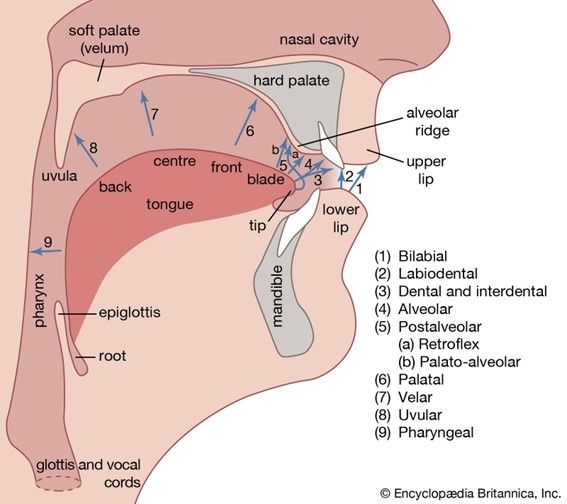
- PLACES OF ARTICULATION IN THE VOCAL TRACT
- 1.Bilabial: Bilabial sounds inply the upper and lower lips. In the production of a bilabial sound, the lips come into contact with each other to form an effective constriction. In English, /p,b,m/ are bilabial sounds.
- 2.Labiodental: the sounds are made with top teeth on the bottom lip. Some Examples are of /f,v/.
- 4.Alveolar sounds are made by raising the tip of the tongue towards the ridge, somme examples are: d,z,n do,zoo,now
- 5.Postalveolar sound are consonants articulated with the tongue near or touching the back of the alveolar ridge, placing them a bit further back in the mouth than the alveolar consonants.
- 6.Palatal, a consonant sound produced by raising the blade, or front, of the tongue toward or against the hard palate just behind the alveolar ridge (the gums).
- 7.Velar.made by the tongue touching the velum: In English, /k/ and /g/ are examples of velar sounds.
- The vocal tract has different sections, which play a pivotal role in the production of speech. These sections are called articulators and are what make speech sounds possible. They are divided into two types.
- MANNER
- This refers to the way a sound is made, Sounds differ in the way they are produced.
- Stop articulations: are sounds that imply a closure in the vocal track, it is formed when two articulators come together to prevent air escaping between them. Stop articulations are categorized in two types: Plosives which are sounds that are made with a complete closure in the oral (vocal) tract and Nasals which are made with a complete closure in the oral (vocal) tract.
- Apporximant: sounds are created by narrowing the distance between the two articulators. English has 4 approximant sounds which are /w,j,r,l/.
- Fricatives: These are produced by bringing the mouth into position to block the passage of the airstream.
- This refers to the way a sound is made, Sounds differ in the way they are produced.
- VOICE
- Articulatory phonetics are devided in three areas to describe consonants. They are voice, place and manner respectively.
Phonology describes the way how sounds and abstract sounds units work, a word can be changed in another by changing one sound, this is basically the relationship between speech sounds and components of a language.
- DIFERENCE: The main diference betwen these is that phonetics is the study of human sounds and phonology studies the classification of the sounds within the system of lenguages
- DIFERENCE The main diference betwen these is that phonetics is the study of human sounds and phonology studies the classification of the sounds within the system of lenguages
- suprasegmental features
- Is a speech feature such as stress, tone or word which linear elements that affect segments larger than the phoneme.
- The acent: The intensity accent is a force with which a phoneme vowel is pronounced of each word.
- The pauses: They are that interrupt the speech and separate some segments (phrases, phrases …) of others. This is necesary sometimes to recover air and keep talking
- The intonation. This is the main feature and i help us to change the meaning of a sentence for intance in the next phrase: your name is Andrew-your name is Andrew? depends on the intonation the fir sentence sounds like an afirmation and the second one sounds like a question.
- Is a speech feature such as stress, tone or word which linear elements that affect segments larger than the phoneme.
- DIFERENCE: The main diference betwen these is that phonetics is the study of human sounds and phonology studies the classification of the sounds within the system of lenguages
Imágenes y archivos del mapa
Información
- Descripción
- Mapa Mental sobre PHONETICS - PHONOLOGY, creado por RONALD ANDRES RAMIREZ CAÑAVERAL el 28/08/2022.
- Creado por
- RONALD ANDRES RAMIREZ CAÑAVERAL
- Visitas
- 7
- Valoración