
Mapa mental
Data Processing
Contenido del mapa
Data Processing
Data processing is the conversion of raw data to meaningful information.
Batch processing: multiple data records are collected and stored before being processed together in a single operation.
- HOW
- Newly arriving data are collected and store to process the whole group as a batch. Each batch can be processed based on a schedule time interval, a trigger, or as the result of an event.
- Generated data is captured in a stream source: a folder in a cloud data store, or a table in a database.
- SOURCES
- Azure Event Hub, Azure IoT Hub, Azure Data Lake Store Gen2, Apache Kafka.
- SOURCES
- Event data is processed by a perpetual query. Results are written to an output/sink for further processing.
- SINKS
- Azure Event Hub, Azure Data Lake Store Gen2, Azure blob storage, Azure SQL Database, Azure Synapse Analytics, Azure Databricks, Power BI.
- SINKS
- Generated data is captured in a stream source: a folder in a cloud data store, or a table in a database.
- Newly arriving data are collected and store to process the whole group as a batch. Each batch can be processed based on a schedule time interval, a trigger, or as the result of an event.
- ADVANTAGES
- Processing large volumes of data at a time. Support for specific schedules/needs.
- DISADVANTAGES
- Time delay between ingestion and results visualization. Input data must be carefully checked before batch processing.
- CHARACTERISTICS
- DATA SCOPE: batch processing can process all the data in the dataset.
- DATA SIZE: suitable for large dataset.
- PERFORMANCE: latency is expected as a few hours.
- ANALYSIS: to perform complex analytics.
- HOW
Stream processing: a source of data where new data events occur is constantly monitored and processed in real-time.
- HOW
- Each new piece of data is processed as individual units in real-time.
- ADVANTAGES
- No need to wait for the next processing interval. Ideal for time-critical operations that require an inmediate response.
- CHARACTERISTICS
- DATA SCOPE: only access to the most recent data received or within a rolling time window.
- DATA SIZE: intended for individual records or micro batches (groups of few records).
- PERFORMANCE: occurs immediately or within seconds/milliseconds.
- ANALYSIS: for simple response functions, aggregates, or calculations.
- HOW
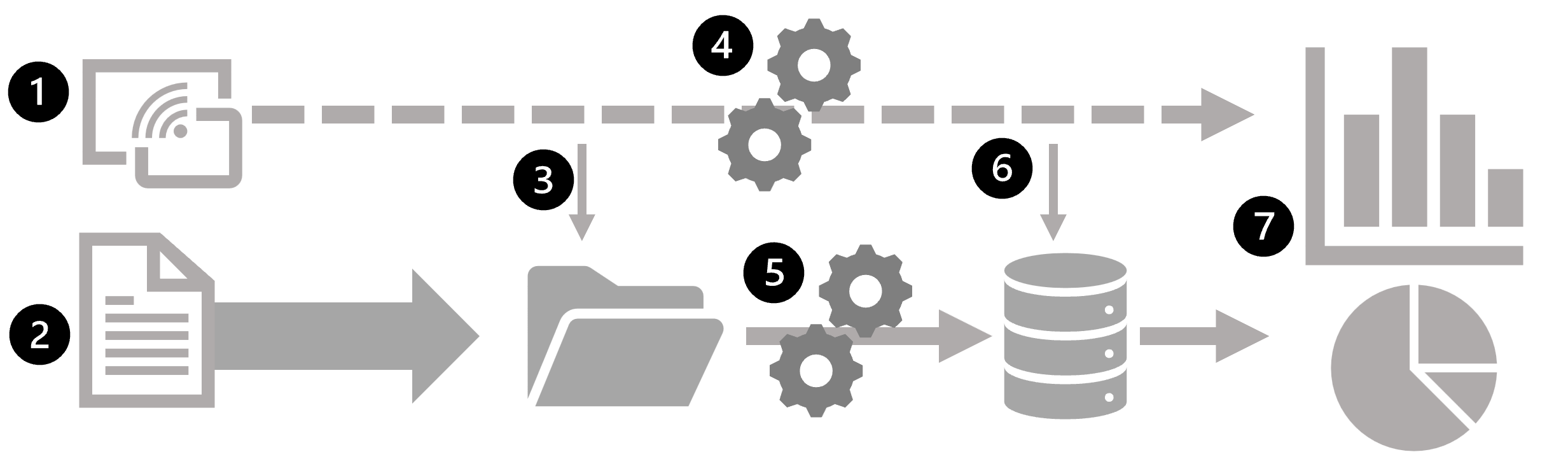
Combining Batch & Stream Processing
- 1. Data from a stream source is captured.
- 2. Data from other sources is ingested/stored for batch processing (often, a data lake).
- 3. If real-time analytics isn't required, stream data is written into the data store for batch processing. If real-time analytics is required, a stream processing technology is used for analysis/visualization.
- 5. Batch data is periodically processed, results are stored in an analytical data store (often, a data warehouse).
- 6. Results of stream processing might also be stored in the analytical data store.
- 7. Analytical/visualization tools are used for real-time and historical data.
- 6. Results of stream processing might also be stored in the analytical data store.
- 5. Batch data is periodically processed, results are stored in an analytical data store (often, a data warehouse).
- 3. If real-time analytics isn't required, stream data is written into the data store for batch processing. If real-time analytics is required, a stream processing technology is used for analysis/visualization.
- 2. Data from other sources is ingested/stored for batch processing (often, a data lake).
- 1. Data from a stream source is captured.
Imágenes y archivos del mapa
Información
- Descripción
- Administración de Bases de Datos DP900 - Microsoft Certification Mapa Mental sobre Data Processing, creado por Castro Benítez Gabriela el 04/10/2022.
- Creado por
- Castro Benítez Gabriela
- Visitas
- 0
- Valoración