
Mapa mental
2.2 Neurons and Synaptic Transmission
Contenido del mapa
2.2 Neurons and Synaptic Transmission
The structure and function of neurons
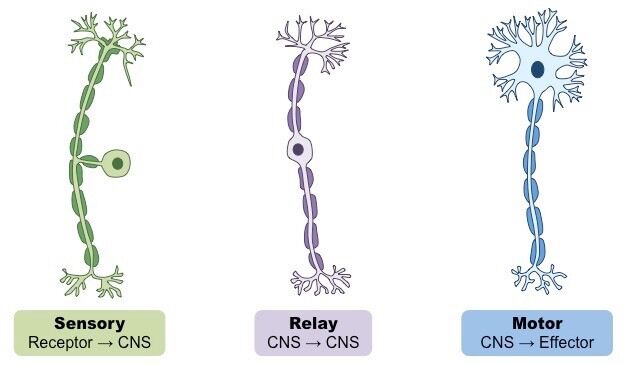
- Types of Neuron
- Sensory Neuron
- Carry messages from the peripheral nervous system to the central nervous system.
- Relay Neuron
- Found between the sensory input and motor output/response.
- Mainly in the brain and spinal cord and allow sensory and motor neurons to communicate.
- Found between the sensory input and motor output/response.
- Motor Neuron
- Found in the CNS
- Connects the CNS to effectors such as muscles and glands in order to control muscle movement.
- When stimulated they release neurotransmitters that bind to the receptors on muscles to trigger a response which lead to movement.
- Connects the CNS to effectors such as muscles and glands in order to control muscle movement.
- Found in the CNS
- Sensory Neuron
- Structure of a Neuron
- Cell Body
- Includes the nucleus which contains the genetic material.
- Axon
- Carries impulses in the form of an electrical signal known as an action potential, AWAY from the cell body.
- Myelin Sheath
- Insulates the axon to protect it and speed up electrical transmission.
- Dendrites
- Branch like structures that receive nerve impulses from neighbouring neurons or sensory receptors
- Node of Ranvier
- Gaps between the myelin sheath that speed up transmission of impulses.
- Terminal buttons
- At the end of an axon, communicate with the next neuron.
- Cell Body
- Electrical transmission
- When a neuron is at resting state the inside of a cell is negatively charged, compared to the outside.
- When a neuron is activated by stimulus, inside becomes positively charged causing an action potential.
- This creates an electrical impulse which travels down the axon.
- When a neuron is activated by stimulus, inside becomes positively charged causing an action potential.
- When a neuron is at resting state the inside of a cell is negatively charged, compared to the outside.
- Types of Neuron
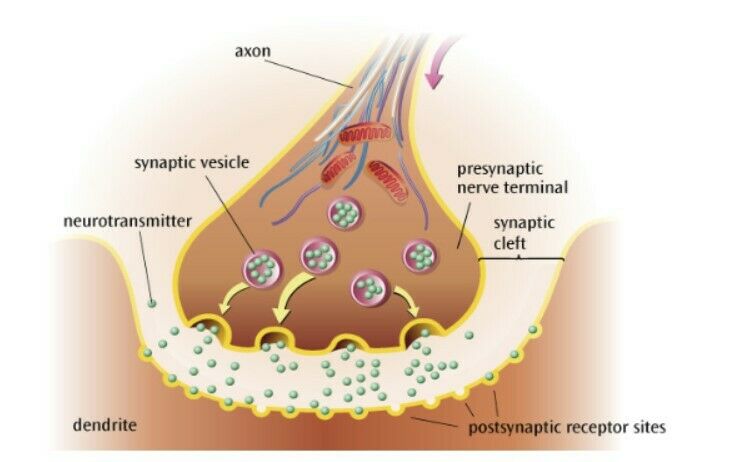
Synaptic Transmission
- Impulse arrives at the PRESYNAPTIC NEURON
- Neurotransmitters released from vesicles:
- - Diffuse across synapse -Bind to receptor sites on post synaptic neuron
- Chemical message is converted back into an electrical impulse.
- Neurotransmitters are broken down and reabsorbed into the presynaptic neuron.
- Chemical message is converted back into an electrical impulse.
- - Diffuse across synapse -Bind to receptor sites on post synaptic neuron
- Neurotransmitters released from vesicles:
- Excitation and Inhibition
- Neurotransmitters can have one of two effects on neighbouring neurons.
- Some cause it to become positively charged and more likely to fire
- E.G Adrenaline causes exhitation
- Some cause an increased negative charge and less likely to fire
- E.G Serotonin causes inhibition in the receiving neuron
- Summation
- Majority rules. The action potential will only be triggered if the sum of the excitatory and inhibitory signals when it reaches threshold.
- Synaptic vesicles containing neurotransmitter are ONLY PRESENT on presynaptic membrane.
- So can only move in ONE DIRECTION.
- Impulse arrives at the PRESYNAPTIC NEURON
Imágenes y archivos del mapa
Información
- Descripción
- El usuario ha eliminado su información de asignaturas Mapa Mental sobre 2.2 Neurons and Synaptic Transmission, creado por Usuario eliminado el 04/03/2023.
- Creado por
- Usuario eliminado
- Visitas
- 26
- Historial
-
- Creado por Alicja Klak · 4 mar 2023
- Copiado por Alicja Klak · 4 mar 2023
- Valoración