
Mapa mental
Principles of Chemotherapy
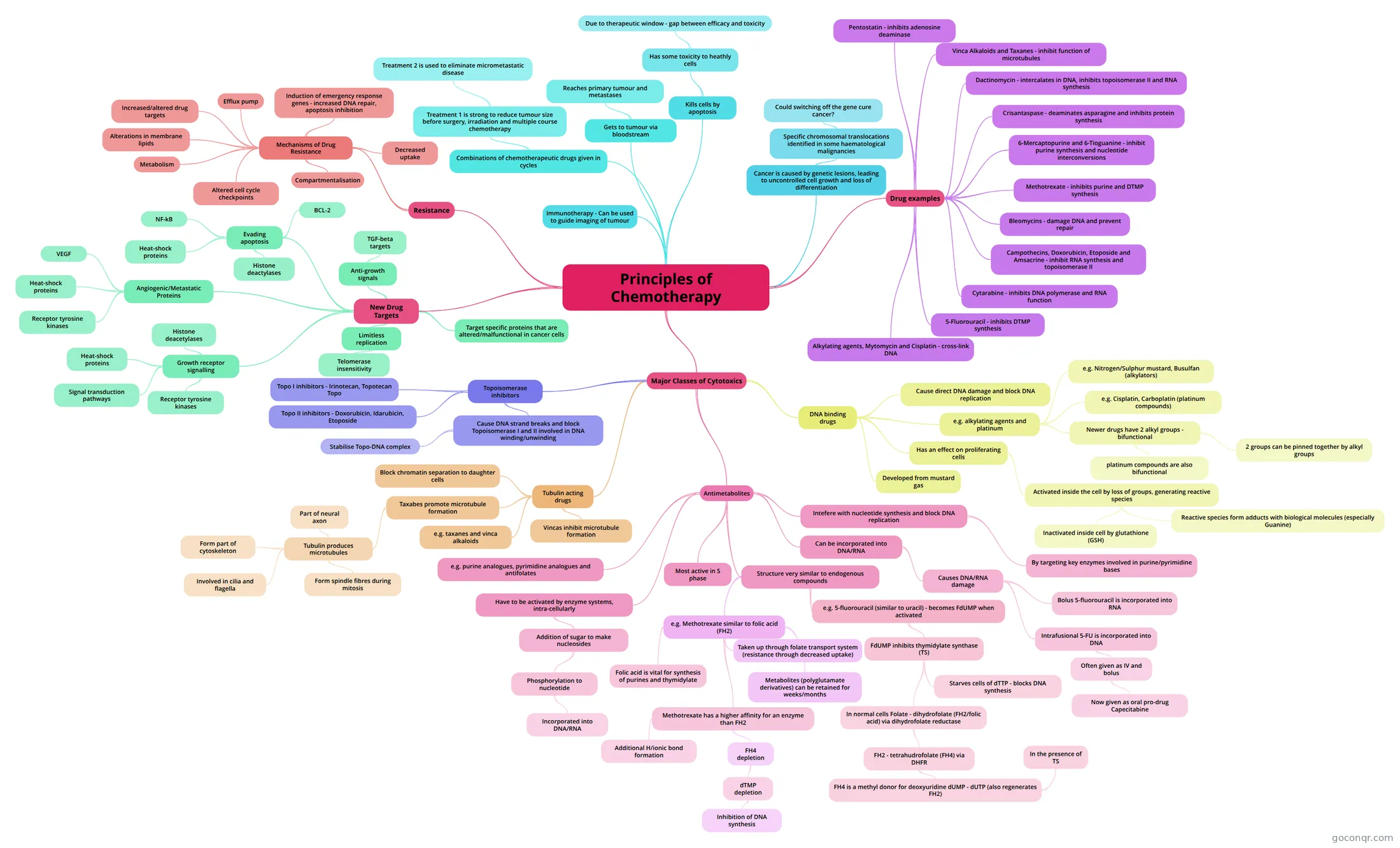
Mind map: principles of chemotherapy
Contenido del mapa
Principles of Chemotherapy
Gets to tumour via bloodstream
- Reaches primary tumour and metastases
Kills cells by apoptosis
- Has some toxicity to heathly cells
- Due to therapeutic window - gap between efficacy and toxicity
- Has some toxicity to heathly cells
Combinations of chemotherapeutic drugs given in cycles
- Treatment 1 is strong to reduce tumour size before surgery, irradiation and multiple course chemotherapy
- Treatment 2 is used to eliminate micrometastatic disease
- Treatment 1 is strong to reduce tumour size before surgery, irradiation and multiple course chemotherapy
Immunotherapy - Can be used to guide imaging of tumour
Drug examples
- Pentostatin - inhibits adenosine deaminase
- 6-Mercaptopurine and 6-Tioguanine - inhibit purine synthesis and nucleotide interconversions
- Methotrexate - inhibits purine and DTMP synthesis
- Cytarabine - inhibits DNA polymerase and RNA function
- Crisantaspase - deaminates asparagine and inhibits protein synthesis
- 5-Fluorouracil - inhibits DTMP synthesis
- Bleomycins - damage DNA and prevent repair
- Alkylating agents, Mytomycin and Cisplatin - cross-link DNA
- Campothecins, Doxorubicin, Etoposide and Amsacrine - inhibit RNA synthesis and topoisomerase II
- Dactinomycin - intercalates in DNA, inhibits topoisomerase II and RNA synthesis
- Vinca Alkaloids and Taxanes - inhibit function of microtubules
Major Classes of Cytotoxics
- DNA binding drugs
- Cause direct DNA damage and block DNA replication
- e.g. alkylating agents and platinum
- Newer drugs have 2 alkyl groups - bifunctional
- 2 groups can be pinned together by alkyl groups
- platinum compounds are also bifunctional
- e.g. Nitrogen/Sulphur mustard, Busulfan (alkylators)
- e.g. Cisplatin, Carboplatin (platinum compounds)
- Newer drugs have 2 alkyl groups - bifunctional
- Developed from mustard gas
- Has an effect on proliferating cells
- Activated inside the cell by loss of groups, generating reactive species
- Reactive species form adducts with biological molecules (especially Guanine)
- Inactivated inside cell by glutathione (GSH)
- Activated inside the cell by loss of groups, generating reactive species
- Antimetabolites
- Intefere with nucleotide synthesis and block DNA replication
- By targeting key enzymes involved in purine/pyrimidine bases
- Can be incorporated into DNA/RNA
- Causes DNA/RNA damage
- Bolus 5-fluorouracil is incorporated into RNA
- Intrafusional 5-FU is incorporated into DNA
- Often given as IV and bolus
- Now given as oral pro-drug Capecitabine
- Often given as IV and bolus
- Causes DNA/RNA damage
- e.g. purine analogues, pyrimidine analogues and antifolates
- Structure very similar to endogenous compounds
- e.g. 5-fluorouracil (similar to uracil) - becomes FdUMP when activated
- FdUMP inhibits thymidylate synthase (TS)
- Starves cells of dTTP - blocks DNA synthesis
- In normal cells Folate - dihydrofolate (FH2/folic acid) via dihydrofolate reductase
- FH2 - tetrahudrofolate (FH4) via DHFR
- FH4 is a methyl donor for deoxyuridine dUMP - dUTP (also regenerates FH2)
- In the presence of TS
- FH4 is a methyl donor for deoxyuridine dUMP - dUTP (also regenerates FH2)
- FH2 - tetrahudrofolate (FH4) via DHFR
- FdUMP inhibits thymidylate synthase (TS)
- e.g. Methotrexate similar to folic acid (FH2)
- Folic acid is vital for synthesis of purines and thymidylate
- Methotrexate has a higher affinity for an enzyme than FH2
- Additional H/ionic bond formation
- FH4 depletion
- dTMP depletion
- Inhibition of DNA synthesis
- dTMP depletion
- Taken up through folate transport system (resistance through decreased uptake)
- Metabolites (polyglutamate derivatives) can be retained for weeks/months
- e.g. 5-fluorouracil (similar to uracil) - becomes FdUMP when activated
- Most active in S phase
- Have to be activated by enzyme systems, intra-cellularly
- Addition of sugar to make nucleosides
- Phosphorylation to nucleotide
- Incorporated into DNA/RNA
- Phosphorylation to nucleotide
- Addition of sugar to make nucleosides
- Intefere with nucleotide synthesis and block DNA replication
- Topoisomerase inhibitors
- Cause DNA strand breaks and block Topoisomerase I and II involved in DNA winding/unwinding
- Stabilise Topo-DNA complex
- Topo I inhibitors - Irinotecan, Topotecan Topo
- Topo II inhibitors - Doxorubicin, Idarubicin, Etoposide
- Cause DNA strand breaks and block Topoisomerase I and II involved in DNA winding/unwinding
- Tubulin acting drugs
- Block chromatin separation to daughter cells
- Vincas inhibit microtubule formation
- Taxabes promote microtubule formation
- Tubulin produces microtubules
- Form part of cytoskeleton
- Involved in cilia and flagella
- Part of neural axon
- Form spindle fibres during mitosis
- Tubulin produces microtubules
- e.g. taxanes and vinca alkaloids
- DNA binding drugs
Resistance
- Mechanisms of Drug Resistance
- Efflux pump
- Alterations in membrane lipids
- Compartmentalisation
- Decreased uptake
- Increased/altered drug targets
- Metabolism
- Altered cell cycle checkpoints
- Induction of emergency response genes - increased DNA repair, apoptosis inhibition
- Mechanisms of Drug Resistance
Cancer is caused by genetic lesions, leading to uncontrolled cell growth and loss of differentiation
- Specific chromosomal translocations identified in some haematological malignancies
- Could switching off the gene cure cancer?
- Specific chromosomal translocations identified in some haematological malignancies
New Drug Targets
- Target specific proteins that are altered/malfunctional in cancer cells
- Evading apoptosis
- BCL-2
- NF-kB
- Heat-shock proteins
- Histone deactylases
- Growth receptor signalling
- Receptor tyrosine kinases
- Signal transduction pathways
- Heat-shock proteins
- Histone deacetylases
- Anti-growth signals
- TGF-beta targets
- Limitless replication
- Telomerase insensitivity
- Angiogenic/Metastatic Proteins
- VEGF
- Receptor tyrosine kinases
- Heat-shock proteins
Información
- Descripción
- Cancer Biology Mapa Mental sobre Principles of Chemotherapy, creado por maisie_oj el 11/04/2013.
- Creado por
- maisie_oj
- Visitas
- 220
- Etiquetas
- Valoración