
Mapa mental
Jean Piaget's Theory of Cognitive Development
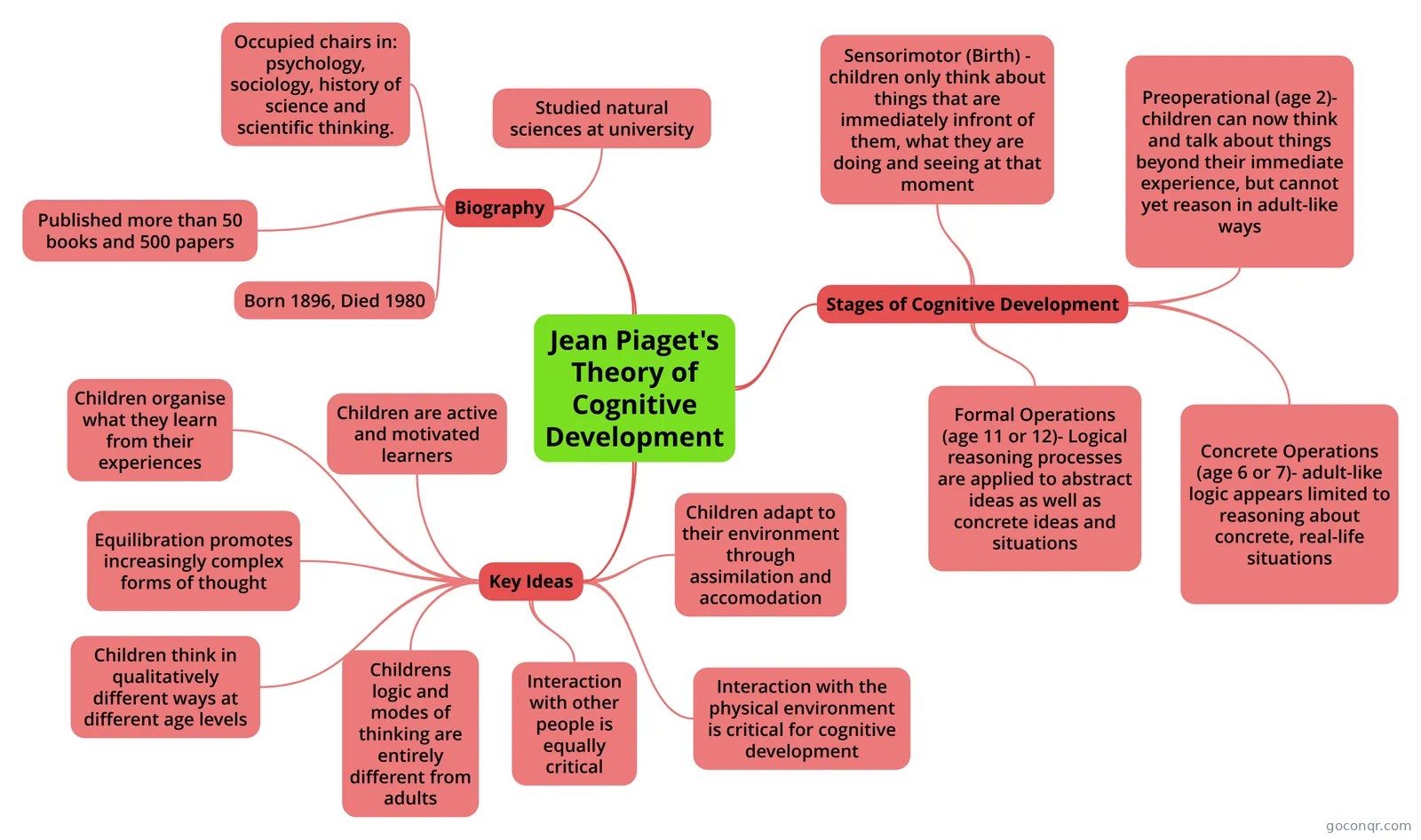
Mind map: Jean Piaget's theory of cognitive development
Contenido del mapa
Jean Piaget's Theory of Cognitive Development
- fe
Key Ideas
- Children are active and motivated learners
- Children organise what they learn from their experiences
- Children adapt to their environment through assimilation and accomodation
- Interaction with the physical environment is critical for cognitive development
- Equilibration promotes increasingly complex forms of thought
- Interaction with other people is equally critical
- Children think in qualitatively different ways at different age levels
- Childrens logic and modes of thinking are entirely different from adults
Stages of Cognitive Development
- Sensorimotor (Birth) - children only think about things that are immediately infront of them, what they are doing and seeing at that moment
- Preoperational (age 2)- children can now think and talk about things beyond their immediate experience, but cannot yet reason in adult-like ways
- Concrete Operations (age 6 or 7)- adult-like logic appears limited to reasoning about concrete, real-life situations
- Formal Operations (age 11 or 12)- Logical reasoning processes are applied to abstract ideas as well as concrete ideas and situations
Biography
- Born 1896, Died 1980
- Studied natural sciences at university
- Published more than 50 books and 500 papers
- Occupied chairs in: psychology, sociology, history of science and scientific thinking.
Información
- Descripción
- Mapa Mental sobre Jean Piaget's Theory of Cognitive Development, creado por teegan.p el 13/04/2013.
- Creado por
- teegan.p
- Visitas
- 310
- Valoración