
Mapa mental
Quantum Phenomena
Contenido del mapa
Quantum Phenomena
Wave or Particle
- A Photon is a Quantum of EM radiation
- E = hf = (hc)/wavelength
- Energy carried by Photons = Planck's Constant x frequency (Hz)
- h = 6.63x10^-34 Js
- c = speed of light in a vacuum = 3.00x10^8 m/s
- eV=(1/2)mv^2
- An electronvolt is defined as: the kinetic energy gained by an electron when it is accelerated through a potential of 1V
- 1eV = 1.6x10^-19J
- An electronvolt is defined as: the kinetic energy gained by an electron when it is accelerated through a potential of 1V
- E = hf = (hc)/wavelength
- The Threshold Voltage of an LED is the voltage needed to give the electrons the same energy as a photon emitted by the LED. All of the electron's KE after it is accelerated over this potential difference is transferred into a photon
- A Photon is a Quantum of EM radiation
The Photoelectric Effect
- Shining Light on a Metal Surface can release Electrons
- Free electrons on the surface of the metal absorb energy from light, making them vibrate - If an electron absorbs enough energy , the bonds holing it to the metal breaks and it's released - The electrons emitted are called Photoelectrons
- If no photoelectrons are released the radiation is below the threshold frequency
- The photoelectron's KE ranges from 0 - a maximum value
- This max value depends on the frequency of the radiation
- The number of photoelectrons emitted is proportional to the intensity of the beam
- Free electrons on the surface of the metal absorb energy from light, making them vibrate - If an electron absorbs enough energy , the bonds holing it to the metal breaks and it's released - The electrons emitted are called Photoelectrons
- It can't be explained by wave theory (energy transferred by the light would be evenly spread over the surface so all electrons would leave at once)
- But it can be explained by Photon Theory (if one of the photons collides with a free electron the electron will gain energy equal to hf
- Work Energy Function - Energy needed for an electron to break the bonds holding it to the metal
- But it can be explained by Photon Theory (if one of the photons collides with a free electron the electron will gain energy equal to hf
- f = work function/h
- f = threshold frequency if it's below this the metal just heats up
- hf = work function + (1/2)mv(max)^2
- Independent of Intensity
- Shining Light on a Metal Surface can release Electrons
Energy Levels and Photon Emission
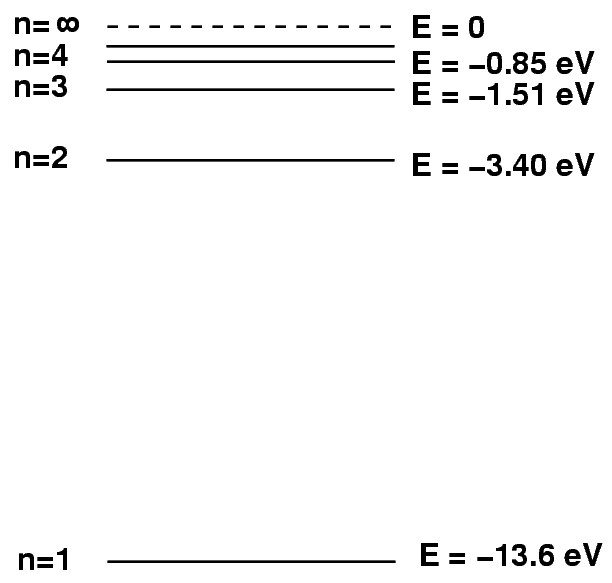
- Electrons in atoms only exist in energy levels (n=1 being the ground state) - Electrons move down energy levels be emitting a photon - because there's only certain energy levels the photons only have certain wavelengths - The energy carried by each photon is equal to the difference between the 2 energy levels
- If you heat a gas to high temperatures, many electrons move to higher energy levels - when they return they emit protons - if you split the light you get an emission spectra (spectrum of the wavelengths of the photons it emits)
- Shining White light through a cool gas gives an absorption spectrum
- This matches up with the emission spectra of the gas
Wave - Particle Duality
- Interference and diffraction show light as a wave
- The Photoelectric effect shows light as a Particle
- De Broglie came up with the wave-particle duality theory: If 'wave-like' light shows particle properties, 'particles' should be expected to show wave-like properties
- wavelength = h/mv
- The De Broglie wave of a particle can be interpreted a 'probability wave'
- De Broglie came up with the wave-particle duality theory: If 'wave-like' light shows particle properties, 'particles' should be expected to show wave-like properties
- The Photoelectric effect shows light as a Particle
- Electron Diffraction shows the wave nature of electrons
- Particles don't show wave-like properties all the time
- You only get diffraction if it interacts with something the same size as it's DBwavelength
- Particles don't show wave-like properties all the time
- Interference and diffraction show light as a wave
Imágenes y archivos del mapa
Información
- Descripción
- (Mulv. Resit) Physics Mapa Mental sobre Quantum Phenomena, creado por SarahBarrett el 15/01/2014.
- Creado por
- SarahBarrett
- Visitas
- 27
- Etiquetas
- Valoración