
Mapa mental
What factors shaped public opinion and attitudes towards the Second Republic (1931-1936) in Spain?
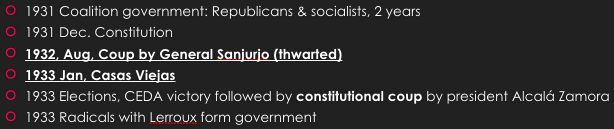
Contenido del mapa
What factors shaped public opinion and attitudes towards the Second Republic (1931-1936) in Spain?
Basic history: what happened in the Second Republic?
- After the Primo de Rivera regime fell in 1929, there was a transitional dictablanda (General Balaguer) and in April 1930 elections were held. Landslide Republican victory, King Alfonso XIII expelled. 14th April 1931: Republic declared. Provisional government: President Niceto Alcalá Zamora. Prime Minister Manuel Azaña. Republican-Socialist coalition. Provisional until passing of the constitution in December.
- REPUBLICAN SYSTEM: The President is the Head of State, elected and with the capacity to make certain decisions. Prime Minister head of executive power and stands alongside legislative power and judicial power. They are elected in different elections and may not be from the same party. Unicameralism
Political and Social Problems in the Second Republic
- Overview: lack of constitutional guarantees, great number of landless, impoverished farmworkers (after failed agrarian reform), low wages and poor living conditions for more than 4 million urban workers, lack of interregional integration (disparate degrees of modernisation and peripheral nationalism)
1931 Constitution
- Pledged to establish universal suffrage (including women), curb the privileges of the Church and the army, give, after approval from central government, statute of autonomy to regions (Cataluña), carry out the much awaited agrarian reform, legalise divorce and civil marriage, establish unicameralism
Threats to the Republic
Imágenes y archivos del mapa
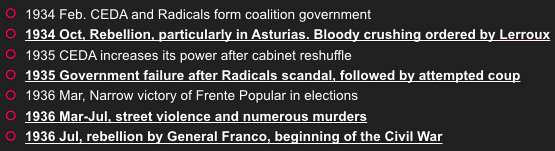
Información
- Descripción
- What factors shaped public opinion and attitudes towards the Second Republic (1931-1936) in Spain?
- Creado por
- charlotte.boys
- Visitas
- 16
- Valoración