
Mapa mental
The hallmarks of cancer(lecture 4)
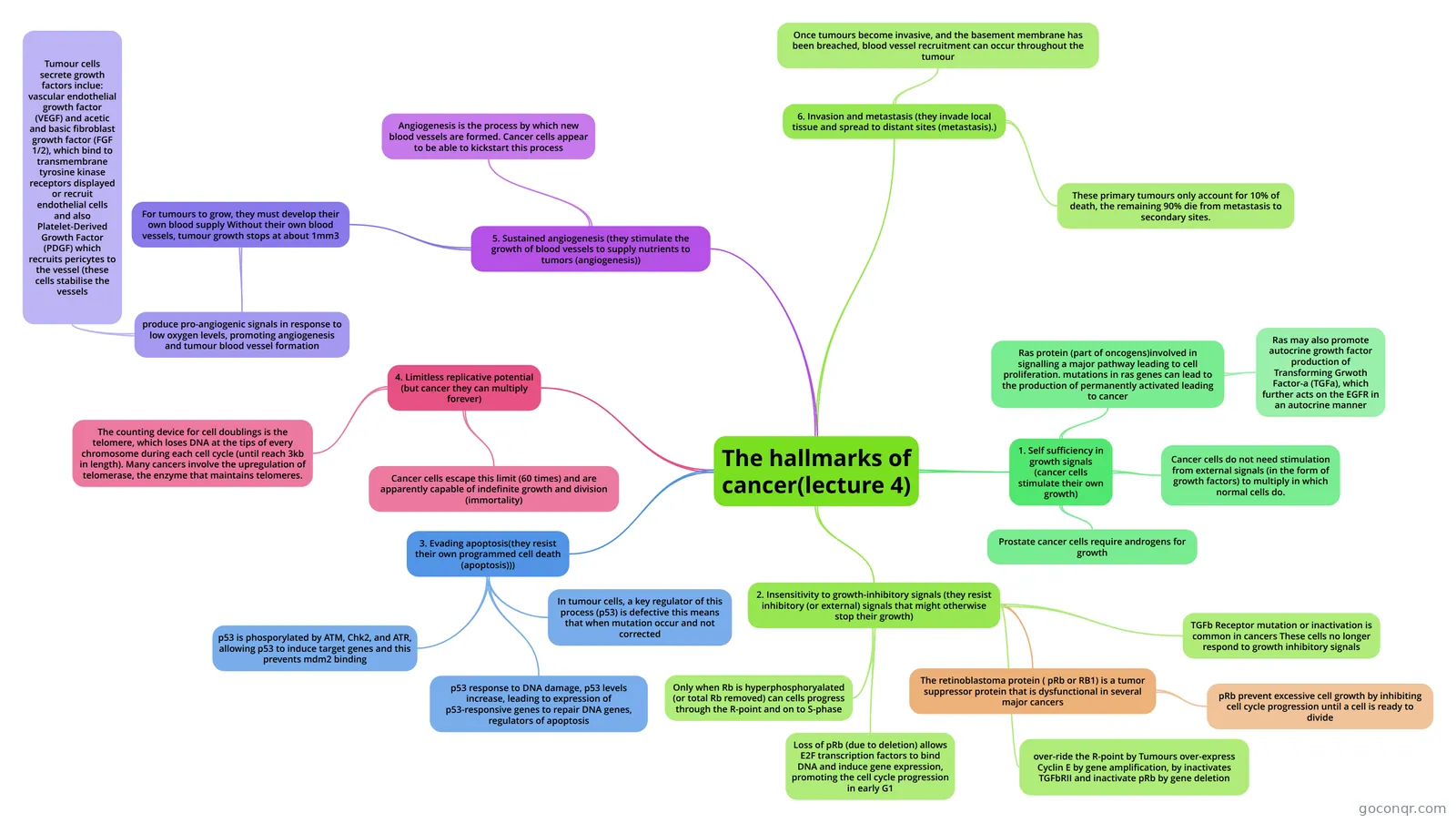
Mind map: hallmarks of cancer
Contenido del mapa
The hallmarks of cancer(lecture 4)
1. Self sufficiency in growth signals (cancer cells stimulate their own growth)
- Cancer cells do not need stimulation from external signals (in the form of growth factors) to multiply in which normal cells do.
- Prostate cancer cells require androgens for growth
- Ras protein (part of oncogens)involved in signalling a major pathway leading to cell proliferation. mutations in ras genes can lead to the production of permanently activated leading to cancer
- Ras may also promote autocrine growth factor production of Transforming Grwoth Factor-a (TGFa), which further acts on the EGFR in an autocrine manner
2. Insensitivity to growth-inhibitory signals (they resist inhibitory (or external) signals that might otherwise stop their growth)
- TGFb Receptor mutation or inactivation is common in cancers These cells no longer respond to growth inhibitory signals
- The retinoblastoma protein ( pRb or RB1) is a tumor suppressor protein that is dysfunctional in several major cancers
- pRb prevent excessive cell growth by inhibiting cell cycle progression until a cell is ready to divide
- Loss of pRb (due to deletion) allows E2F transcription factors to bind DNA and induce gene expression, promoting the cell cycle progression in early G1
- Only when Rb is hyperphosphoryalated (or total Rb removed) can cells progress through the R-point and on to S-phase
- over-ride the R-point by Tumours over-express Cyclin E by gene amplification, by inactivates TGFbRII and inactivate pRb by gene deletion
3. Evading apoptosis(they resist their own programmed cell death (apoptosis)))
- In tumour cells, a key regulator of this process (p53) is defective this means that when mutation occur and not corrected
- p53 response to DNA damage, p53 levels increase, leading to expression of p53-responsive genes to repair DNA genes, regulators of apoptosis
- p53 is phosporylated by ATM, Chk2, and ATR, allowing p53 to induce target genes and this prevents mdm2 binding
- sdf
4. Limitless replicative potential (but cancer they can multiply forever)
- Cancer cells escape this limit (60 times) and are apparently capable of indefinite growth and division (immortality)
- The counting device for cell doublings is the telomere, which loses DNA at the tips of every chromosome during each cell cycle (until reach 3kb in length). Many cancers involve the upregulation of telomerase, the enzyme that maintains telomeres.
5. Sustained angiogenesis (they stimulate the growth of blood vessels to supply nutrients to tumors (angiogenesis))
- Angiogenesis is the process by which new blood vessels are formed. Cancer cells appear to be able to kickstart this process
- For tumours to grow, they must develop their own blood supply Without their own blood vessels, tumour growth stops at about 1mm3
- produce pro-angiogenic signals in response to low oxygen levels, promoting angiogenesis and tumour blood vessel formation
- Tumour cells secrete growth factors inclue: vascular endothelial growth factor (VEGF) and acetic and basic fibroblast growth factor (FGF 1/2), which bind to transmembrane tyrosine kinase receptors displayed or recruit endothelial cells and also Platelet-Derived Growth Factor (PDGF) which recruits pericytes to the vessel (these cells stabilise the vessels
- produce pro-angiogenic signals in response to low oxygen levels, promoting angiogenesis and tumour blood vessel formation
6. Invasion and metastasis (they invade local tissue and spread to distant sites (metastasis).)
- These primary tumours only account for 10% of death, the remaining 90% die from metastasis to secondary sites.
- Once tumours become invasive, and the basement membrane has been breached, blood vessel recruitment can occur throughout the tumour
Información
- Descripción
- Mapa Mental sobre The hallmarks of cancer(lecture 4), creado por namar1 el 21/01/2014.
- Creado por
- namar1
- Visitas
- 43
- Valoración