
5037128
Descripción

Mapa Mental por Edward O'Grady, actualizado hace más de 1 año

|
Creado por Edward O'Grady
hace casi 10 años
|
|
Edexcel GCSE Physics - P1 Topic 1
- Ideas of the Solar System
- Geocentric Model
- Everything orbits around the Earth in perfect circles
- Accepted by Ancient Greeks -> 1600s
- Everything orbits around the Earth in perfect circles
- Heliocentric Model
- The Earth and the other planets orbit the Sun in elliptical circles
- Evidence
- 1610- Galileo observed Jupiter with Telescope
- 3 stars moving in wrong direction. Then 4th star
- Jupiter moons- not everything orbited Earth
- Jupiter moons- not everything orbited Earth
- 3 stars moving in wrong direction. Then 4th star
- 1610- Galileo observed Jupiter with Telescope
- Evidence
- First introduced by Copernicus in 1543
- The Earth and the other planets orbit the Sun in elliptical circles
- Geocentric Model
- Waves
- Wavelength= Distance between peaks
- Frequency= Amount of complete waves in a second (Hertz-Hz)
- Amplitude= Height of Wave
- Speed= How fast it is
- Speed(m/s)= Freq(Hz) x Wavelength(m)
- Wave Speed(m/s)= Distance(m)/ Time(t)
- Transverse
- Vibrations are 90 degrees to Direction of Travel
- 1. All Electromagnetic Waves
- 2. S-Waves
- 3. Water Ripples
- 3. Water Ripples
- 2. S-Waves
- Vibrations are 90 degrees to Direction of Travel
- Longitudinal
- Vibrations travel same direction as travel
- 1. Sound and Ultrasound
- 2. P-Waves
- 2. P-Waves
- Vibrations travel same direction as travel
- Wavelength= Distance between peaks
- Light
- Reflection
- Angle of Incidence=Angle of Reflection
- When wave hits denser object some energy is reflected
- Angle of Incidence=Angle of Reflection
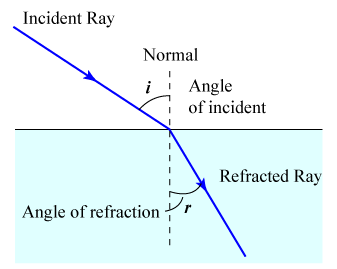
- Refraction
- When wave hits denser object some energy is refracted
- Change in density= change in speed
- Slows down - bends towards normal
- Slows down - bends towards normal
- Change in density= change in speed
- When wave hits denser object some energy is refracted
- Lenses
- Converging Lenses
- Focus Light
- Causes rays of light to converge (move together) to focus
- Focus Light
- Focal Length= Distance from lense to its focal point
- Telescopes
- Refracting Telescope
- 2 Converging Lenses
- Light goes through first lense and refracts towards focal point
- Light continues into second lense thats refracts them towards eyes
- Light continues into second lense thats refracts them towards eyes
- 2 Converging Lenses
- Reflecting Telescope
- Concave Mirror and Converging Lense
- Concave Mirror reflects parallel light to mirror in front of focal point
- Reflects light through hole in Concave mirror into converging lense
- Magnifys image and refracts it into eye.
- Magnifys image and refracts it into eye.
- Reflects light through hole in Concave mirror into converging lense
- Concave Mirror and Converging Lense
- Refracting Telescope
- Concave Mirrors
- Curved Mirror
- Reflects
- Reflects
- Incident Ray PARALLEL to the axis will pass THROUGH the focal point
- Incident Ray THROUGH focal point will be PARALLEL when reflected
- Point where reflected rays join is height of image
- Curved Mirror
- Converging Lenses
- Reflection
Recursos multimedia adjuntos
¿Quieres crear tus propios Mapas Mentales gratis con GoConqr? Más información.