
Mapa mental
GCSE Physics Unit 1 AQA
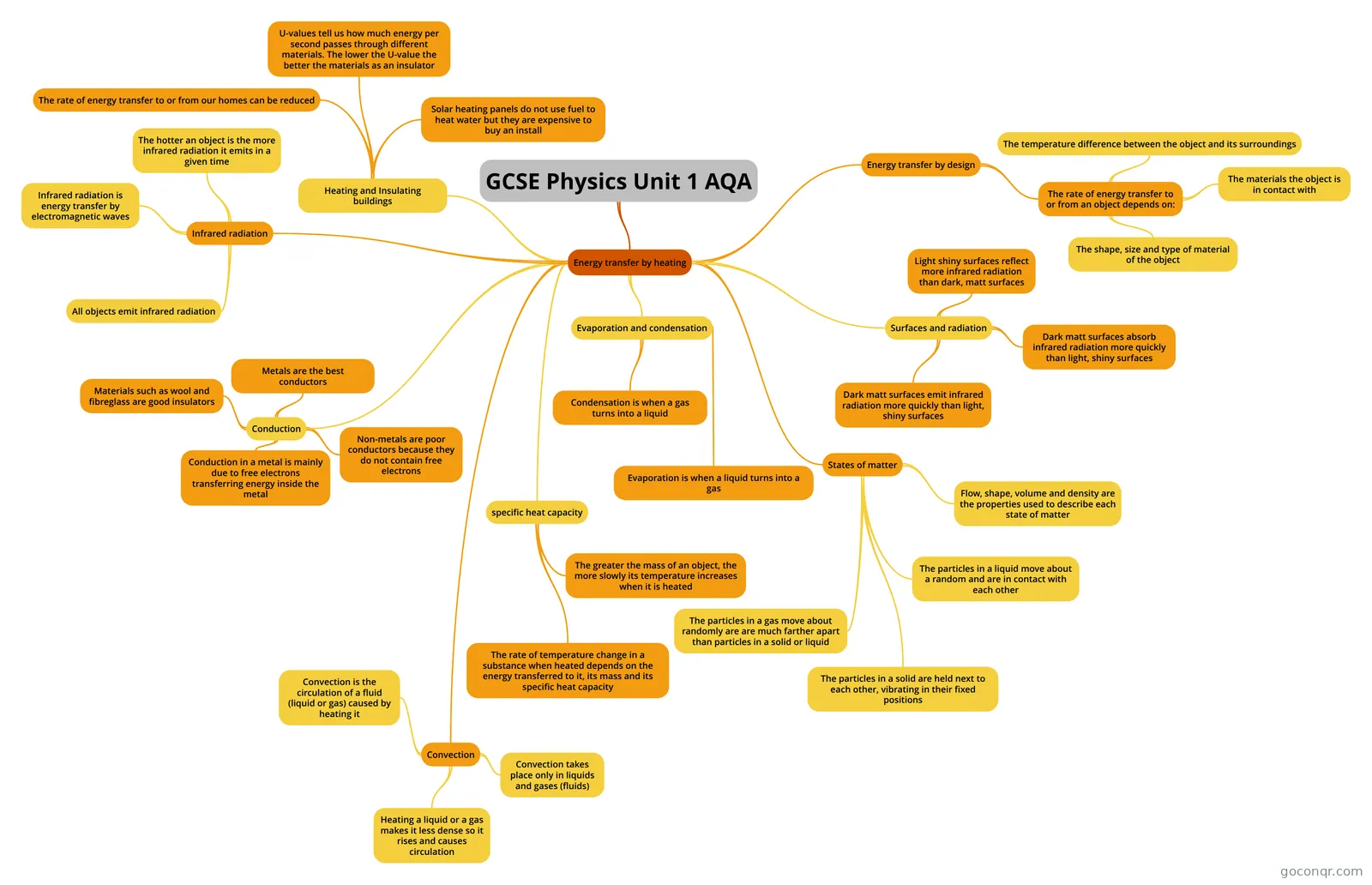
Mind map: GCSE Physics Unit 1 AQA
Contenido del mapa
GCSE Physics Unit 1 AQA
Energy transfer by heating
- Infrared radiation
- Infrared radiation is energy transfer by electromagnetic waves
- All objects emit infrared radiation
- The hotter an object is the more infrared radiation it emits in a given time
- Surfaces and radiation
- Dark matt surfaces emit infrared radiation more quickly than light, shiny surfaces
- Dark matt surfaces absorb infrared radiation more quickly than light, shiny surfaces
- Light shiny surfaces reflect more infrared radiation than dark, matt surfaces
- States of matter
- Flow, shape, volume and density are the properties used to describe each state of matter
- The particles in a solid are held next to each other, vibrating in their fixed positions
- The particles in a liquid move about a random and are in contact with each other
- The particles in a gas move about randomly are are much farther apart than particles in a solid or liquid
- Conduction
- Metals are the best conductors
- Materials such as wool and fibreglass are good insulators
- Conduction in a metal is mainly due to free electrons transferring energy inside the metal
- Non-metals are poor conductors because they do not contain free electrons
- Convection
- Convection is the circulation of a fluid (liquid or gas) caused by heating it
- Convection takes place only in liquids and gases (fluids)
- Heating a liquid or a gas makes it less dense so it rises and causes circulation
- Evaporation and condensation
- Evaporation is when a liquid turns into a gas
- Condensation is when a gas turns into a liquid
- Energy transfer by design
- The rate of energy transfer to or from an object depends on:
- The shape, size and type of material of the object
- The materials the object is in contact with
- The temperature difference between the object and its surroundings
- The rate of energy transfer to or from an object depends on:
- specific heat capacity
- The greater the mass of an object, the more slowly its temperature increases when it is heated
- The rate of temperature change in a substance when heated depends on the energy transferred to it, its mass and its specific heat capacity
- Heating and Insulating buildings
- The rate of energy transfer to or from our homes can be reduced
- U-values tell us how much energy per second passes through different materials. The lower the U-value the better the materials as an insulator
- Solar heating panels do not use fuel to heat water but they are expensive to buy an install
- Infrared radiation
Información
- Descripción
- Mindmap of GCSE Physics Unit 1 AQA
- Creado por
- lottie_richter
- Visitas
- 155
- Etiquetas
- Valoración