
Mapa mental
Overview, uniqueness and real-life listening
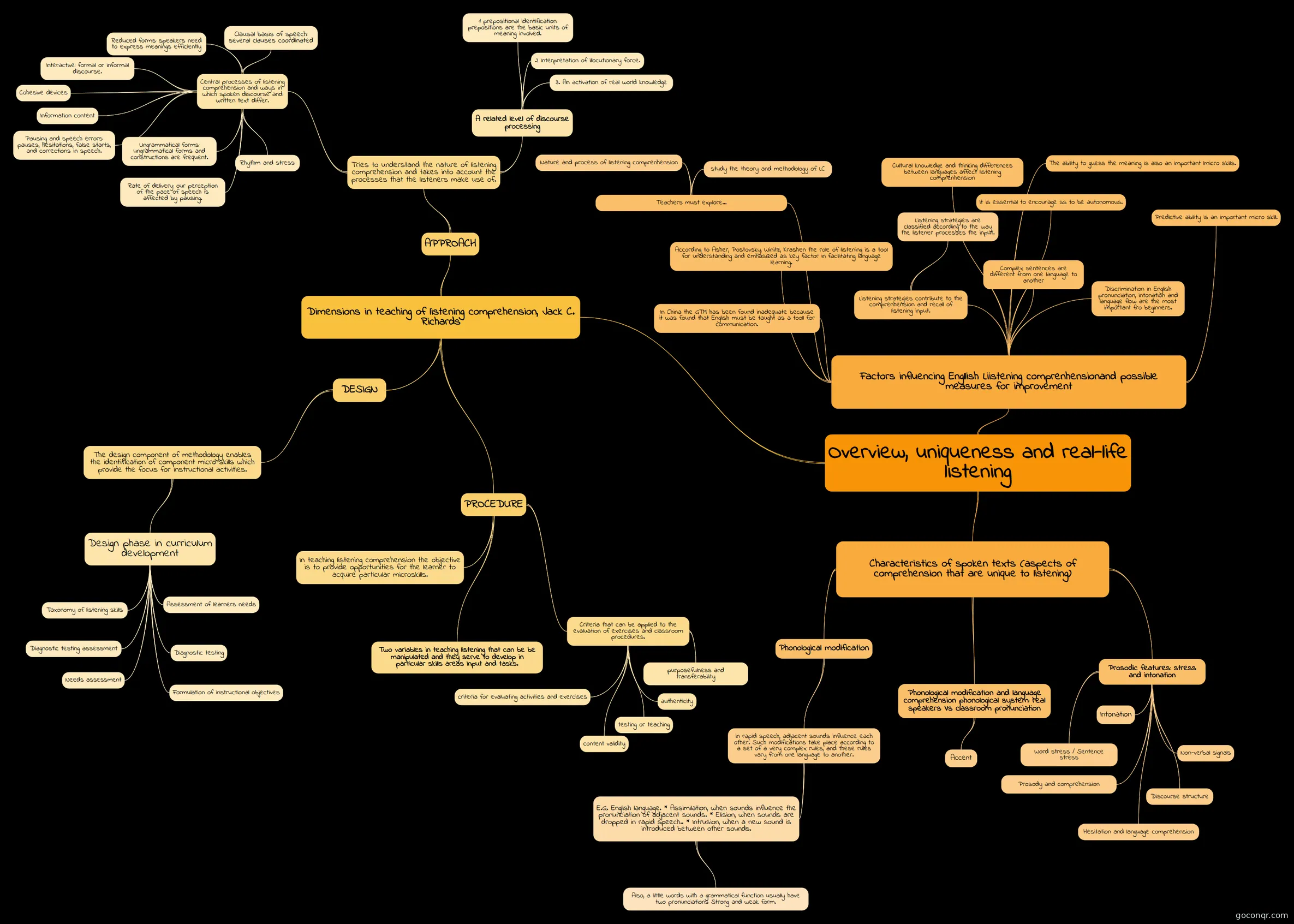
Mind map: Overview, Uniqueness and Real-Life Listening
Contenido del mapa
Overview, uniqueness and real-life listening
Dimensions in teaching of listening comprehension, Jack C. Richards
- APPROACH
- Tries to understand the nature of listening comprehension and takes into account the processes that the listeners make use of.
- A related level of discourse processing
- 1 prepositional identification: prepositions are the basic units of meaning involved.
- 2 Interpretation of illocutionary force.
- 3. An activation of real world knowledge
- Central processes of listening comprehension and ways in which spoken discourse and written text differ.
- Clausal basis of speech: several clauses coordinated
- Reduced forms: speakers need to express meanings efficiently
- Ungrammatical forms: ungrammatical forms and constructions are frequent.
- Pausing and speech errors: pauses, hesitations, false starts, and corrections in speech.
- Rate of delivery: our perception of the pace of speech is affected by pausing.
- Rhythm and stress:
- Cohesive devices
- Information content
- Interactive: formal or informal discourse.
- A related level of discourse processing
- Tries to understand the nature of listening comprehension and takes into account the processes that the listeners make use of.
- DESIGN
- The design component of methodology enables the identification of component micro-skills which provide the focus for instructional activities.
- Design phase in curriculum development
- Diagnostic testing assessment
- Assessment of learners needs
- Diagnostic testing
- Formulation of instructional objectives
- Needs assessment
- Taxonomy of listening skills
- Design phase in curriculum development
- The design component of methodology enables the identification of component micro-skills which provide the focus for instructional activities.
- PROCEDURE
- In teaching listening comprehension the objective is to provide opportunities for the learner to acquire particular microskills.
- Two variables in teaching listening that can be be manipulated and they serve to develop in particular skills areas Input and tasks.
- Criteria that can be applied to the evaluation of exercises and classroom procedures.
- criteria for evaluating activities and exercises
- content validity
- purposefulness and transferability
- testing or teaching
- authenticity
- APPROACH
Characteristics of spoken texts (aspects of comprehension that are unique to listening)
- Phonological modification
- in rapid speech, adjacent sounds influence each other. Such modifications take place according to a set of a very complex rules, and these rules vary from one language to another.
- E.G. English language. * Assimilation, when sounds influence the pronunciation of adjacent sounds. * Elision, when sounds are dropped in rapid speech.. * Intrusion, when a new sound is introduced between other sounds.
- Also, a little words with a grammatical function usually have two pronunciations Strong and weak form.
- E.G. English language. * Assimilation, when sounds influence the pronunciation of adjacent sounds. * Elision, when sounds are dropped in rapid speech.. * Intrusion, when a new sound is introduced between other sounds.
- in rapid speech, adjacent sounds influence each other. Such modifications take place according to a set of a very complex rules, and these rules vary from one language to another.
- Phonological modification and language comprehension phonological system: real speakers Vs classroom pronunciation
- Accent
- Prosodic features: stress and intonation
- Word stress / Sentence stress
- Intonation
- Prosody and comprehension
- Hesitation and language comprehension
- Discourse structure
- Non-verbal signals
- Phonological modification
Factors influencing Engllish Liistening comprenhensionand possible measures for improvement
- In China the GTM has been found inadequate because it was found that English must be taught as a tooll for communication.
- According to Asher, Postovsky, Winitz, Krashen the role of listening is a tool for understanding and emhasized as key factor in facilitating language learning.
- Teachers must explore...
- Nature and process of listening comprenhension
- study the theory and methodology of LC
- Listening strategies contribute to the comprenhension and recall of listening input.
- Listening strategies are classified according to the way the listener processes the input.
- Complex sentences are different from one language to another
- Cultural knowledge and thinking differences between languages affect listening comprenhension
- It is essential to encourage ss to be autonomous.
- Discrimination in English pronunciation, intonation and language flow are the most important fro beginners.
- Predictive ability is an important micro skill.
- The ability to guess the meaning is also an important lmicro skills.