
Mapa mental
Modern Network Security Threats
Contenido del mapa
Modern Network Security Threats
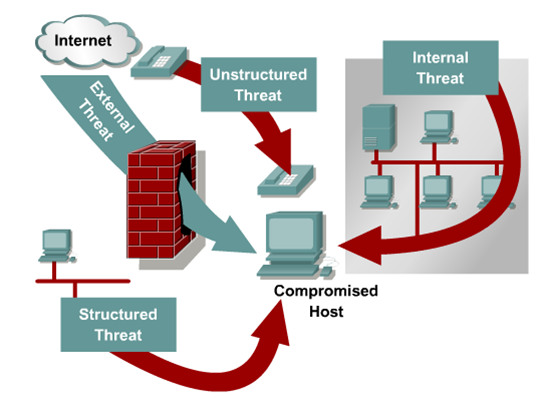
Threats
Network Security
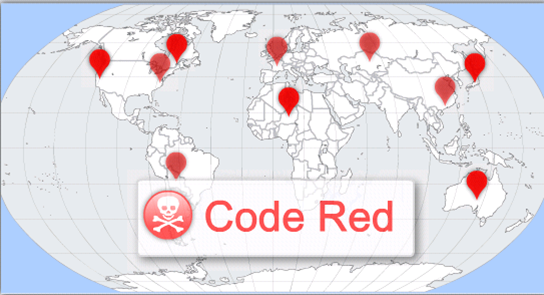
Code Red
- The Code Red worm was a DoS attack and was released on July 19, 2001 and attacked web servers globally, infecting over 350,000 hosts and in turn affected millions of users.
- The "Code Red" worm attempted to connect to TCP port 80 on a randomly chosen host assuming that a web server will be found
- Network security professionals must develop and implement a security policy which includes a process to continually keep tabs on security advisories and patches.
- The "Code Red" worm attempted to connect to TCP port 80 on a randomly chosen host assuming that a web server will be found
- The Code Red worm was a DoS attack and was released on July 19, 2001 and attacked web servers globally, infecting over 350,000 hosts and in turn affected millions of users.
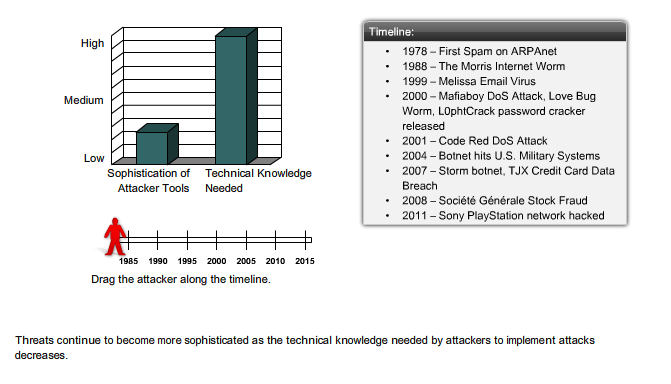
Drivers for Network Security
- Hacker Titles
- Phreaker An individual that manipulates the phone network in order to cause it to perform a function that is normally not allowed such as to make free long distance calls. Captain Crunch (John Drapper)
- Spammer Individual that sends large quantities of unsolicited email messages. Spammers often use viruses to take control of home computers to send out their bulk messages.
- Phisher Individual uses email or other means in an attempt to trick others into providing sensitive information, such as credit card numbers or passwords
- Hacker Titles
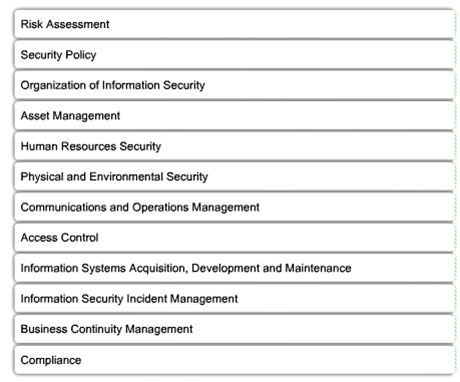
Domains of Network Security
Types of Attacks
- There are four categories of attacks: Malicious Code: Viruses, Worms and Trojan Horses Reconnaissance Attacks Access Attacks Denial of Service (DoS) Attacks
- virus
- A virus is malicious software that is attached to another program to execute a particular unwanted function on a user's workstation.
- worm
- A worm executes arbitrary code and installs copies of itself in the infected computer’s memory, which infects other hosts
- trojan
- A Trojan horse is different only in that the entire application was written to look like something else, when in fact it is an attack tool
- virus
- There are four categories of attacks: Malicious Code: Viruses, Worms and Trojan Horses Reconnaissance Attacks Access Attacks Denial of Service (DoS) Attacks
Access Attacks
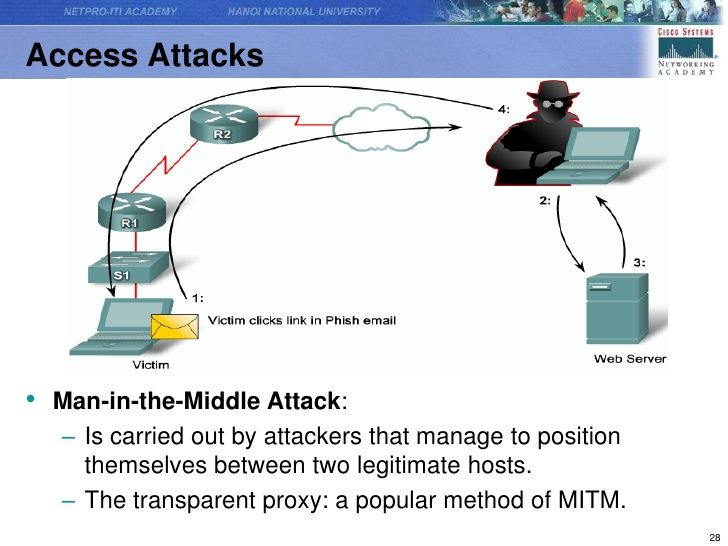
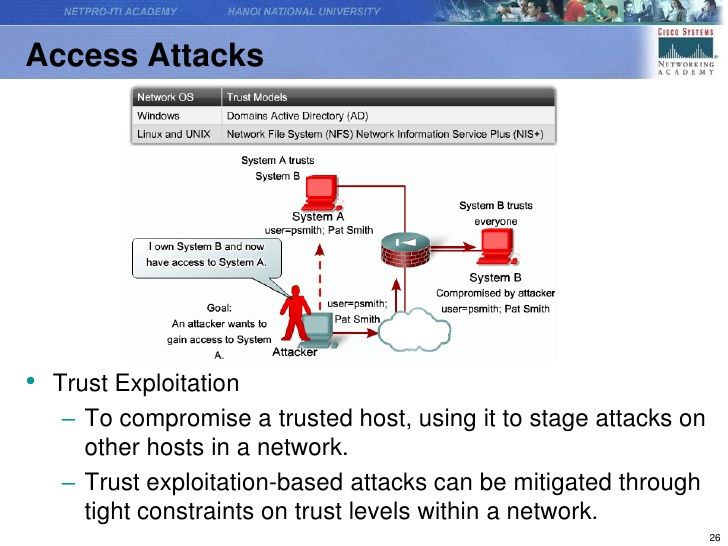
- Access attacks exploit known vulnerabilities in authentication services, FTP services, and web services to gain entry to web accounts, confidential databases, and other sensitive information
- Password Attacks
- Port Redirection
- “Man-in-the-Middle” Attacks
- Access attacks exploit known vulnerabilities in authentication services, FTP services, and web services to gain entry to web accounts, confidential databases, and other sensitive information
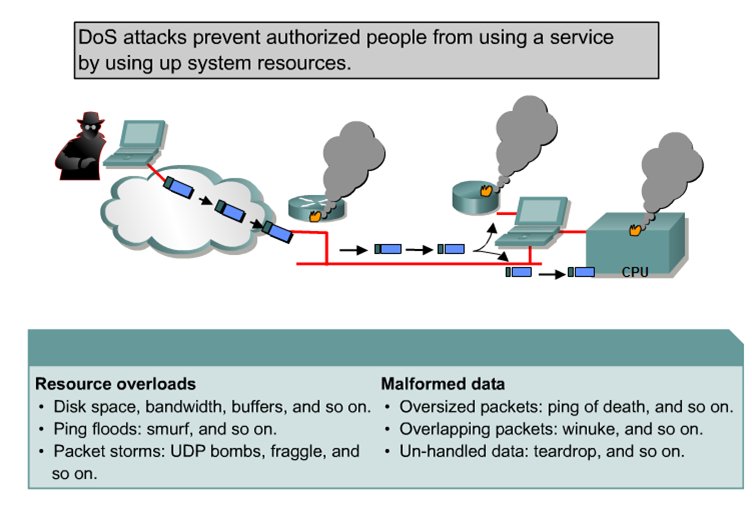
DoS Attacks
Mitigating Attacks
- Implementing and enforcing a policy directive that forbids the use of protocols with known susceptibilities to eavesdropping. Using encryption that meets the data security needs of the organization without imposing an excessive burden on the system resources or the users. Using switched networks.
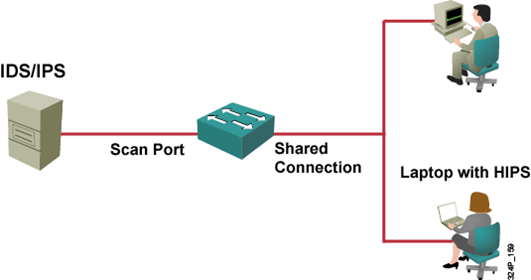
- Ping Sweeps and Port Scans MitigationCan’t be prevented without compromising network capabilities. However, damage can be mitigated using intrusion prevention systems (IPS) at network and host levels
- Implementing and enforcing a policy directive that forbids the use of protocols with known susceptibilities to eavesdropping. Using encryption that meets the data security needs of the organization without imposing an excessive burden on the system resources or the users. Using switched networks.
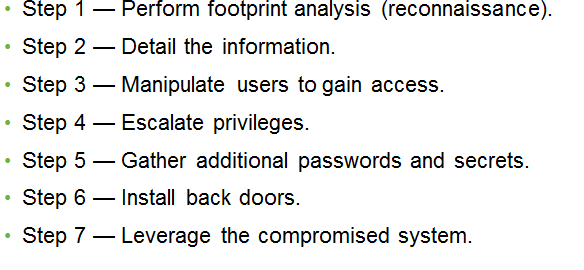
Seven Steps to Hacking a Network
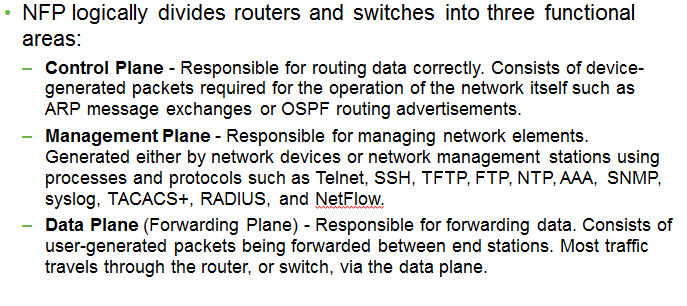
Cisco Network Foundation Protection (NFP)
Imágenes y archivos del mapa




Información
- Descripción
- 3 Redes de computadora Mapa Mental sobre Modern Network Security Threats, creado por Liliana Torres el 25/08/2016.
- Creado por
- Liliana Torres · ago 2016
- Actualizado
- 26 ago 2016
- Visitas
- 1
- Valoración