
Mapa mental
Read an assignment
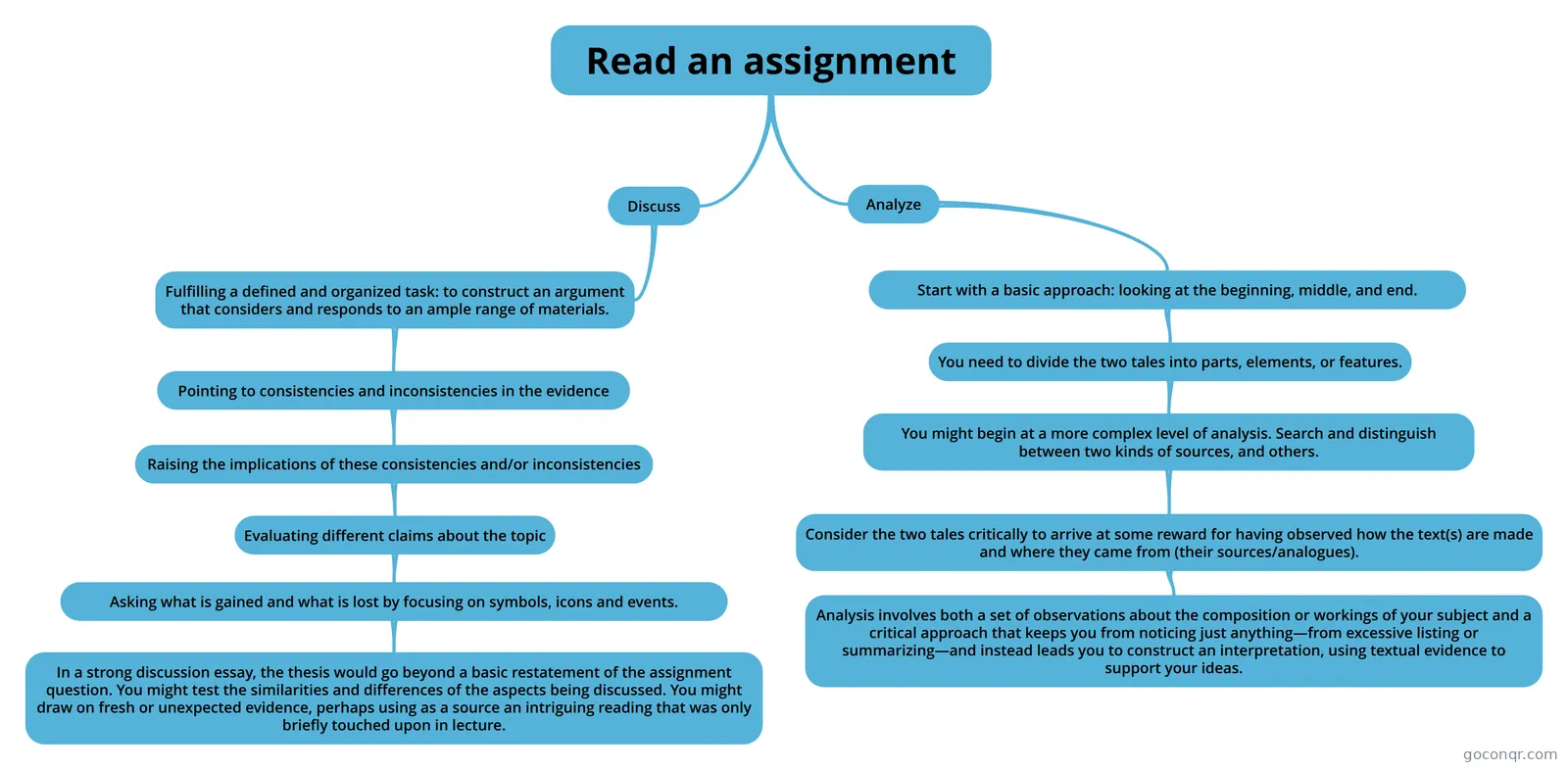
Mind map: Read an assignment
Contenido del mapa
Read an assignment
Discuss
- Fulfilling a defined and organized task: to construct an argument that considers and responds to an ample range of materials.
- Pointing to consistencies and inconsistencies in the evidence
- Raising the implications of these consistencies and/or inconsistencies
- Evaluating different claims about the topic
- Asking what is gained and what is lost by focusing on symbols, icons and events.
- In a strong discussion essay, the thesis would go beyond a basic restatement of the assignment question. You might test the similarities and differences of the aspects being discussed. You might draw on fresh or unexpected evidence, perhaps using as a source an intriguing reading that was only briefly touched upon in lecture.
- Asking what is gained and what is lost by focusing on symbols, icons and events.
- Evaluating different claims about the topic
- Raising the implications of these consistencies and/or inconsistencies
- Pointing to consistencies and inconsistencies in the evidence
- Fulfilling a defined and organized task: to construct an argument that considers and responds to an ample range of materials.
Analyze
- Start with a basic approach: looking at the beginning, middle, and end.
- You need to divide the two tales into parts, elements, or features.
- You might begin at a more complex level of analysis. Search and distinguish between two kinds of sources, and others.
- Consider the two tales critically to arrive at some reward for having observed how the text(s) are made and where they came from (their sources/analogues).
- Analysis involves both a set of observations about the composition or workings of your subject and a critical approach that keeps you from noticing just anything—from excessive listing or summarizing—and instead leads you to construct an interpretation, using textual evidence to support your ideas.
- Consider the two tales critically to arrive at some reward for having observed how the text(s) are made and where they came from (their sources/analogues).
- You might begin at a more complex level of analysis. Search and distinguish between two kinds of sources, and others.
- You need to divide the two tales into parts, elements, or features.
- Start with a basic approach: looking at the beginning, middle, and end.
Información
- Descripción
- Differences between analysis and discussion in an essay
- Creado por
- Victor Vergara
- Visitas
- 12
- Etiquetas
- Valoración