
Mapa mental
Modal Verbs
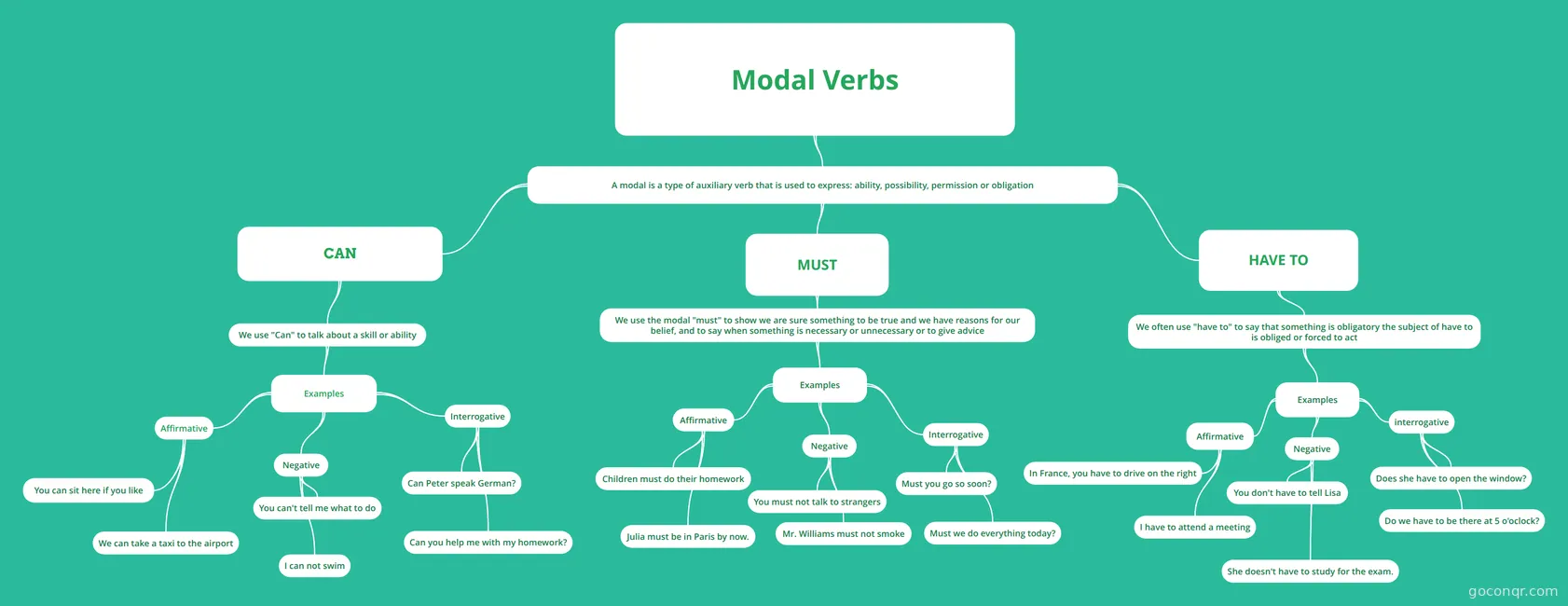
Mind map: Modal verbs
Contenido del mapa
Modal Verbs
A modal is a type of auxiliary verb that is used to express: ability, possibility, permission or obligation
- CAN
- We use "Can" to talk about a skill or ability
- Examples
- Affirmative
- You can sit here if you like
- We can take a taxi to the airport
- Negative
- You can't tell me what to do
- I can not swim
- Interrogative
- Can Peter speak German?
- Can you help me with my homework?
- Affirmative
- Examples
- We use "Can" to talk about a skill or ability
- MUST
- We use the modal "must" to show we are sure something to be true and we have reasons for our belief, and to say when something is necessary or unnecessary or to give advice
- Examples
- Affirmative
- Children must do their homework
- Julia must be in Paris by now.
- Negative
- You must not talk to strangers
- Mr. Williams must not smoke
- Interrogative
- Must we do everything today?
- Must you go so soon?
- Affirmative
- Examples
- We use the modal "must" to show we are sure something to be true and we have reasons for our belief, and to say when something is necessary or unnecessary or to give advice
- HAVE TO
- We often use "have to" to say that something is obligatory the subject of have to is obliged or forced to act
- Examples
- Affirmative
- I have to attend a meeting
- In France, you have to drive on the right
- Negative
- You don't have to tell Lisa
- She doesn't have to study for the exam.
- interrogative
- Does she have to open the window?
- Do we have to be there at 5 o'oclock?
- Affirmative
- Examples
- We often use "have to" to say that something is obligatory the subject of have to is obliged or forced to act
- CAN
Información
- Descripción
- En este mapa mental podremos observar el significado y los ejemplos de los verbos modales en ingles de can, must y have to
- Creado por
- SOFIA GONZALEZ
- Visitas
- 125
- Etiquetas
- Valoración