
Mapa mental
Asset Pricing
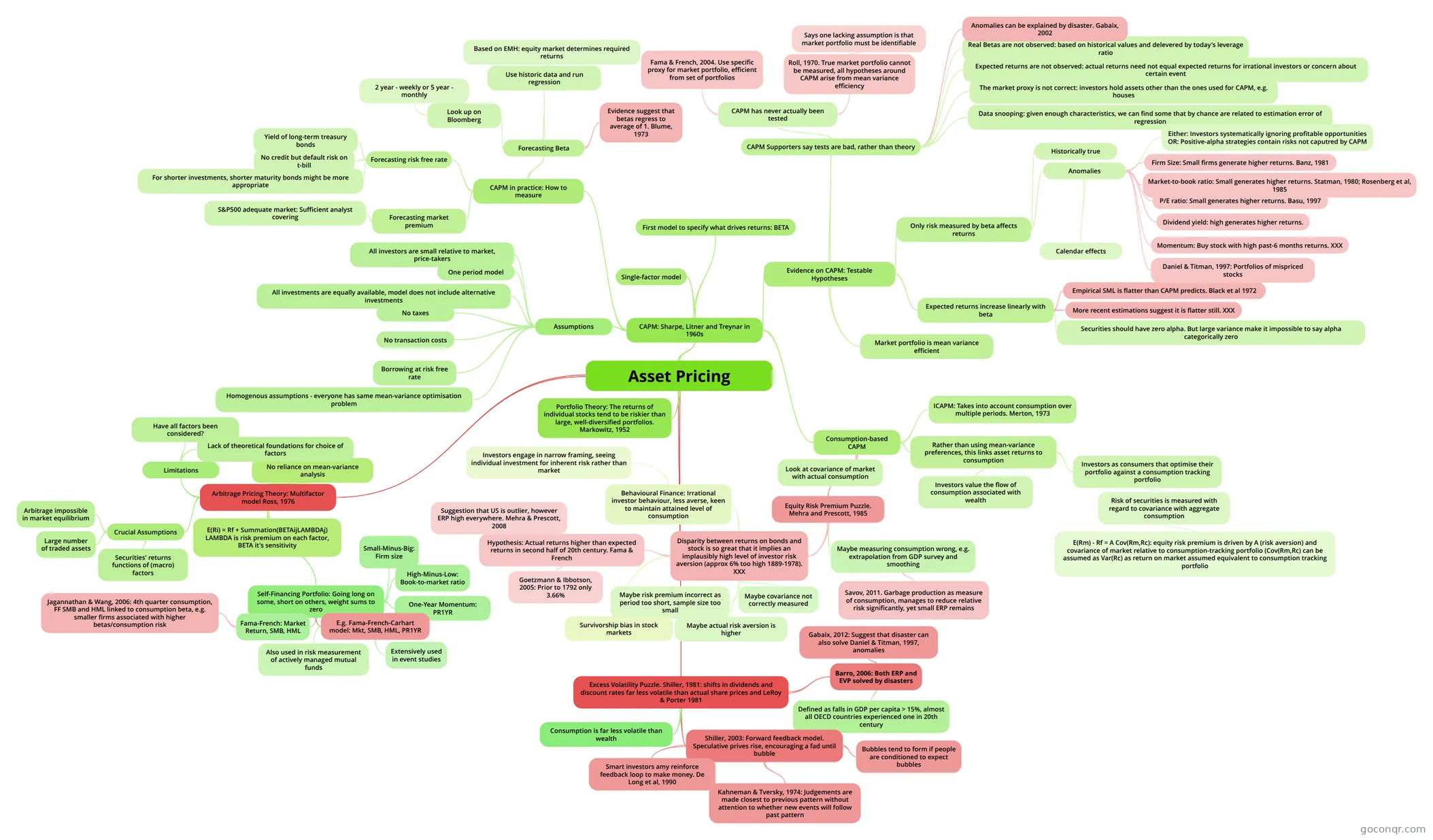
Mind map: asset pricing
Contenido del mapa
Asset Pricing
Portfolio Theory: The returns of individual stocks tend to be riskier than large, well-diversified portfolios. Markowitz, 1952
CAPM: Sharpe, Litner and Treynar in 1960s
- Assumptions
- All investors are small relative to market, price-takers
- One period model
- All investments are equally available, model does not include alternative investments
- No taxes
- No transaction costs
- Borrowing at risk free rate
- Homogenous assumptions - everyone has same mean-variance optimisation problem
- CAPM in practice: How to measure
- Forecasting Beta
- Use historic data and run regression
- Based on EMH: equity market determines required returns
- Look up on Bloomberg
- 2 year - weekly or 5 year - monthly
- Evidence suggest that betas regress to average of 1. Blume, 1973
- Use historic data and run regression
- Forecasting risk free rate
- Yield of long-term treasury bonds
- For shorter investments, shorter maturity bonds might be more appropriate
- No credit but default risk on t-bill
- Forecasting market premium
- S&P500 adequate market: Sufficient analyst covering
- Forecasting Beta
- Evidence on CAPM: Testable Hypotheses
- Only risk measured by beta affects returns
- Historically true
- Anomalies
- Firm Size: Small firms generate higher returns. Banz, 1981
- Market-to-book ratio: Small generates higher returns. Statman, 1980; Rosenberg et al, 1985
- P/E ratio: Small generates higher returns. Basu, 1997
- Dividend yield: high generates higher returns.
- Momentum: Buy stock with high past-6 months returns. XXX
- Calendar effects
- Daniel & Titman, 1997: Portfolios of mispriced stocks
- Either: Investors systematically ignoring profitable opportunities OR: Positive-alpha strategies contain risks not caputred by CAPM
- Expected returns increase linearly with beta
- Empirical SML is flatter than CAPM predicts. Black et al 1972
- More recent estimations suggest it is flatter still. XXX
- Securities should have zero alpha. But large variance make it impossible to say alpha categorically zero
- Market portfolio is mean variance efficient
- CAPM Supporters say tests are bad, rather than theory
- Real Betas are not observed: based on historical values and delevered by today's leverage ratio
- Expected returns are not observed: actual returns need not equal expected returns for irrational investors or concern about certain event
- The market proxy is not correct: investors hold assets other than the ones used for CAPM, e.g. houses
- Data snooping: given enough characteristics, we can find some that by chance are related to estimation error of regression
- Anomalies can be explained by disaster. Gabaix, 2002
- CAPM has never actually been tested
- Fama & French, 2004. Use specific proxy for market portfolio, efficient from set of portfolios
- Roll, 1970. True market portfolio cannot be measured, all hypotheses around CAPM arise from mean variance efficiency
- Says one lacking assumption is that market portfolio must be identifiable
- Only risk measured by beta affects returns
- Consumption-based CAPM
- ICAPM: Takes into account consumption over multiple periods. Merton, 1973
- Rather than using mean-variance preferences, this links asset returns to consumption
- Investors as consumers that optimise their portfolio against a consumption tracking portfolio
- Risk of securities is measured with regard to covariance with aggregate consumption
- E(Rm) - Rf = A Cov(Rm,Rc): equity risk premium is driven by A (risk aversion) and covariance of market relative to consumption-tracking portfolio (Cov(Rm,Rc) can be assumed as Var(Rc) as return on market assumed equivalent to consumption tracking portfolio
- Risk of securities is measured with regard to covariance with aggregate consumption
- Investors value the flow of consumption associated with wealth
- Investors as consumers that optimise their portfolio against a consumption tracking portfolio
- Equity Risk Premium Puzzle. Mehra and Prescott, 1985
- Look at covariance of market with actual consumption
- Disparity between returns on bonds and stock is so great that it implies an implausibly high level of investor risk aversion (approx 6% too high 1889-1978). XXX
- Maybe covariance not correctly measured
- Maybe actual risk aversion is higher
- Maybe risk premium incorrect as period too short, sample size too small
- Hypothesis: Actual returns higher than expected returns in second half of 20th century. Fama & French
- Goetzmann & Ibbotson, 2005: Prior to 1792 only 3.66%
- Suggestion that US is outlier, however ERP high everywhere. Mehra & Prescott, 2008
- Survivorship bias in stock markets
- Behavioural Finance: Irrational investor behaviour, less averse, keen to maintain attained level of consumption
- Investors engage in narrow framing, seeing individual investment for inherent risk rather than market
- Maybe measuring consumption wrong, e.g. extrapolation from GDP survey and smoothing
- Savov, 2011. Garbage production as measure of consumption, manages to reduce relative risk significantly, yet small ERP remains
- First model to specify what drives returns: BETA
- Single-factor model
- Assumptions
Arbitrage Pricing Theory: Multifactor model Ross, 1976
- Intuition: If you have n factors, n securities can replicate any factor profile. Price of n+1st security must be determined by previous n securities. In practice # of factors << # of securities
- E(Ri) = Rf + Summation(BETAijLAMBDAj) LAMBDA is risk premium on each factor, BETA it's sensitivity
- No reliance on mean-variance analysis
- Crucial Assumptions
- Arbitrage impossible in market equilibrium
- Securities' returns functions of (macro) factors
- Large number of traded assets
- Limitations
- Lack of theoretical foundations for choice of factors
- Have all factors been considered?
- Self-Financing Portfolio: Going long on some, short on others, weight sums to zero
- Small-Minus-Big: Firm size
- High-Minus-Low: Book-to-market ratio
- One-Year Momentum: PR1YR
- E.g. Fama-French-Carhart model: Mkt, SMB, HML, PR1YR
- Extensively used in event studies
- Also used in risk measurement of actively managed mutual funds
- Fama-French: Market Return, SMB, HML
- Jagannathan & Wang, 2006: 4th quarter consumption, FF SMB and HML linked to consumption beta, e.g. smaller firms associated with higher betas/consumption risk
Excess Volatility Puzzle. Shiller, 1981: shifts in dividends and discount rates far less volatile than actual share prices and LeRoy & Porter 1981
- Consumption is far less volatile than wealth
- Barro, 2006: Both ERP and EVP solved by disasters
- Defined as falls in GDP per capita > 15%, almost all OECD countries experienced one in 20th century
- Gabaix, 2012: Suggest that disaster can also solve Daniel & Titman, 1997, anomalies
- Shiller, 2003: Forward feedback model. Speculative prives rise, encouraging a fad until bubble
- Bubbles tend to form if people are conditioned to expect bubbles
- Kahneman & Tversky, 1974: Judgements are made closest to previous pattern without attention to whether new events will follow past pattern
- Smart investors amy reinforce feedback loop to make money. De Long et al, 1990
Información
- Descripción
- Mapa Mental sobre Asset Pricing, creado por luisglaeser el 22/04/2014.
- Creado por
- luisglaeser
- Visitas
- 123
- Etiquetas
- Valoración