
Mapa mental
Public Relations Mid-term
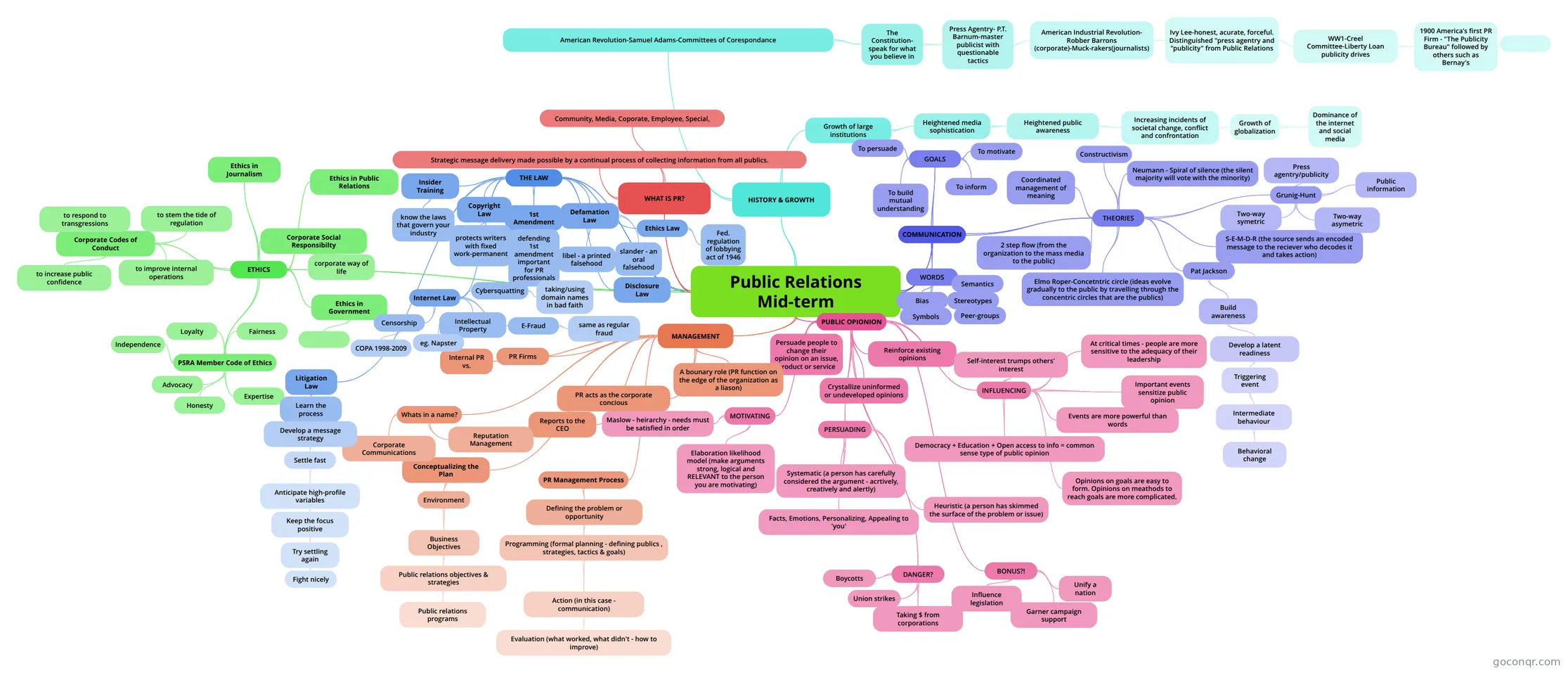
Mind map: Public relations mid-term
Contenido del mapa
Public Relations Mid-term
WHAT IS PR?
- Strategic message delivery made possible by a continual process of collecting information from all publics.
- Community, Media, Coporate, Employee, Special,
HISTORY & GROWTH
- American Revolution-Samuel Adams-Committees of Corespondance
- The Constitution- speak for what you believe in
- Press Agentry- P.T. Barnum-master publicist with questionable tactics
- American Industrial Revolution- Robber Barrons (corporate)-Muck-rakers(journalists)
- Ivy Lee-honest, acurate, forceful. Distinguished "press agentry and "publicity" from Public Relations
- WW1-Creel Committee-Liberty Loan publicity drives
- 1900 America's first PR Firm - "The Publicity Bureau" followed by others such as Bernay's
- 1900 America's first PR Firm - "The Publicity Bureau" followed by others such as Bernay's
- WW1-Creel Committee-Liberty Loan publicity drives
- Ivy Lee-honest, acurate, forceful. Distinguished "press agentry and "publicity" from Public Relations
- American Industrial Revolution- Robber Barrons (corporate)-Muck-rakers(journalists)
- Press Agentry- P.T. Barnum-master publicist with questionable tactics
- The Constitution- speak for what you believe in
- Growth of large institutions
- Heightened media sophistication
- Heightened public awareness
- Increasing incidents of societal change, conflict and confrontation
- Growth of globalization
- Dominance of the internet and social media
- Growth of globalization
- Increasing incidents of societal change, conflict and confrontation
- Heightened public awareness
- Heightened media sophistication
- American Revolution-Samuel Adams-Committees of Corespondance
COMMUNICATION
- GOALS
- To persuade
- To motivate
- To build mutual understanding
- To inform
- THEORIES
- 2 step flow (from the organization to the mass media to the public)
- Elmo Roper-Concetntric circle (ideas evolve gradually to the public by travelling through the concentric circles that are the publics)
- Pat Jackson
- Build awareness
- Develop a latent readiness
- Triggering event
- Intermediate behaviour
- Behavioral change
- Intermediate behaviour
- Triggering event
- Develop a latent readiness
- Build awareness
- S-E-M-D-R (the source sends an encoded message to the reciever who decodes it and takes action)
- Neumann - Spiral of silence (the silent majority will vote with the minority)
- Constructivism
- Coordinated management of meaning
- Grunig-Hunt
- Press agentry/publicity
- Public information
- Two-way asymetric
- Two-way symetric
- WORDS
- Semantics
- Bias
- Stereotypes
- Symbols
- Peer-groups
- GOALS
PUBLIC OPIONION
- Persuade people to change their opinion on an issue, product or service
- Crystallize uninformed or undeveloped opinions
- Reinforce existing opinions
- MOTIVATING
- Elaboration likelihood model (make arguments strong, logical and RELEVANT to the person you are motivating)
- Maslow - heirarchy - needs must be satisfied in order
- PERSUADING
- Systematic (a person has carefully considered the argument - acrtively, creatively and alertly)
- Heuristic (a person has skimmed the surface of the problem or issue)
- Facts, Emotions, Personalizing, Appealing to 'you'
- INFLUENCING
- Important events sensitize public opinion
- Events are more powerful than words
- At critical times - people are more sensitive to the adequacy of their leadership
- Self-interest trumps others' interest
- Opinions on goals are easy to form. Opinions on meathods to reach goals are more complicated.
- Democracy + Education + Open access to info = common sense type of public opinion
- DANGER?
- Union strikes
- Taking $ from corporations
- Boycotts
- BONUS?!
- Influence legislation
- Garner campaign support
- Unify a nation
MANAGEMENT
- A bounary role (PR function on the edge of the organization as a liason)
- PR acts as the corporate concious
- Reports to the CEO
- Conceptualizing the Plan
- Environment
- Business Objectives
- Public relations objectives & strategies
- Public relations programs
- Public relations objectives & strategies
- Business Objectives
- Environment
- PR Management Process
- Defining the problem or opportunity
- Programming (formal planning - defining publics , strategies, tactics & goals)
- Action (in this case - communication)
- Evaluation (what worked, what didn't - how to improve)
- Action (in this case - communication)
- Programming (formal planning - defining publics , strategies, tactics & goals)
- Defining the problem or opportunity
- Internal PR vs.
- PR Firms
- Whats in a name?
- Corporate Communications
- Reputation Management
ETHICS
- PSRA Member Code of Ethics
- Advocacy
- Honesty
- Expertise
- Independence
- Loyalty
- Fairness
- Corporate Codes of Conduct
- to increase public confidence
- to stem the tide of regulation
- to improve internal operations
- to respond to transgressions
- Corporate Social Responsibilty
- corporate way of life
- Ethics in Government
- Ethics in Journalism
- Ethics in Public Relations
- PSRA Member Code of Ethics
THE LAW
- 1st Amendment
- defending 1st amendment important for PR professionals
- Defamation Law
- libel - a printed falsehood
- slander - an oral falsehood
- Insider Training
- know the laws that govern your industry
- Disclosure Law
- Ethics Law
- Fed. regulation of lobbying act of 1946
- Copyright Law
- protects writers with fixed work-permanent
- Internet Law
- Censorship
- COPA 1998-2009
- Intellectual Property
- eg. Napster
- Cybersquatting
- taking/using domain names in bad faith
- E-Fraud
- same as regular fraud
- Censorship
- Litigation Law
- Learn the process
- Develop a message strategy
- Settle fast
- Anticipate high-profile variables
- Keep the focus positive
- Try settling again
- Fight nicely
- Try settling again
- Keep the focus positive
- Anticipate high-profile variables
- Settle fast
- Develop a message strategy
- Learn the process
- 1st Amendment
Información
- Descripción
- Mapa Mental sobre Public Relations Mid-term, creado por Jennifer Lee Foy el 13/05/2013.
- Creado por
- Jennifer Lee Foy
- Visitas
- 198
- Valoración