
Mapa mental
Lipids
Contenido del mapa
Lipids
Definition
- - Heterogeneous group of compounds which are soluble in organic solvents and insoluble in water.
- - Not polymers.
- - Related to fatty acids.
Function
- - Important dietary constituents, because of their high energy value.
- - Fate soluble vitamins D,E,K,A. (DEKA).
- - Lipids act as thermal insulator in subcutaneous tissues and around certain organs.
- - Act as electrical insulator around myelinated nerves.
- - Cell membrane structure.
- - Act as electrical insulator around myelinated nerves.
- - Lipids act as thermal insulator in subcutaneous tissues and around certain organs.
- - Fate soluble vitamins D,E,K,A. (DEKA).
- - Important dietary constituents, because of their high energy value.
Classification
- Simple Lipids
- Ester of (fatty acids + alcohol)
- Tag
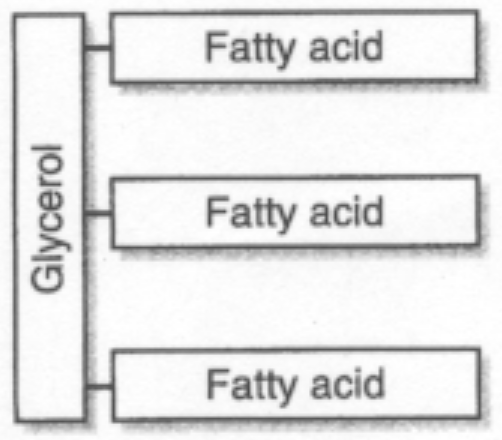
- Oils or fat (Triacylglycerol)
- - They are Ester of ( fatty acids + Glycerol )
- Simple Triacylglycerol
- If the three fatty acids are the same
- Mixed Triacylglycerol
- If the three fatty acids are not the same
- Function
- - Main storage form of fatty acids.
- They provide sufficient energy for survival for several weeks of starvation.
- - Can be stored in large amount as it is hydrophobic
- - acts as insulator for heat
- - supports internal viscera
- - acts as insulator for heat
- - Can be stored in large amount as it is hydrophobic
- They provide sufficient energy for survival for several weeks of starvation.
- - Main storage form of fatty acids.
- Solid or liquid ?
- Solid Form
- If the fatty acid chain is long or saturated (fat)
- Liquid form
- If the fatty acid chain is short or unsaturated (oils)
- ( In room temp )
- Solid Form
- Oils or fat (Triacylglycerol)
- Wax
- - Ester of ( fatty acid + high molecular monohydric alcohol)
- (alcohol has 16~30 carbon)
- As : Bee wax, Lanoline
- (alcohol has 16~30 carbon)
- - Ester of ( fatty acid + high molecular monohydric alcohol)
- Tag
- Ester of (fatty acids + alcohol)
- Compound lipids
- Esters of fatty acids with alcohols containing additional groups
- Lipoproteins
- contain protein
- Sulfolipids
- contain sulphate
- Glycolipids
- contain carbohydrates
- - Contain ( Ceramide + carbohydrate )
- Contain Ceramide+ two or more monosaccharides+ one or more sialic acid.
- The principle sialic acid is gangliosides is N-acetyl neuraminic acid (NANA).
- They are present in ganglion cells of nervous system.
- They act as receptor or for cell- cell recognition.
- Act as receptor e.g. for Cholera toxin in human intestine.
- *All glycolipids and sphingomyelin contain Sphingosine alcohol and are referred as Sphingolipids*
- *All glycolipids and sphingomyelin contain Sphingosine alcohol and are referred as Sphingolipids*
- Act as receptor e.g. for Cholera toxin in human intestine.
- They act as receptor or for cell- cell recognition.
- They are present in ganglion cells of nervous system.
- The principle sialic acid is gangliosides is N-acetyl neuraminic acid (NANA).
- Contain Ceramide+ two or more monosaccharides+ one or more sialic acid.
- - Contain ( Ceramide + carbohydrate )
- Cerebrosides
- ( Ceramide monohexosides )
- Contain Ceramide that is attached to monosaccharide unit by β-glycosidic bond
- Galactocerebrosides
- .Present in brain & nervous tissue
- Glucocerebrosides
- .Present in extra neural tissue
- Galactocerebrosides
- Contain Ceramide that is attached to monosaccharide unit by β-glycosidic bond
- ( Ceramide monohexosides )
- Sulfatides
- Contain galactocerebroside + sulfate
- Gangliosides
- contain carbohydrates
- Phospholipids
- contain phosphate
- Glycerophospholipids
- ( phosphoglycerides )
- - They are polar, ionic lipids
- Acidic phospholipids:
- They are phospholipids with (-1) net charge or more at physiological PH (7.4).
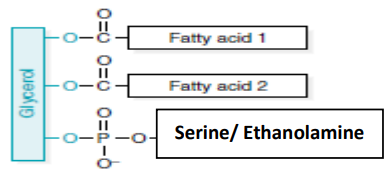
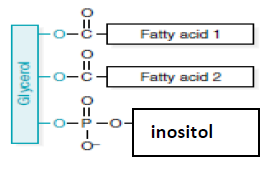
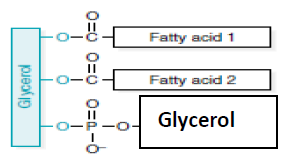
- Example: Phosphatidyl serine, inositol, glycerol and cardiolipin
- They play a role in blood coagulation.
- Antibodies against acidic phospholipids lead to recurrent thrombosis and recurrent fetal loss (antiphospholipids syndrome)
- They play a role in blood coagulation.
- Example: Phosphatidyl serine, inositol, glycerol and cardiolipin
- They are phospholipids with (-1) net charge or more at physiological PH (7.4).
- Acidic phospholipids:
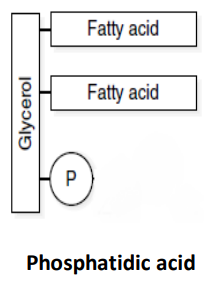
- Phosphatidic acid
- - An Intermediate in the synthesis of TAG, phospholipid (parent compounds).
- It isn’t common constituents in tissue.
- - An Intermediate in the synthesis of TAG, phospholipid (parent compounds).
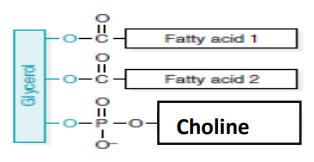
- Phosphatidyl choline
- ( lecithin )
- ( Dipalmityl lecithin )
- ( lung surfactant )
- - It contains palmitic acid at C1,2
- - It decreases the surface tension in the lung alveoli.
- - It is synthesized around time of birth.
- - Deficiency of lung surfactant in premature babies causes respiratory distress syndrome (RDS).
- - It is synthesized around time of birth.
- - It decreases the surface tension in the lung alveoli.
- - It contains palmitic acid at C1,2
- ( lung surfactant )
- ( Dipalmityl lecithin )
- ( lecithin )
- Phosphatidyl serine
- phosphatidyl ethanolamine
- - They have role in blood coagulation.
- - They are found in the cell membrane.
- (cephalin)
- Phosphatidyl inositol
- Phosphatidyl inositol 4,5 bisphosphate acts as second messenger in signal transduction and present in cell membrane.
- *inositol is a cyclic hexahydric alcohol*
- Phosphatidyl inositol 4,5 bisphosphate acts as second messenger in signal transduction and present in cell membrane.
- Phosphatidyl glycerol
- Present in mitochondrial membrane and is the precursor of cardiolipin.
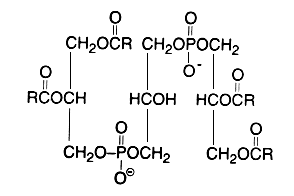
- Cardiolipin (Diphosphatidyl glycerol)
- - Present in mitochondrial membrane -It has some immunological properties.
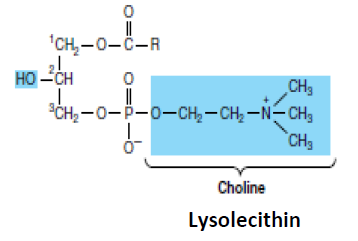
- Lysophospholipid
- (lysophosphatidyl choline) (lysolecithin)
- - This type of phospholipid with free OH in C2.
- - They are important intermediates in metabolism and phospholipid interconversions.
- - This type of phospholipid with free OH in C2.
- (lysophosphatidyl choline) (lysolecithin)
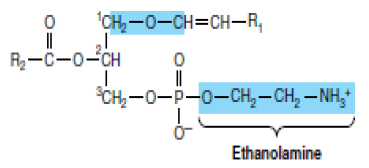
- Plasmalogens
- - Resemble phospholipids, except: they have ether link in C1 not ester link.
- - Represent 10-30% of phospholipids in brain and heart.
- - Example: Ethanolamine plasmalogen.
- - Represent 10-30% of phospholipids in brain and heart.
- - Resemble phospholipids, except: they have ether link in C1 not ester link.
- - They are polar, ionic lipids
- ( phosphoglycerides )
- Sphingophospholipid
- ( Sphingomyelin )
- Ceramide
- fatty acid
- Sphingosine
- Serine
- ( amino acid )
- (palmitate)
- ( fatty acid )
- Serine
- Phosphocholine
- Functions of phospholipids
- 1- They serve as structural component of membranes
- They are important for mobilization of triacylglycerol from liver preventing the development of fatty liver
- 2- They form the surface layer of lipoprotein structure, which help in lipid transport in blood.
- 3- They solubilize cholesterol in bile, and prevent the formation of cholesterol stones
- They are important for mobilization of triacylglycerol from liver preventing the development of fatty liver
- Important notes on phospholipids:
- • Most phospholipids contain more than one kind of fatty acids.
- • Saturated fatty acid is attached to C1. While, unsaturated fatty acid is attached to C2 except in Dipalmityl lecithin
- • Phospholipase A2 enzyme attacks C2 position leads to removal of unsaturated fatty acid at C2.
- • Saturated fatty acid is attached to C1. While, unsaturated fatty acid is attached to C2 except in Dipalmityl lecithin
- • Most phospholipids contain more than one kind of fatty acids.
- 1- They serve as structural component of membranes
- Derived lipids
- These are produced from the hydrolysis or digestion of simple or compound lipids.
- Fatty acids
- properties
- They are mono carboxylic (only one –COOH-), which is completely ionized in plasma.
- Fatty acids are amphipathic as it contain hydrophilic part and hydrophobic part.
- They have long straight chains Except, phytanic acid is branched.
- - Up to five carbon : short chain fatty acid
- - 5~10 : medium fatty acid
- - More than 10 : long chain
- Fatty acids in human have even number of carbon atoms. plants have odd number.
- Some fatty acids contain a hydroxyl group as ( cerebronic acid)
- Saturated
- Unsaturated
- Mono-unsaturated
- Poly-unsaturated
- Essential fatty acids
- polyunsaturated fatty acids
- Can't be synthesized inside the body.
- They should be taken in diet for synthesis of other members of ω3,ω6 family.
- Linoleic acid
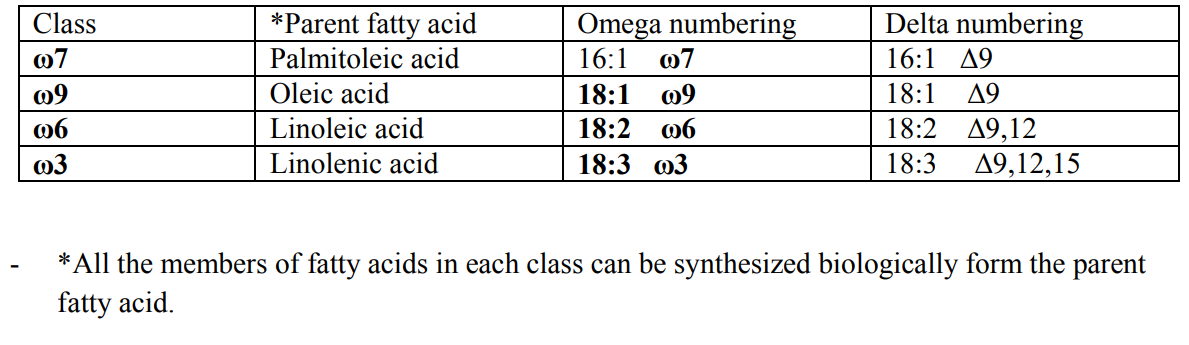
- (18:2 Δ9,12 ω6)
- Constitutes about 60-80% of total fatty acid in dietary oils as corn oil, sunflower oil, and soyabean oil.
- (18:2 Δ9,12 ω6)
- Linolenic acid
- (18:3 Δ9,12 ,15 ω3)
- Present in small amount in plant oil in association with linoleic acid, particularly present in linseed oil
- (18:3 Δ9,12 ,15 ω3)
- Arachidonic acid
- - Present in (arachis oil) Peanut oil. Present in small amount in plant oil in association with linoleic acid
- - It may not be essential to take Arachidonic acid in diet if there is an adequate supply of linoleic acid.
- - It can be synthesized inside the body from linoleic.
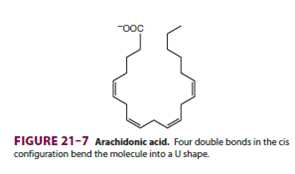
- - It contains 20 carbons contains 4 double bonds, ( so it's more kinked )
- - Its U shape is very important in fluidity of biological membrane
- - It contains 20 carbons contains 4 double bonds, ( so it's more kinked )
- - It can be synthesized inside the body from linoleic.
- - It may not be essential to take Arachidonic acid in diet if there is an adequate supply of linoleic acid.
- - Present in (arachis oil) Peanut oil. Present in small amount in plant oil in association with linoleic acid
- Linoleic acid
- They should be taken in diet for synthesis of other members of ω3,ω6 family.
- Can't be synthesized inside the body.
- The importance of essential fatty acids
- - Are used for synthesis of prostaglandins and thromboxanes (Eicosanoids)
- - Enter in cell membrane structure.
- - Lower the cholesterol level in plasma.
- - Role in growth and development
- - Role of Linolenic acid in the formation of docosahexaenoic (DHA) acid (22:6 3), DHA is needed for normal brain & retina.
- - Role in growth and development
- - Lower the cholesterol level in plasma.
- - Enter in cell membrane structure.
- - Are used for synthesis of prostaglandins and thromboxanes (Eicosanoids)
- polyunsaturated fatty acids
- other ω-3 fatty acids
- Eicosapentaenoic acid (20:5)
- Docosahexaenoic acid (22:6)
- Both are present in fish oil (Salmon) They protect from cardiovascular diseases
- Essential fatty acids
- Notes
- The double bound are always separated from each other by methylene group (-CH2-)
- They are neither adjacent nor conjugated ( not alternating with single bonds )
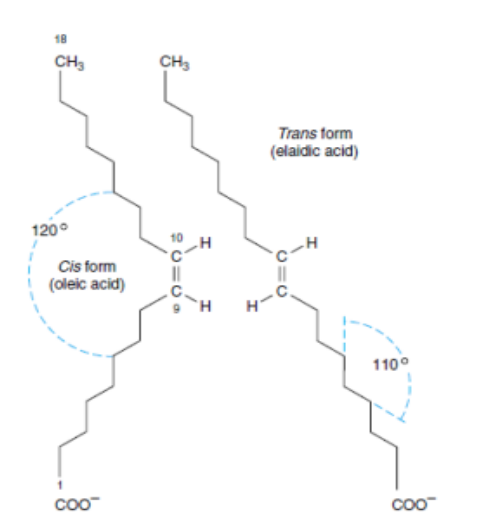
- The presence of double bound produces ( Cis-trans ) isomerism
- The melting point of fatty acid decreases if the fatty acids are shorter and have more double bonds
- Short fatty acids (up to 5C) and medium chain fatty acids (6-10C) are liquid at room temp
- Longer chain fatty acids (more than 10C) are solid at room temp.
- Parent fatty acids :
- Fatty acid numbering : اسمع المحاضرة التانية على الدرايف
- Parent fatty acids :
- Longer chain fatty acids (more than 10C) are solid at room temp.
- Short fatty acids (up to 5C) and medium chain fatty acids (6-10C) are liquid at room temp
- The melting point of fatty acid decreases if the fatty acids are shorter and have more double bonds
- Cis
- When the two bulky groups are at the same side of the bond
- - Less thermal stable, have lower melting temp
- When the two bulky groups are at the same side of the bond
- Trans
- When the two bulky groups are at the opposite side of the bond
- - More thermal stable, need high melting temp.
- - They are nearer to in properties to the corresponding saturated fatty acid.
- - They are metabolized like saturated fatty acids. So, they tend to increase cholesterol in blood.
- - They are nearer to in properties to the corresponding saturated fatty acid.
- - More thermal stable, need high melting temp.
- When the two bulky groups are at the opposite side of the bond
- The presence of double bound produces ( Cis-trans ) isomerism
- They are neither adjacent nor conjugated ( not alternating with single bonds )
- The double bound are always separated from each other by methylene group (-CH2-)
- Fatty acids in human have even number of carbon atoms. plants have odd number.
- - More than 10 : long chain
- - 5~10 : medium fatty acid
- - Up to five carbon : short chain fatty acid
- They have long straight chains Except, phytanic acid is branched.
- Fatty acids are amphipathic as it contain hydrophilic part and hydrophobic part.
- They are mono carboxylic (only one –COOH-), which is completely ionized in plasma.
- properties
- glycerol
- sphingosine
- Fatty acids
- These are produced from the hydrolysis or digestion of simple or compound lipids.
- Polyprenoid Compounds
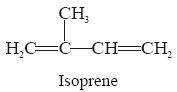
- A group of compounds which contains isoprene units
- Steroids
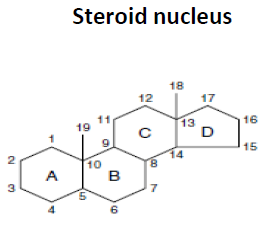
- • They are compounds that have steroid nucleus.
- Steroid nucleus is composed of 4 rings identified by A-BC- D, and formed of 19 carbons
- The OH at C3 is often esterified with unsaturated fatty acid (cholesterol ester)
- Cholesterol ester is the storage form inside the cell. Cholesterol and cholesterol ester present in animal fats not in plant fats.
- Blood cholesterol is either in free form (1/3 of total) or in ester form (2/3 of total).
- Free cholesterol is an amphipathic as it contains the OH group at C3 (hydrophilic).
- Cholesterol is an important constituent in cell membrane
- Plant sterol is ergosterol, the precursor of vitamin D2
- Bacteria do not contain sterol
- Plant sterol is ergosterol, the precursor of vitamin D2
- Cholesterol is an important constituent in cell membrane
- Free cholesterol is an amphipathic as it contains the OH group at C3 (hydrophilic).
- Blood cholesterol is either in free form (1/3 of total) or in ester form (2/3 of total).
- Cholesterol ester is the storage form inside the cell. Cholesterol and cholesterol ester present in animal fats not in plant fats.
- The OH at C3 is often esterified with unsaturated fatty acid (cholesterol ester)
- Steroid nucleus is composed of 4 rings identified by A-BC- D, and formed of 19 carbons
- Cholesterol
- precursor of
- Vitamin D
- precursor of
- Fat soluble Vitamins (EKA)
- Bile acids
- sex hormones
- adrenocortical hormones
- • They are compounds that have steroid nucleus.
- Terpenes
- in plants
- As essential oils in plants that have characteristics flavors . Example : limonene (from lemon oil)
- in plants
- Steroids
- A group of compounds which contains isoprene units
- Simple Lipids
Imágenes y archivos del mapa

Información
- Descripción
- Start From : 1- definition 2- function 3- classification (A- simple lipids B- Compound lipids C- Derived lipids D- polyprenoid ) 4- Fatty acids
- Creado por
- Ahmed Ahdmmtq
- Visitas
- 122
- Etiquetas
- Valoración