
Mapa mental
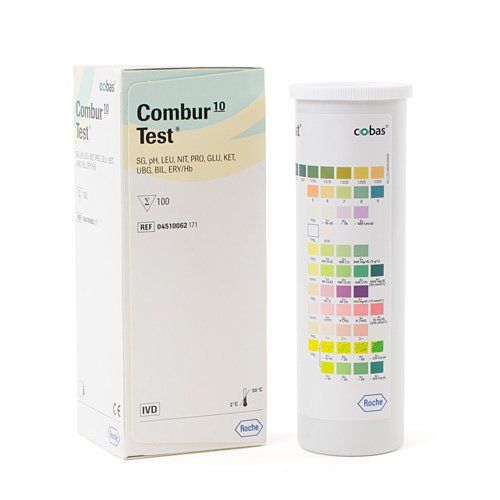
Combur 10 Test
Contenido del mapa
Combur 10 Test
SUMMARY: Urine test strips are used to measure certain constituents in urine which are significant of renal, urinary, hepatic and metabolic disorders.
Test principle
- Specific gravity: The test detects the ion concentration of the urine. In the presence of cattions, protons are released by complexing agent and produce a color change in the ndicator bromothymol blu via blue-green to yellow.
- pH: The test rpaper contains the indicators metnyl red, phenolphtalein and bromothymol blue and reacts specifically with H+-ions. The most frequent pH values of fresh urine from healthy subjects lie between 5 and 6.
- Leukocytes(LEU): the test reveals the presence of granulocyte esterases.These esterases cleave and indolyx ester, and the indolyx so liberated reacts with a diazonium salt to produce a violet dye. BActeria, trichomonas or erythrocytes present in the urine do not affect the reaction.
- Nitrite: The lest is based on the principle of the Griess test and is specific for nitrite. The reaction reveals the presence of nitrite and hence indirectly nitrite-forming bacteria in the urine by a pink to-red coloration of the test patch. Even a slight pink coloration is indicative of significant bacteriuria.
- Protein(PRO): the test is based on the principle of the protein error of a pH indicator, it is particularly sensitive to albumin. An elevated pH (up to9) does not affect the test.
- Glucose(GLU): the glucose determination is based on the specific glucose-oxidase/peroxidase reaction (GOD/POD method). The test is independent of the pH and specific gravity of the urine and is not affected by the presence of ketone bodies
- Ketones(KET): This test is based on the principle of Legal´s test and is more sensitive to acetoacetic acid than to acetone.
- Urubilinogen(UBG): A stable diazonium salt reacts almost immediately with urubilinogen to give a red azo dye. The test is specific for urubilinogen and is not susceptible to the interfering factors known to affect the Erlich´s test.
- Bilirubin(BIL): The test is based on the coupling of bilirubin with a diazonium salt. Even the slightest pink coloration constitutes a positive, i.e. pathologic, result. Other urinary constituents produce a more or less intense yellow coloration.
- Blood(ERY/Hb): the peroxidase-like action of hemoglobin and myoglobin specifically catalyzes the oxidation of the indicator by means of the organic hydroperoxide contained in the test paper to give a blue-green coloration.
Imágenes y archivos del mapa
Información
- Descripción
- Uroanalisis Mapa Mental sobre Combur 10 Test, creado por dany granda el 24/10/2017.
- Creado por
- dany granda · oct 2017
- Actualizado
- 24 oct 2017
- Visitas
- 0
- Valoración