
Mapa mental
Search for Settlement (1646 - 1649)
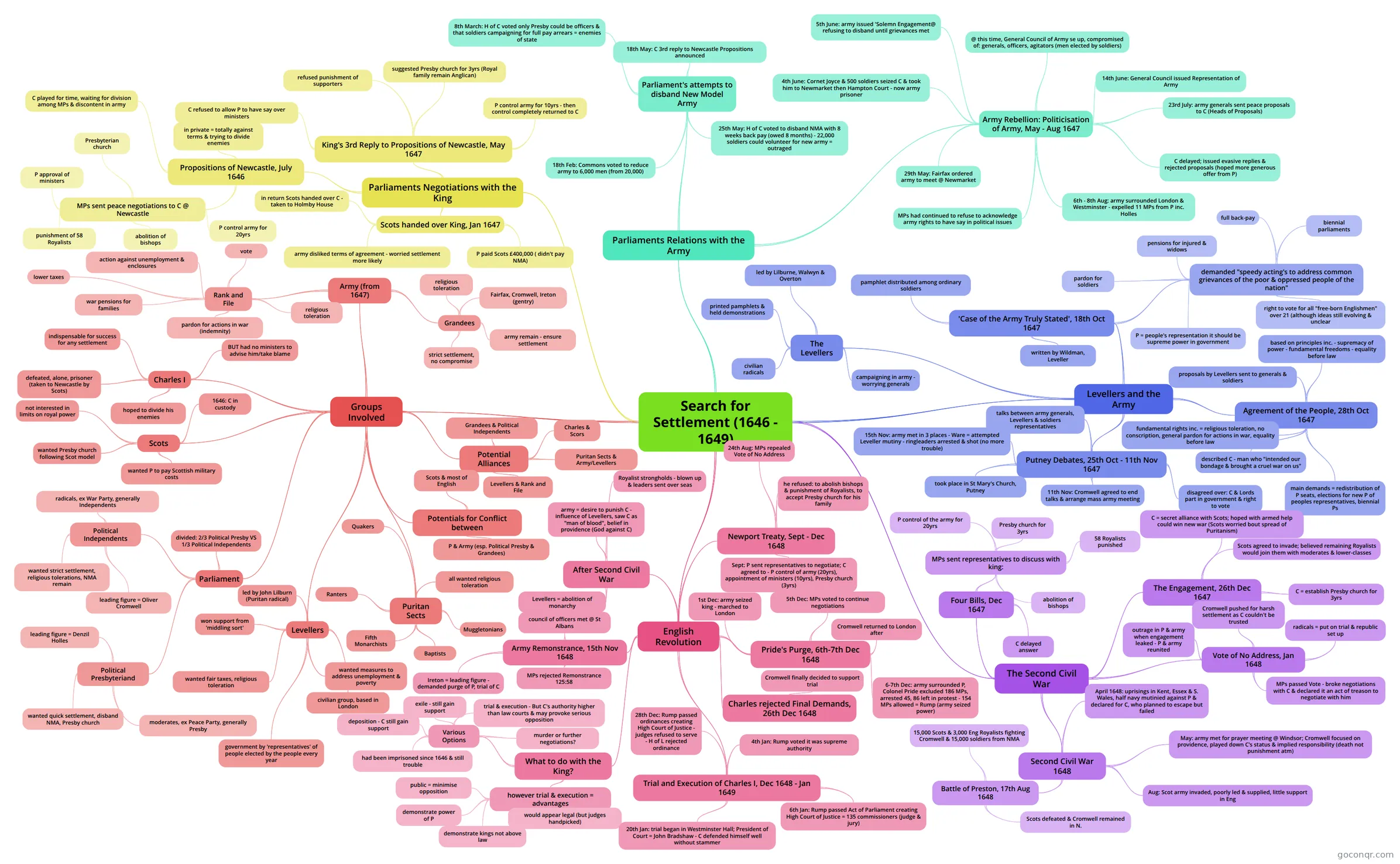
Mind map: Search for Settlement (1646 - 1649)
Contenido del mapa
Search for Settlement (1646 - 1649)
Groups Involved
- Charles I
- defeated, alone, prisoner (taken to Newcastle by Scots)
- indispensable for success for any settlement
- hoped to divide his enemies
- BUT had no ministers to advise him/take blame
- Scots
- 1646: C in custody
- wanted Presby church following Scot model
- wanted P to pay Scottish military costs
- not interested in limits on royal power
- Parliament
- divided: 2/3 Political Presby VS 1/3 Political Independents
- Political Presbyteriand
- moderates, ex Peace Party, generally Presby
- wanted quick settlement, disband NMA, Presby church
- leading figure = Denzil Holles
- Political Independents
- radicals, ex War Party, generally Independents
- wanted strict settlement, religious tolerations, NMA remain
- leading figure = Oliver Cromwell
- Army (from 1647)
- Grandees
- Fairfax, Cromwell, Ireton (gentry)
- strict settlement, no compromise
- religious toleration
- army remain - ensure settlement
- Rank and File
- pardon for actions in war (indemnity)
- war pensions for families
- lower taxes
- action against unemployment & enclosures
- religious toleration
- vote
- Grandees
- Levellers
- civilian group, based in London
- led by John Lilburn (Puritan radical)
- won support from 'middling sort'
- wanted fair taxes, religious toleration
- wanted measures to address unemployment & poverty
- government by 'representatives' of people elected by the people every year
- Puritan Sects
- Fifth Monarchists
- Baptists
- Quakers
- Ranters
- Muggletonians
- all wanted religious toleration
- Potential Alliances
- Grandees & Political Independents
- Levellers & Rank and File
- Puritan Sects & Army/Levellers
- Charles & Scors
- Potentials for Conflict between
- P & Army (esp. Political Presby & Grandees)
- Scots & most of English
- Charles I
Parliaments Negotiations with the King
- Propositions of Newcastle, July 1646
- MPs sent peace negotiations to C @ Newcastle
- P approval of ministers
- abolition of bishops
- Presbyterian church
- P control army for 20yrs
- punishment of 58 Royalists
- C played for time, waiting for division among MPs & discontent in army
- in private = totally against terms & trying to divide enemies
- MPs sent peace negotiations to C @ Newcastle
- Scots handed over King, Jan 1647
- P paid Scots £400,000 ( didn't pay NMA)
- in return Scots handed over C - taken to Holmby House
- army disliked terms of agreement - worried settlement more likely
- King's 3rd Reply to Propositions of Newcastle, May 1647
- C refused to allow P to have say over ministers
- refused punishment of supporters
- suggested Presby church for 3yrs (Royal family remain Anglican)
- P control army for 10yrs - then control completely returned to C
- Propositions of Newcastle, July 1646
Parliaments Relations with the Army
- Parliament's attempts to disband New Model Army
- 18th Feb: Commons voted to reduce army to 6,000 men (from 20,000)
- 8th March: H of C voted only Presby could be officers & that soldiers campaigning for full pay arrears = enemies of state
- 18th May: C 3rd reply to Newcastle Propositions announced
- 25th May: H of C voted to disband NMA with 8 weeks back pay (owed 8 months) - 22,000 soldiers could volunteer for new army = outraged
- Army Rebellion: Politicisation of Army, May - Aug 1647
- 29th May: Fairfax ordered army to meet @ Newmarket
- 4th June: Cornet Joyce & 500 soldiers seized C & took him to Newmarket then Hampton Court - now army prisoner
- 5th June: army issued 'Solemn Engagement@ refusing to disband until grievances met
- @ this time, General Council of Army se up, compromised of: generals, officers, agitators (men elected by soldiers)
- 14th June: General Council issued Representation of Army
- 23rd July: army generals sent peace proposals to C (Heads of Proposals)
- C delayed; issued evasive replies & rejected proposals (hoped more generous offer from P)
- 6th - 8th Aug: army surrounded London & Westminster - expelled 11 MPs from P inc. Holles
- MPs had continued to refuse to acknowledge army rights to have say in political issues
- Parliament's attempts to disband New Model Army
Levellers and the Army
- The Levellers
- civilian radicals
- led by Lilburne, Walwyn & Overton
- printed pamphlets & held demonstrations
- campaigning in army - worrying generals
- 'Case of the Army Truly Stated', 18th Oct 1647
- pamphlet distributed among ordinary soldiers
- written by Wildman, Leveller
- demanded "speedy acting's to address common grievances of the poor & oppressed people of the nation"
- pardon for soldiers
- pensions for injured & widows
- full back-pay
- biennial parliaments
- right to vote for all "free-born Englishmen" over 21 (although ideas still evolving & unclear
- P = people's representation it should be supreme power in government
- Agreement of the People, 28th Oct 1647
- proposals by Levellers sent to generals & soldiers
- based on principles inc. - supremacy of power - fundamental freedoms - equality before law
- main demands = redistribution of P seats, elections for new P of peoples representatives, biennial Ps
- fundamental rights inc. = religious toleration, no conscription, general pardon for actions in war, equality before law
- described C - man who "intended our bondage & brought a cruel war on us"
- Putney Debates, 25th Oct - 11th Nov 1647
- talks between army generals, Levellers & soldiers representatives
- took place in St Mary's Church, Putney
- disagreed over: C & Lords part in government & right to vote
- 11th Nov: Cromwell agreed to end talks & arrange mass army meeting
- 15th Nov: army met in 3 places - Ware = attempted Leveller mutiny - ringleaders arrested & shot (no more trouble)
- The Levellers
The Second Civil War
- Four Bills, Dec 1647
- MPs sent representatives to discuss with king:
- P control of the army for 20yrs
- Presby church for 3yrs
- abolition of bishops
- 58 Royalists punished
- C delayed answer
- MPs sent representatives to discuss with king:
- The Engagement, 26th Dec 1647
- C = secret alliance with Scots; hoped with armed help could win new war (Scots worried bout spread of Puritanism)
- Scots agreed to invade; believed remaining Royalists would join them with moderates & lower-classes
- C = establish Presby church for 3yrs
- Vote of No Address, Jan 1648
- outrage in P & army when engagement leaked - P & army reunited
- Cromwell pushed for harsh settlement as C couldn't be trusted
- MPs passed Vote - broke negotiations with C & declared it an act of treason to negotiate with him
- radicals = put on trial & republic set up
- Second Civil War 1648
- April 1648: uprisings in Kent, Essex & S. Wales, half navy mutinied against P & declared for C, who planned to escape but failed
- May: army met for prayer meeting @ Windsor; Cromwell focused on providence, played down C's status & implied responsibility (death not punishment atm)
- Aug: Scot army invaded, poorly led & supplied, little support in Eng
- Battle of Preston, 17th Aug 1648
- 15,000 Scots & 3,000 Eng Royalists fighting Cromwell & 15,000 soldiers from NMA
- Scots defeated & Cromwell remained in N.
- Four Bills, Dec 1647
English Revolution
- After Second Civil War
- Royalist strongholds - blown up & leaders sent over seas
- Levellers = abolition of monarchy
- army = desire to punish C - influence of Levellers, saw C as "man of blood", belief in providence (God against C)
- Newport Treaty, Sept - Dec 1648
- 24th Aug: MPs repealed Vote of No Address
- Sept: P sent representatives to negotiate; C agreed to - P control of army (20yrs), appointment of ministers (10yrs), Presby church (3yrs)
- he refused: to abolish bishops & punishment of Royalists, to accept Presby church for his family
- Pride's Purge, 6th-7th Dec 1648
- 1st Dec: army seized king - marched to London
- 5th Dec: MPs voted to continue negotiations
- 6-7th Dec: army surrounded P, Colonel Pride excluded 186 MPs, arrested 45, 86 left in protest - 154 MPs allowed = Rump (army seized power)
- Cromwell returned to London after
- Army Remonstrance, 15th Nov 1648
- council of officers met @ St Albans
- Ireton = leading figure - demanded purge of P, trial of C
- MPs rejected Remonstrance 125:58
- What to do with the King?
- Various Options
- trial & execution - But C's authority higher than law courts & may provoke serious opposition
- deposition - C still gain support
- had been imprisoned since 1646 & still trouble
- exile - still gain support
- murder or further negotiations?
- however trial & execution = advantages
- public = minimise opposition
- demonstrate power of P
- demonstrate kings not above law
- would appear legal (but judges handpicked)
- Various Options
- Charles rejected Final Demands, 26th Dec 1648
- Cromwell finally decided to support trial
- Trial and Execution of Charles I, Dec 1648 - Jan 1649
- 28th Dec: Rump passed ordinances creating High Court of Justice - judges refused to serve - H of L rejected ordinance
- 4th Jan: Rump voted it was supreme authority
- 6th Jan: Rump passed Act of Parliament creating High Court of Justice = 135 commissioners (judge & jury)
- 20th Jan: trial began in Westminster Hall; President of Court = John Bradshaw - C defended himself well without stammer
- After Second Civil War
Información
- Descripción
- Mapa Mental sobre Search for Settlement (1646 - 1649), creado por stacie.carter el 30/05/2013.
- Creado por
- stacie.carter
- Visitas
- 697
- Valoración