
Mapa mental
Chapter 6 - Materials
Contenido del mapa
Chapter 6 - Materials
Springs and Hooke's Law
- A helical spring undergoes tensile deformation when tensile forces are exerted, and compressive deformation when compressive forces are exerted
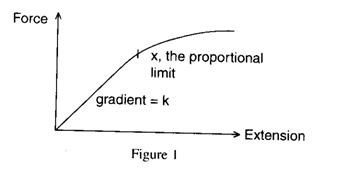
- Here is a force extension graph for a spring. The line is straight up until the elastic limit, where there is elastic deformation. The spring returns to it's original length
- Above the elastic limit, the spring undergoes plastic deformation. where there are permanent structural changes. The spring stays at permanent extension once the force is removed.
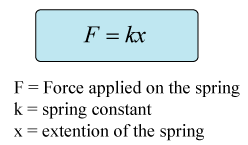
- Hookes law = The extension of the spring is directly proportional to the force applied, below the elastic limit
- The force constant k (Units Nm^-1) is a measure of stiffness of the spring, and is given by the gradient of the graph
Elastic potential energy
- If work is done below the elastic limit, the work done on the material can be fully recovered,
- However, above the elastic llimit, atoms have been moved into new permanent positions, meaning the work done is not recoverable
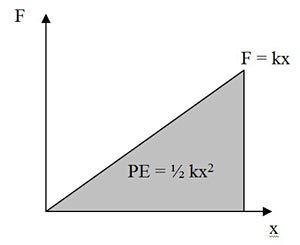
- The area underneath a force-extension graph = Work done
- Since the area under the graph is the area of a triangle, E=0.5Fx
- By using hookes law, of F=kx, another equation can also be created. E=0.5(kx)x, therefore E=0.5kx^2
- Since the area under the graph is the area of a triangle, E=0.5Fx
- If work is done below the elastic limit, the work done on the material can be fully recovered,
Deforming materials
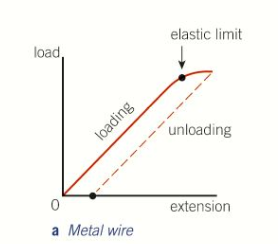
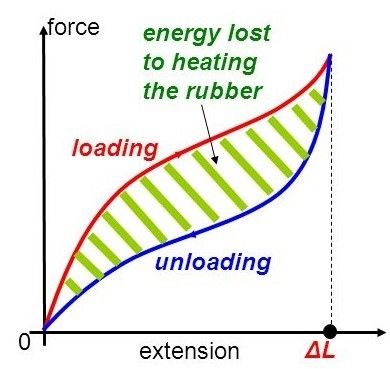
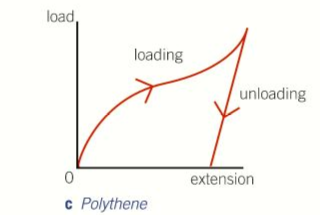
- Different materials respond differently to tensile forces, meaning the loading and unloading curves will not be the same
- METAL
- For metal, hookes law is followed until the elastic limit, meaning that the unloading curve is identical below this limit. Beyond however, there is plastic deformation and the unloading curve is parallel, with permanent extension x.
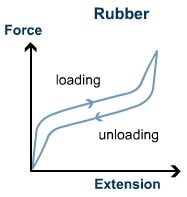
- RUBBER
- They do not obey hookes law, there is elastic deformation. The Hysterisis loop is due to differences of work done. More work is done stretching the band than unloading it. The area inside the loop is the energy released when the material is loaded then unloaded, meaning it's hotter
- POLYTHENE
- Used in plastic bags, polythene does not obey hookes law. Very easy to stretch with little force, resulting in plastic deformation
- METAL
- Different materials respond differently to tensile forces, meaning the loading and unloading curves will not be the same
Stress, Strain, and the Young Modulus
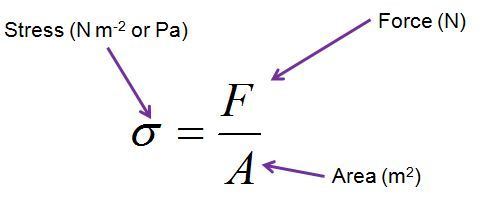
- Tensile stress (Pa) = Force applied per unit cross-sectional area
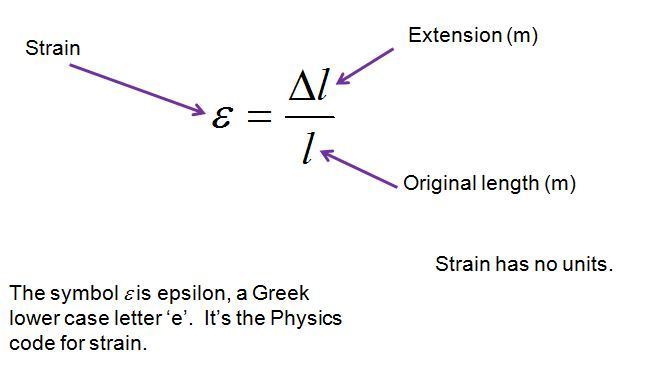
- Tensile strain (No unit's as it's a ratio) = The fractional change in the original length of the wire
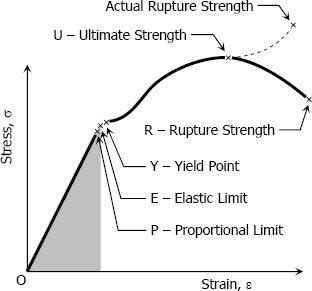
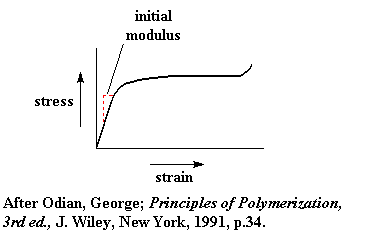
- The following is a stress-strain graph for a ductile (steel)material, i.e which can be hammered or drawn in into a wire
- Stress is directly proportional to strain until point P
- Hookes law is followed until the elastic limit E, with elastic deformation
- At the Yield points, the material extends rapidly. Non-steel materials may not have this
- Point U is the maximum stress a material withstands before it breaks. Beyond this point, necking occurs, where the steel becomes thinner and weaker
- The Rupture strength, or breaking point is when the material breaks
- Point U is the maximum stress a material withstands before it breaks. Beyond this point, necking occurs, where the steel becomes thinner and weaker
- At the Yield points, the material extends rapidly. Non-steel materials may not have this
- Hookes law is followed until the elastic limit E, with elastic deformation
- Stress is directly proportional to strain until point P
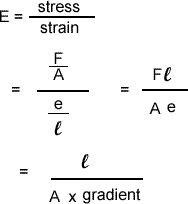
- The ratio of stress to strain is the Young modulus (Units Nm^-2), and is found by the gradient of the linear region of a stress strain graph
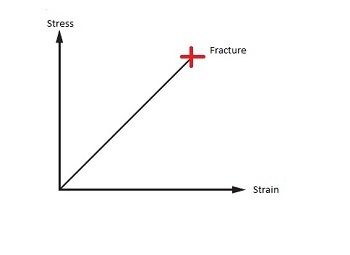
- Brittle materials experience elastic deformation until their breaking point, but polymeric (Rubber or polythene) behave differently based on temperature and structure
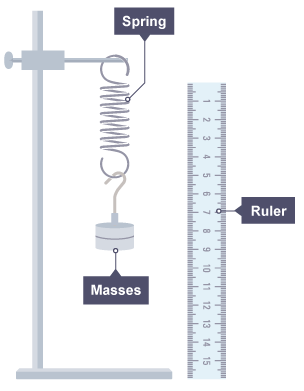
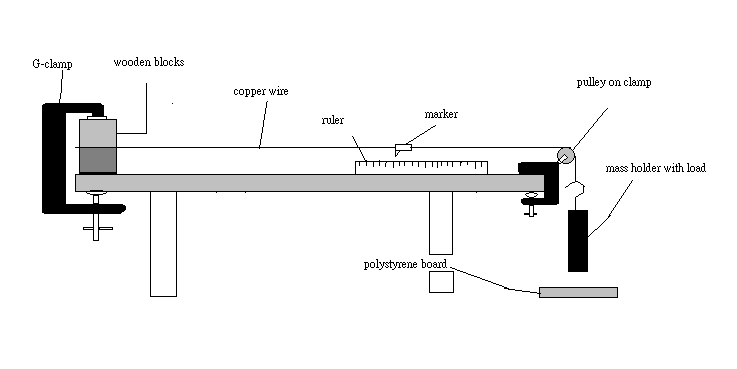
- Determining the Young modulus of a wire
- Measure Diameter d of the wire with a micrometer, to then work out C.S.A. Average measurements can improve accuracy
- The tensile force is worked out using F=mg, where m is the mass hanger and g=9.81
- After applying each mass, work out the extension change from the original length, again repeating readings
- For each load, the stress and strain values are plotted on a stress strain graph. The gradient of the linear section gives the Young modulus
- After applying each mass, work out the extension change from the original length, again repeating readings
- The tensile force is worked out using F=mg, where m is the mass hanger and g=9.81
- Measure Diameter d of the wire with a micrometer, to then work out C.S.A. Average measurements can improve accuracy
Imágenes y archivos del mapa
Información
- Descripción
- A level (6 - Materials) Physics Mapa Mental sobre Chapter 6 - Materials, creado por Kieran Lancaster el 20/12/2017.
- Creado por
- Kieran Lancaster
- Visitas
- 155
- Etiquetas
- Valoración