
Mapa mental
The Commonwealth (1649 - 1653)
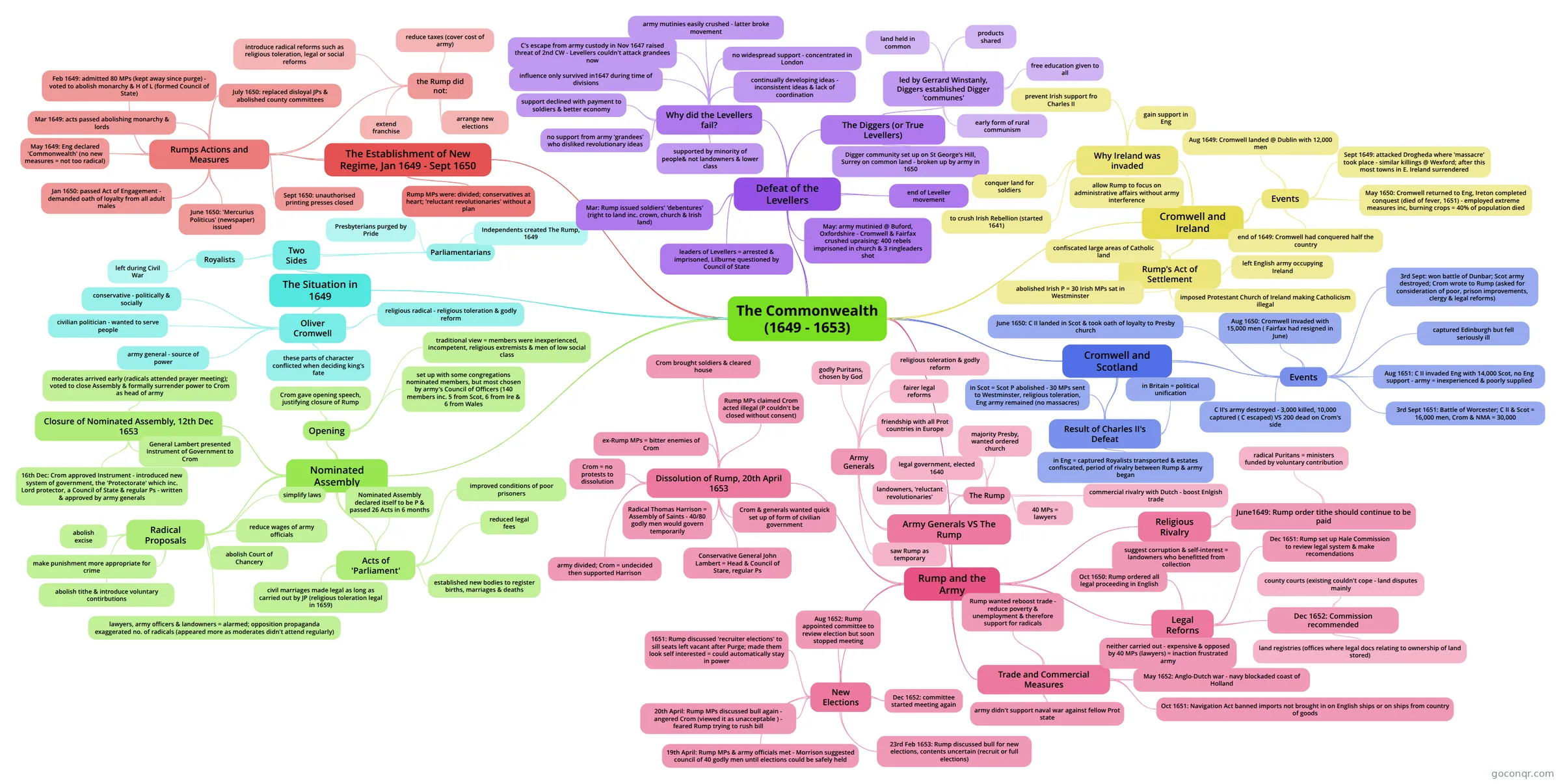
Mind map: The Commonwealth (1649 - 1653)
Contenido del mapa
The Commonwealth (1649 - 1653)
The Situation in 1649
- Two Sides
- Royalists
- left during Civil War
- Parliamentarians
- Presbyterians purged by Pride
- Independents created The Rump, 1649
- Royalists
- Oliver Cromwell
- conservative - politically & socially
- civilian politician - wanted to serve people
- religious radical - religious toleration & godly reform
- army general - source of power
- these parts of character conflicted when deciding king's fate
- Two Sides
The Establishment of New Regime, Jan 1649 - Sept 1650
- Rump MPs were: divided; conservatives at heart; 'reluctant revolutionaries' without a plan
- Rumps Actions and Measures
- Feb 1649: admitted 80 MPs (kept away since purge) - voted to abolish monarchy & H of L (formed Council of State)
- Mar 1649: acts passed abolishing monarchy & lords
- May 1649: Eng declared 'Commonwealth' (no new measures = not too radical)
- Jan 1650: passed Act of Engagement - demanded oath of loyalty from all adult males
- June 1650: 'Mercurius Politicus' (newspaper) issued
- July 1650: replaced disloyal JPs & abolished county committees
- Sept 1650: unauthorised printing presses closed
- the Rump did not:
- extend franchise
- arrange new elections
- reduce taxes (cover cost of army)
- introduce radical reforms such as religious toleration, legal or social reforms
Defeat of the Levellers
- Why did the Levellers fail?
- no widespread support - concentrated in London
- no support from army 'grandees' who disliked revolutionary ideas
- influence only survived in1647 during time of divisions
- C's escape from army custody in Nov 1647 raised threat of 2nd CW - Levellers couldn't attack grandees now
- army mutinies easily crushed - latter broke movement
- continually developing ideas - inconsistent ideas & lack of coordination
- support declined with payment to soldiers & better economy
- supported by minority of people& not landowners & lower class
- The Diggers (or True Levellers)
- led by Gerrard Winstanly, Diggers established Digger 'communes'
- land held in common
- products shared
- free education given to all
- early form of rural communism
- Digger community set up on St George's Hill, Surrey on common land - broken up by army in 1650
- led by Gerrard Winstanly, Diggers established Digger 'communes'
- Mar: Rump issued soldiers' 'debentures' (right to land inc. crown, church & Irish land)
- leaders of Levellers = arrested & imprisoned, Lilburne questioned by Council of State
- May: army mutinied @ Buford, Oxfordshire - Cromwell & Fairfax crushed upraising: 400 rebels imprisoned in church & 3 ringleaders shot
- end of Leveller movement
- Why did the Levellers fail?
Cromwell and Ireland
- Why Ireland was invaded
- to crush Irish Rebellion (started 1641)
- conquer land for soldiers
- prevent Irish support fro Charles II
- gain support in Eng
- allow Rump to focus on administrative affairs without army interference
- Events
- Aug 1649: Cromwell landed @ Dublin with 12,000 men
- Sept 1649: attacked Drogheda where 'massacre' took place - similar killings @ Wexford; after this most towns in E. Ireland surrendered
- end of 1649: Cromwell had conquered half the country
- May 1650: Cromwell returned to Eng, Ireton completed conquest (died of fever, 1651) - employed extreme measures inc, burning crops = 40% of population died
- Rump's Act of Settlement
- confiscated large areas of Catholic land
- abolished Irish P = 30 Irish MPs sat in Westminster
- imposed Protestant Church of Ireland making Catholicism illegal
- left English army occupying Ireland
- Why Ireland was invaded
Cromwell and Scotland
- Events
- June 1650: C II landed in Scot & took oath of loyalty to Presby church
- Aug 1650: Cromwell invaded with 15,000 men ( Fairfax had resigned in June)
- 3rd Sept: won battle of Dunbar; Scot army destroyed; Crom wrote to Rump (asked for consideration of poor, prison improvements, clergy & legal reforms)
- captured Edinburgh but fell seriously ill
- Aug 1651: C II invaded Eng with 14,000 Scot, no Eng support - army = inexperienced & poorly supplied
- 3rd Sept 1651: Battle of Worcester; C II & Scot = 16,000 men, Crom & NMA = 30,000
- C II's army destroyed - 3,000 killed, 10,000 captured ( C escaped) VS 200 dead on Crom's side
- Result of Charles II's Defeat
- in Scot = Scot P abolished - 30 MPs sent to Westminster, religious toleration, Eng army remained (no massacres)
- in Britain = political unification
- in Eng = captured Royalists transported & estates confiscated, period of rivalry between Rump & army began
- Events
Rump and the Army
- Army Generals VS The Rump
- Army Generals
- godly Puritans, chosen by God
- saw Rump as temporary
- religious toleration & godly reform
- fairer legal reforms
- friendship with all Prot countries in Europe
- The Rump
- landowners, 'reluctant revolutionaries'
- legal government, elected 1640
- majority Presby, wanted ordered church
- 40 MPs = lawyers
- commercial rivalry with Dutch - boost Enlgish trade
- Army Generals
- Religious Rivalry
- June1649: Rump order tithe should continue to be paid
- radical Puritans = ministers funded by voluntary contribution
- suggest corruption & self-interest = landowners who benefitted from collection
- June1649: Rump order tithe should continue to be paid
- Legal Reforns
- Oct 1650: Rump ordered all legal proceeding in English
- Dec 1651: Rump set up Hale Commission to review legal system & make recomendations
- Dec 1652: Commission recommended
- county courts (existing couldn't cope - land disputes mainly
- land registries (offices where legal docs relating to ownership of land stored)
- neither carried out - expensive & opposed by 40 MPs (lawyers) = inaction frustrated army
- Trade and Commercial Measures
- Rump wanted reboost trade - reduce poverty & unemployment & therefore support for radicals
- Oct 1651: Navigation Act banned imports not brought in on English ships or on ships from country of goods
- May 1652: Anglo-Dutch war - navy blockaded coast of Holland
- army didn't support naval war against fellow Prot state
- New Elections
- 1651: Rump discussed 'recruiter elections' to sill seats left vacant after Purge; made them look self interested = could automatically stay in power
- Aug 1652: Rump appointed committee to review election but soon stopped meeting
- Dec 1652: committee started meeting again
- 23rd Feb 1653: Rump discussed bull for new elections, contents uncertain (recruit or full elections)
- 20th April: Rump MPs discussed bull again - angered Crom (viewed it as unacceptable ) - feared Rump trying to rush bill
- 19th April: Rump MPs & army officials met - Morrison suggested council of 40 godly men until elections could be safely held
- Dissolution of Rump, 20th April 1653
- Crom brought soldiers & cleared house
- Rump MPs claimed Crom acted illegal (P couldn't be closed without consent)
- ex-Rump MPs = bitter enemies of Crom
- Crom = no protests to dissolution
- Crom & generals wanted quick set up of form of civilian government
- Radical Thomas Harrison = Assembly of Saints - 40/80 godly men would govern temporarily
- Conservative General John Lambert = Head & Council of Stare, regular Ps
- army divided; Crom = undecided then supported Harrison
- Army Generals VS The Rump
Nominated Assembly
- Opening
- set up with some congregations nominated members, but most chosen by army's Council of Officers (140 members inc. 5 from Scot, 6 from Ire & 6 from Wales
- traditional view = members were inexperienced, incompetent, religious extremists & men of low social class
- Crom gave opening speech, justifying closure of Rump
- Acts of 'Parliament'
- Nominated Assembly declared itself to be P & passed 26 Acts in 6 months
- established new bodies to register births, marriages & deaths
- civil marriages made legal as long as carried out by JP (religious toleration legal in 1659)
- improved conditions of poor prisoners
- reduced legal fees
- Radical Proposals
- abolish Court of Chancery
- simplify laws
- make punishment more appropriate for crime
- abolish excise
- reduce wages of army officials
- abolish tithe & introduce voluntary contirbutions
- lawyers, army officers & landowners = alarmed; opposition propaganda exaggerated no. of radicals (appeared more as moderates didn't attend regularly)
- Closure of Nominated Assembly, 12th Dec 1653
- moderates arrived early (radicals attended prayer meeting); voted to close Assembly & formally surrender power to Crom as head of army
- General Lambert presented Instrument of Government to Crom
- 16th Dec: Crom approved Instrument - introduced new system of government, the 'Protectorate' which inc. Lord protector, a Council of State & regular Ps - written & approved by army generals
- Opening
Información
- Descripción
- Mapa Mental sobre The Commonwealth (1649 - 1653), creado por stacie.carter el 01/06/2013.
- Creado por
- stacie.carter
- Visitas
- 158
- Valoración