
Mapa mental
Physics Topic 1- Motion and Forces
Contenido del mapa
Physics Topic 1- Motion and Forces
Vector Quantities
- Vector quantities have both magnitude and an associated direction
- Examples of vector quantities
- Force
- Weight
- Displacement
- Velocity
- Acceleration
- Momentum
Motion
- Speed= Distance/ Time
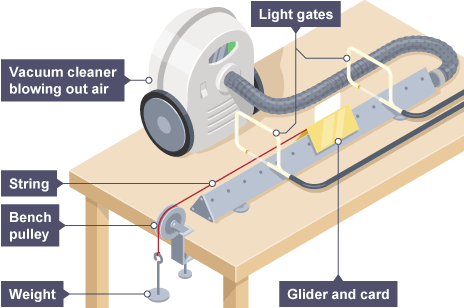
- Speed measurement practicals
- Ruler and stopwatch- Ruler measures distance travelled, stopwatch measures time taken
- Light gates- Size of object measured with ruler, light gate connects to a timer which gives the reading
- Video analysis- Distance moved from frame to frame observed on a ruler in the pictures, time between frames is known
- Acceleration= change in velocity/ time taken
- (final velocity) squared- (initial velocity) squared = 2 x acceleration x distance
- An object will only accelerate if a resultant force acts on it
- Gravitational attraction provides the centripetal force needed to keep a planet in orbit around the Sun
Scalar Quantites
- Scalar quantities only have a magnitude or size
- Examples of scalar quantities
- Temperature
- Mass
- Energy
- Distance
- Speed
- Density
Newtons Laws
- First law of motion- an object remains in the same state of motion unless a resultant force acts on it
- If the forces acting on an object are balanced, the resultant force is zero
- Second law of motion- resultant force= mass x acceleration
- The ratio of force over acceleration is called inertial mass. Inertial mass is a measure of how difficult it is to change the velocity of an object
- Practical
- Third law of motion- every action has an equal or opposite reaction
- Weight= mass x gravitational field strength
- First law of motion- an object remains in the same state of motion unless a resultant force acts on it
Momentum
- Momentum = mass x velocity
- In a closed system (not affected by external forces) total momentum before an event = total momentum after an event
- Force= change in momentum/ time taken
Motion of Vehicles
- Stopping distance= thinking distance+ breaking distance
- Reaction time- ruler drop test
- When a force is applied to the breaks of a vehicle, there is work done by the friction between the breaks and the wheel. This reduces the kinetic energy of the vehicle.
- Kinetic energy = 0.5 x mass x (velocity) squared
- Work Done= Kinetic Energy
Imágenes y archivos del mapa
Información
- Descripción
- GCSE Physics Mapa Mental sobre Physics Topic 1- Motion and Forces, creado por Ellie James el 19/03/2018.
- Creado por
- Ellie James
- Visitas
- 397
- Etiquetas
- Valoración