
Mapa mental
Designing a Multimeter
Contenido del mapa
Designing a Multimeter
Functions
- Frequency Counter
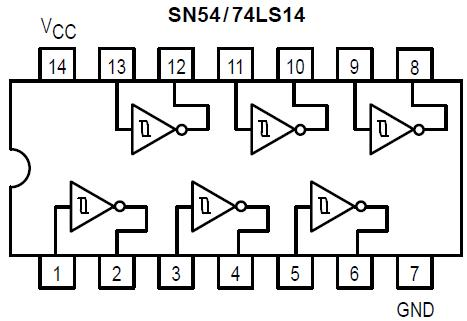
- Use of Schmitt trigger inverter (datasheet below) allows for measurement of triangular and sinusoidal waves
- Could display periodic time alongside frequency
- Max frequency limited by the hardware , ~30 MHz is typical max for digital electronics - warning must be coded in for when frequency exceeds this
- Code should recognise when to display Hz, kHz, MHz
- Multiple possibilities for measuring periodic time
- Option 2: Measure time spent at logic high and add to time spent at logic low
- Option 1: Start timer the instant logic high is reached, stop when reached again
- Average of 6 or 7 frequency values calculated for accuracy, regardless of method
- Voltmeter
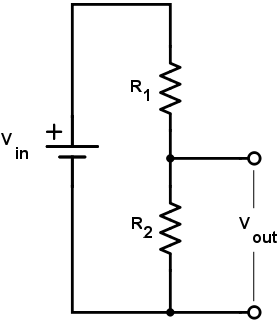
- Voltage limit of board is 3.3 V - use potential divider circuit to scale down
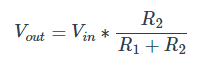
- Ratio of R1 to R2 is known - determines scale factor
- May be possible to share this circuit with ohmmeter to cut down on space/cost?
- Voltage measured in parallel - use probes
- Must measure voltage up to ±15 V
- Voltage limit of board is 3.3 V - use potential divider circuit to scale down
- Ohmmeter
- Known resistor can be varied depending on order of magnitude of unknown resistor - implements autoranging feature
- Resistance measured through a material
- Use potential divider circuit
- Resistor ratio unknown, voltage in/out ratio known
- Has to measure from 10 Ω to 10 MΩ
- Capacitance Meter
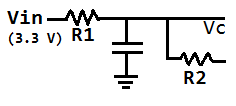
- R2 = 220 Ohms - to limit current into Nucleo
- Must measure capacitance from nanofarad to microfarad range
- Code should account for order of magnitude when displaying capacitance
- Could average out multiple readings for greater accuracy provided charge times aren't too long
- Functions based on RC time constant - 63.2% charged at 1 τ and C = R/τ
- Resistance of circuit is known, time constant found by using timer() function
- Vc monitored consistently - could display charge status on LCD for user?
- R1 is multiple resistors in parallel - autoranging depending on capacitance
- Display
- LCD used as more information can be displayed in smaller space
- LCD allows for more legible display of units
- Backlight requires its own 220 ohm resistor
- Requires ~8 digital pins among others - may necessitate multiplexing
- Codes in development can be trialled on serial monitor until LCD has been obtained and soldered
- Frequency Counter
Other aspects to consider
- Safety
- Reject high voltage inputs, display a warning which states max input
- Keep positive and negative potential leads as far away from each other as design allows
- Insert fuse/circuit breaker to protect circuit from excess current and overheating
- Insulate entire multimeter from its surroundings
- Protect against voltage spikes (transients) - double insulated leads
- Precision
- Scaling of voltage for circuits which increase voltage swing or shift the high/low logic level
- Margins of error must be scaled with voltage
- Known resistances - factor in resistances of wires, ADC converter and any other components used
- Factor in losses in voltage across components, energy dissipated through resistors and through heat loss
- Double insulated wires might make the heat losses negligible
- Calibrate instrument using known multimeter
- Scaling of voltage for circuits which increase voltage swing or shift the high/low logic level
- Team Organisation
- Also divide based on preference where possible
- Divide tasks based on expertise
- Break tasks down into key ideas
- Business Case
- Demand for this instrument from technicians in electrical/electronic industries
- Used to repair household/industrial appliances
- Industrial/commercial troubleshooting, installation, maintenance etc
- Troubleshoots a wide variety of measurement parameters
- Building your own is a cheap alternative to buying a mid-upper range multimeter
- Could sell as kit and market to students
- Essential tool in technology-reliant society, but faces crowded market
- Lacks features available in other multimeters...
- Bluetooth/smartphone connectivity
- Ammeter
- Wireless screens
- Compact/industrial size
- Added functionality/larger ranges drive up cost - less marketable
- Lacks features available in other multimeters...
- Demand for this instrument from technicians in electrical/electronic industries
- Lifecycle
- Must comply with Restriction of Hazardous Substances - 10 restricted substances cannot be used
- Could offer lifetime guarantee on product
- Sell in case that makes it shockproof, waterproof, dustproof etc
- Lifetime guarantee raises manufacturing and therefore retail cost
- Adding fuses and other safety measures to protect against misuse raises price but prolongs life of the product
- 9 million tonnes of electrical and electronic waste in 2005 according to WEEE - needs to be reduced
- Design a product with warranty
- WEEE offers free collection at collection centres
- Must handle disposal of product responsibly when it cannot be used anymore
- Cost
- Have multifunctional circuits where possible - fewer components = cheaper
- Cost of soldering connections should be considered
- Limited memory in microcontroller - concise code so that extra memory is not required
- Tradeoffs occur between cost and...
- Resistor tolerance
- Conversely, a more precise multimeter has a higher retail value to offset manufacturing cost
- Range that can be measured
- Size
- Safety (once regulations are met)
- Resistor tolerance
- Safety
Imágenes y archivos del mapa


Información
- Descripción
- Mapa Mental sobre Designing a Multimeter, creado por Laura Lynch el 19/03/2018.
- Creado por
- Laura Lynch
- Visitas
- 0
- Valoración