
Mapa mental
Nerve impulses; action potential
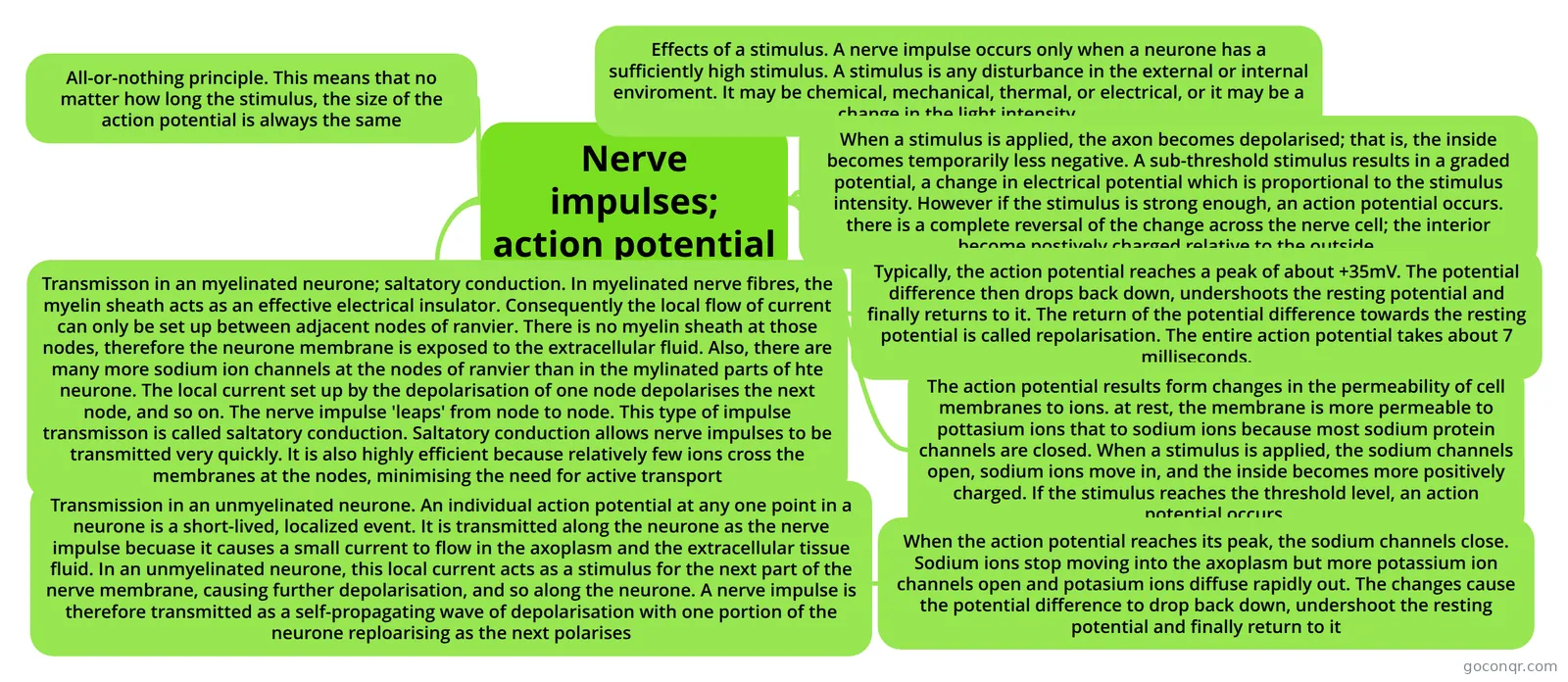
Mind map: nerve impulses and action potential
Contenido del mapa
Nerve impulses; action potential
Effects of a stimulus. A nerve impulse occurs only when a neurone has a sufficiently high stimulus. A stimulus is any disturbance in the external or internal enviroment. It may be chemical, mechanical, thermal, or electrical, or it may be a change in the light intensity.
When a stimulus is applied, the axon becomes depolarised; that is, the inside becomes temporarily less negative. A sub-threshold stimulus results in a graded potential, a change in electrical potential which is proportional to the stimulus intensity. However if the stimulus is strong enough, an action potential occurs. there is a complete reversal of the change across the nerve cell; the interior become postively charged relative to the outside.
Typically, the action potential reaches a peak of about +35mV. The potential difference then drops back down, undershoots the resting potential and finally returns to it. The return of the potential difference towards the resting potential is called repolarisation. The entire action potential takes about 7 milliseconds.
The action potential results form changes in the permeability of cell membranes to ions. at rest, the membrane is more permeable to pottasium ions that to sodium ions because most sodium protein channels are closed. When a stimulus is applied, the sodium channels open, sodium ions move in, and the inside becomes more positively charged. If the stimulus reaches the threshold level, an action potential occurs.
When the action potential reaches its peak, the sodium channels close. Sodium ions stop moving into the axoplasm but more potassium ion channels open and potasium ions diffuse rapidly out. The changes cause the potential difference to drop back down, undershoot the resting potential and finally return to it
Transmission in an unmyelinated neurone. An individual action potential at any one point in a neurone is a short-lived, localized event. It is transmitted along the neurone as the nerve impulse becuase it causes a small current to flow in the axoplasm and the extracellular tissue fluid. In an unmyelinated neurone, this local current acts as a stimulus for the next part of the nerve membrane, causing further depolarisation, and so along the neurone. A nerve impulse is therefore transmitted as a self-propagating wave of depolarisation with one portion of the neurone reploarising as the next polarises
Transmisson in an myelinated neurone; saltatory conduction. In myelinated nerve fibres, the myelin sheath acts as an effective electrical insulator. Consequently the local flow of current can only be set up between adjacent nodes of ranvier. There is no myelin sheath at those nodes, therefore the neurone membrane is exposed to the extracellular fluid. Also, there are many more sodium ion channels at the nodes of ranvier than in the mylinated parts of hte neurone. The local current set up by the depolarisation of one node depolarises the next node, and so on. The nerve impulse 'leaps' from node to node. This type of impulse transmisson is called saltatory conduction. Saltatory conduction allows nerve impulses to be transmitted very quickly. It is also highly efficient because relatively few ions cross the membranes at the nodes, minimising the need for active transport
All-or-nothing principle. This means that no matter how long the stimulus, the size of the action potential is always the same
Información
- Descripción
- A-Levels (Nerves and Muscles) Biology 5 Mapa Mental sobre Nerve impulses; action potential, creado por harry_bygraves el 13/06/2013.
- Creado por
- harry_bygraves
- Visitas
- 236
- Etiquetas
- Valoración