
Mapa mental
Integration Techniques
Contenido del mapa
Integration Techniques
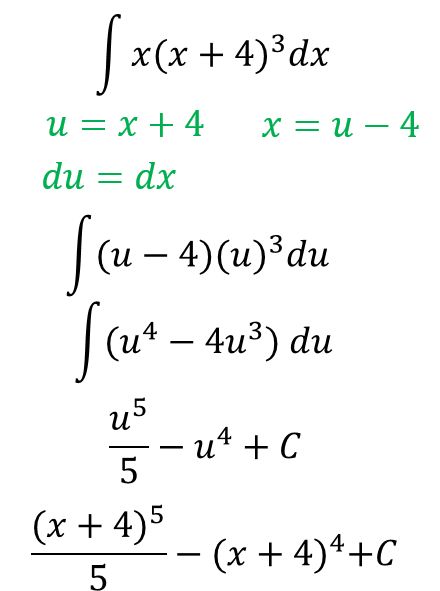
Double Substitution / Change of Variable
- When to use it
- Not able to apply the integration rules directly
- The degree of the variable of the coefficient is the same or bigger than the one of u
- Substituting dx with u'du does not cancel the coefficient of u
- Steps
- 1. Identify u, find du, and solve for dx
- 2. Using the equation of u, solve for the variable in the coefficient to rewrite that variable in terms of u
- 3. Rewrite the integral in terms of u, including the variable in the coefficient
- 4. Use algebra if needed (distributive property) and integrate using the basic rules of integration
- 3. Rewrite the integral in terms of u, including the variable in the coefficient
- 2. Using the equation of u, solve for the variable in the coefficient to rewrite that variable in terms of u
- 1. Identify u, find du, and solve for dx
- Definition
- It is a method used by rewriting the variable in the coefficient of u, in terms of u in order to integrate a function
- When to use it
Partial Fractions
- When to use it
- When the numerator of the fraction is not the derivative of the denominator
- When the natural logarithmic rule of integration cannot be used
- Steps
- 1. Factorize the denominator in all the factors possible.
- 2. The decomposition of the fraction consists of knowing that fraction is equivalent to the sum of fractions consisting of a constant over of each of the factors of the denominator.
- 3. You need to place each of the factors in a denominator and assign a letter to each of the constants that will act as numerators of each partial fraction.
- 4. If one of the factors contains multiplicity, it is necessary to place the factor the times of the degree of its multiplicity. It means that if you have (x+1)^3 as a factor, you will have to write 3 different denominators of the same factor, from degree 1 to degree 3
- 5. After making your original fraction equal to your partial fractions, it is necessary to multiply both sides by the denominator in order to remain with the numerator being equal to factors multiplying each letter of your numerators (canceling the denominator of each letter)
- 6. Having this equation the goal is to assign different values to your variable in order to cancel all but one of the letters (by making the coefficients equal to 0) and find the value of each of them. Sometimes you will need to use the values of letters previously found in order to find the value of the remaining letters.
- 7. When all the numerator letter values are found, you need to rewrite the decomposition of the original fraction with the recently found values of each numerator and follow on to integrate with the basic rules.
- 6. Having this equation the goal is to assign different values to your variable in order to cancel all but one of the letters (by making the coefficients equal to 0) and find the value of each of them. Sometimes you will need to use the values of letters previously found in order to find the value of the remaining letters.
- 5. After making your original fraction equal to your partial fractions, it is necessary to multiply both sides by the denominator in order to remain with the numerator being equal to factors multiplying each letter of your numerators (canceling the denominator of each letter)
- 4. If one of the factors contains multiplicity, it is necessary to place the factor the times of the degree of its multiplicity. It means that if you have (x+1)^3 as a factor, you will have to write 3 different denominators of the same factor, from degree 1 to degree 3
- 3. You need to place each of the factors in a denominator and assign a letter to each of the constants that will act as numerators of each partial fraction.
- 2. The decomposition of the fraction consists of knowing that fraction is equivalent to the sum of fractions consisting of a constant over of each of the factors of the denominator.
- 1. Factorize the denominator in all the factors possible.
- Definition
- When the integral is a fraction where the numerator is not the derivative of the denominator, it is necessary to decompose the fraction into partial fractions to fully integrate it.
- When the integral is a fraction where the numerator is not the derivative of the denominator, it is necessary to decompose the fraction into partial fractions to fully integrate it.
- When to use it
Integration by Parts
- Definition
- It is the method used to integrate 2 functions being multiplied together by multiplying one function being differentiated with the other one being integrated
- It is the method used to integrate 2 functions being multiplied together by multiplying one function being differentiated with the other one being integrated
- Steps
- 1. Identify u and dv in the integral.
- u is selected by using the nemotechnique rule called LATE (the first ones is always the one you should select)
- Logarithmic Algebraic Trigonometric Exponential
- 2. With u and dv find du and v by differentiating u and integrating dv
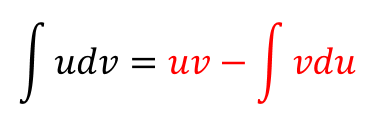
- 3. Place u, du, v, dv in the formula of integration by parts (see image)
- 4. Simplify and solve the substitution
- 3. Place u, du, v, dv in the formula of integration by parts (see image)
- u is selected by using the nemotechnique rule called LATE (the first ones is always the one you should select)
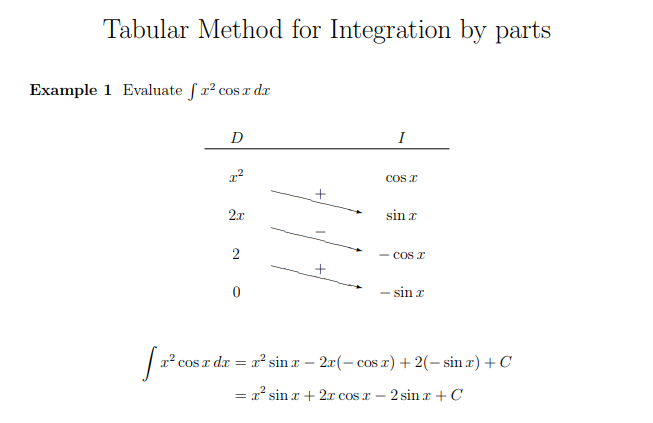
- Tabular Method
- 1. Choose your u and dv
- 2. Make a table with 2 columns one for the derivatives of u and the other one for the integrals of dv
- 3. First, differentiate u until you reach 0, placing each derivative as a new row in the u column (include 0 as the last row)
- 4. Then, taking the number of rows given by the derivatives, integrate dv until you reach the row of 0 in the derivatives of u. As in the last step, place each integral in each row.
- 5. Now you will have to multiplicate diagonally the du times the v. Starting with the original u times the first integral of dv and ending with the last derivative before 0 times the last integral
- 6. The sign of the product should alternate each time. Starting with a positive sign then negative, then positive and so on.
- 7. The addition of all these products is the answer to the original integral
- 7. The addition of all these products is the answer to the original integral
- 6. The sign of the product should alternate each time. Starting with a positive sign then negative, then positive and so on.
- 5. Now you will have to multiplicate diagonally the du times the v. Starting with the original u times the first integral of dv and ending with the last derivative before 0 times the last integral
- 4. Then, taking the number of rows given by the derivatives, integrate dv until you reach the row of 0 in the derivatives of u. As in the last step, place each integral in each row.
- 3. First, differentiate u until you reach 0, placing each derivative as a new row in the u column (include 0 as the last row)
- 2. Make a table with 2 columns one for the derivatives of u and the other one for the integrals of dv
- 1. Choose your u and dv
- 1. Identify u and dv in the integral.
- When to use it
- When you cannot use u substitution to fully integrate
- When the product includes other type of function rather than algebraic ones
- Definition
Alejandro Figueroa Cruz A01176945
Imágenes y archivos del mapa

Información
- Descripción
- Mapa Mental sobre Integration Techniques, creado por Alex Figueroa el 19/04/2018.
- Creado por
- Alex Figueroa
- Visitas
- 3
- Valoración