
Mapa mental
S48442 DEFECTS IN SOLIDS
Contenido del mapa
S48442 DEFECTS IN SOLIDS
: means any deviation of the ideally perfect crystal from the periodic arrangement of its constituents.
- Point Defects
- Stoichiometric defects
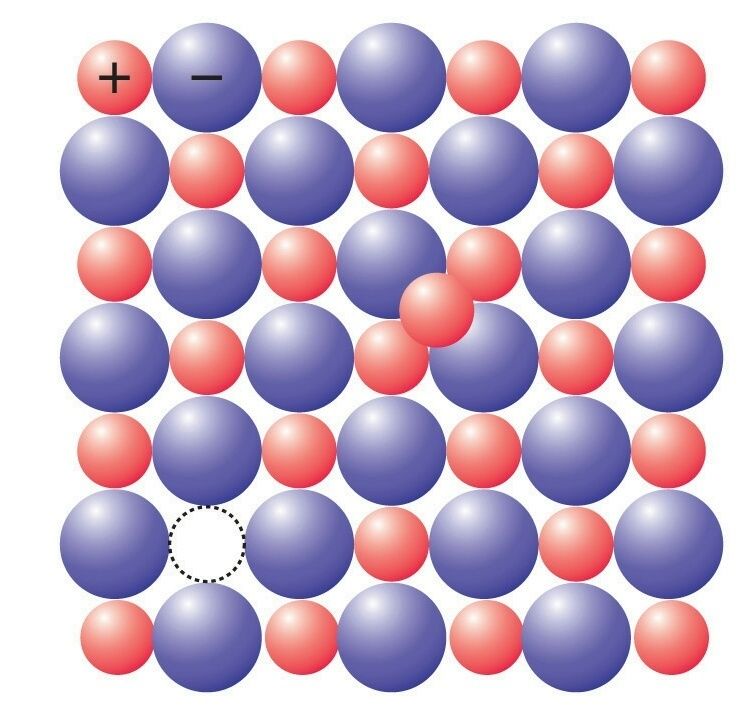
- Frenkel defects
- If an ion is missing from its correct lattice sites (causing a vacancy or a hole) and occupies an interstitial site, electrical neutrality as well as stoichiometry of the compounds are maintained.
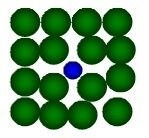
- Interstitial defects
- When some constituent particles (atoms or molecules) occupy an interstitial site
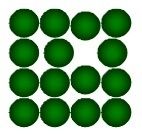
- Vacancy defects
- When some of the lattice sites are vacant
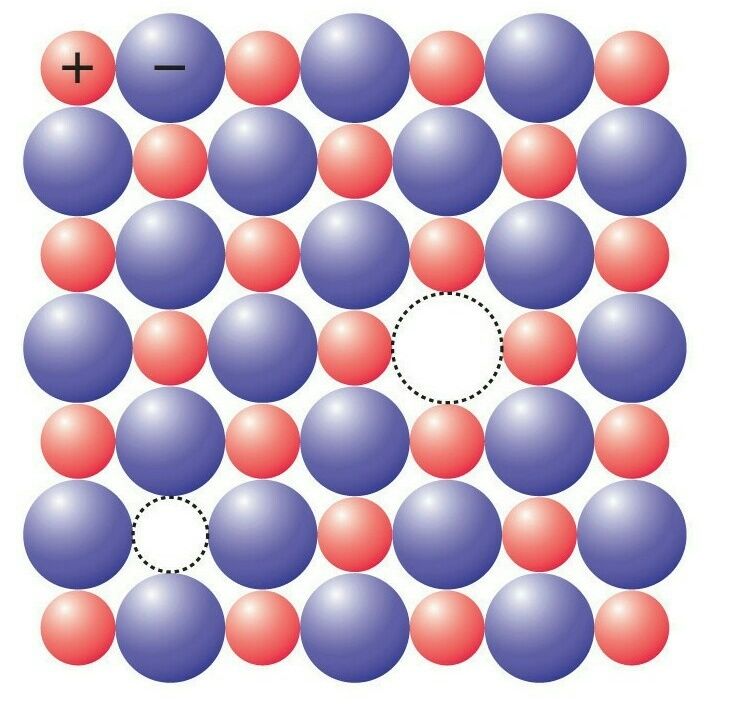
- Schottky defects
- If in an ionic crystal of the type A+ B-, equal number of cations and anions are missing from their lattice.
- Frenkel defects
- Non-Stoichiometric defects
- Metal Deficiency Defect
- Cation Vacancies
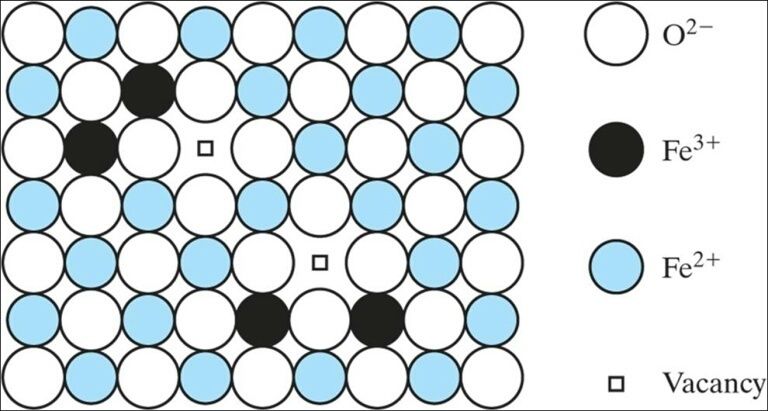
- In some cases, the positive ions may be missing from their lattice sites. The extra negative charge may be balanced by some nearby metal ion acquiring two positive charges instead of one.
- Extra anions occupying interstitial sites
- In the case, the extra anions may be occupying interstitial positions. The extra negative charge is balanced by the extra charges on the adjacent metal ions.
- Cation Vacancies
- Metal Excess Defect
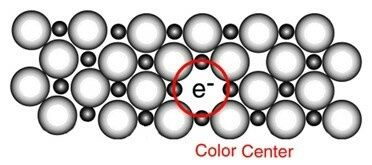
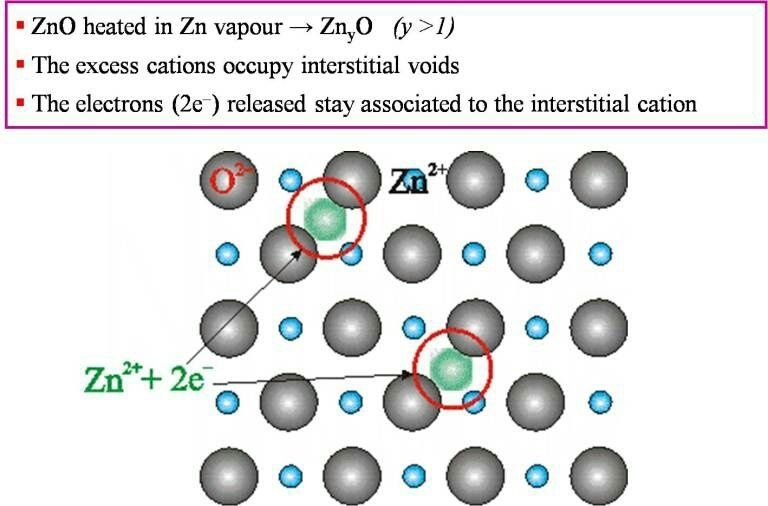
- In this case, negative ions may be missing from their lattice sites leaving holes in which the electrons remain entrapped to maintain the electrical neutrality.
- Metal Deficiency Defect
- Impurity defects
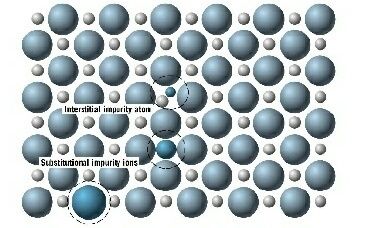
- Foreign atoms that replace some of the atoms making up the solid or that squeeze into the interstices
- Stoichiometric defects
- Linear Defects : Dislocations
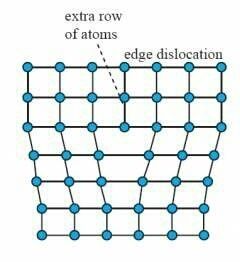
- Edge Dislocations
- The edge defect can be easily visualized as an extra half-plane of atoms in a lattice.
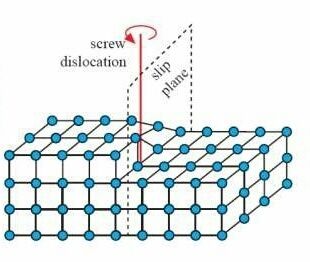
- Screw Dislocations
- The motion of a screw dislocation is also a result of shear stress, but the defect line movement is perpendicular to direction of the stress and the atom displacement, rather than parallel
- Edge Dislocations
- Surface defects
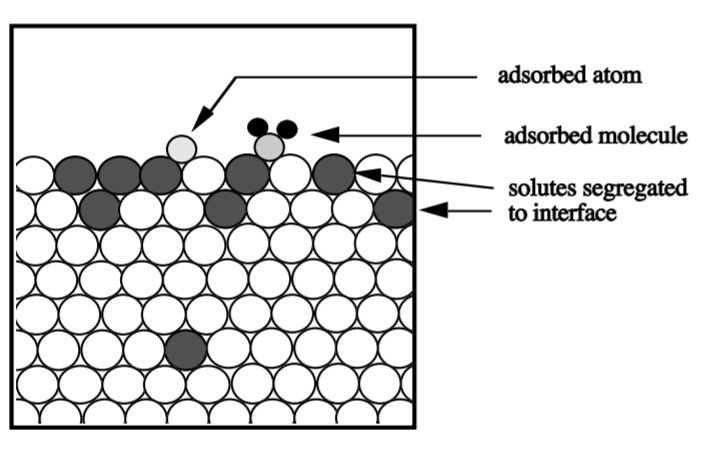
- Free surfaces
- The structure of the surface is derived from the pattern of atomic packing on the crystal plane that lies parallel to the surface, and the behavior of the surface can often be inferred from that pattern
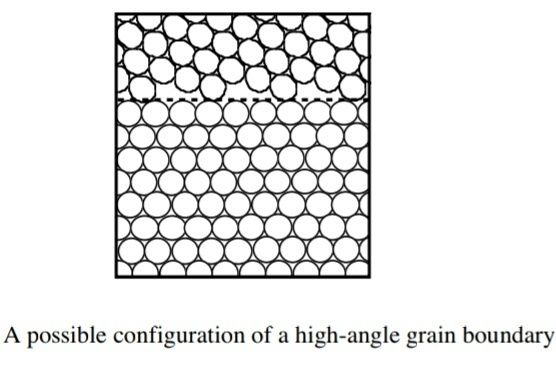
- Interfaces between crystals - Grain boundaries
- The structure of a grain boundary depends on the misorientation of the crystal grains that it separates. When the misorientation is small the boundary, which is then called a low-angle boundary, is a reasonably simple planar array of dislocations.
- Free surfaces
- Volume defects
- Three dimensional aggregates of atoms or vacancies.
- Point Defects
Imágenes y archivos del mapa
Información
- Descripción
- NUR SHAHIRA BINTI ADNAN (S48442)
- Creado por
- Shahira Adnan
- Visitas
- 240
- Etiquetas
- Valoración