
Mapa mental
AS Chemistry Unit 1 Periodic Trends
Contenido del mapa
AS Chemistry Unit 1 Periodic Trends
Nuclear Charge
- Increases across a period as there are more electrons being added to the outer shells.
- The nuclear charge of a group is the same because in a group they all have the same number of electrons on their outer shells.
Atomic Radius
- Increases down a group because more shells are being added to the atom making the radius bigger.
- Decreases across a period because the electron attraction is increasing, pulling the electrons closer together.
Electron Shielding
- Stays the same across a period as the electrons are being put in the same shell.
- Increases down a group as more shells are added.
Nuclear Attraction
- Increases across a period because the atomic radius gets smaller and the nuclear charge increases.
- Decreases down a group due to the increased atomic radius, so there is more shielding.
Ionisation Energy
- Decreases down a group because the atomic radius increases therefore the electron shielding increases so the nuclear attraction decreases.
- Increases across a period because the atomic radius decreases therefore the nuclear attraction is increasing, this makes it harder to remove an electron.
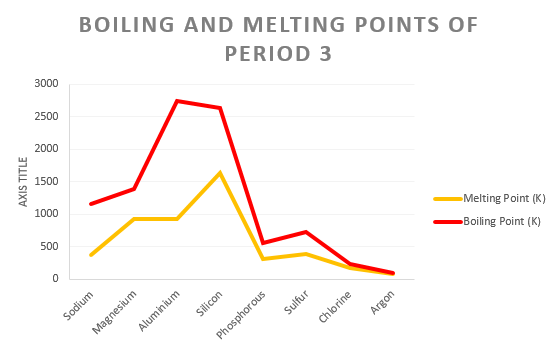
Melting and Boiling Points
- Giant Metallic Lattice
- High Boiling and Melting Point that increases with charge (1+ to 3+)
- Giant Covalent Lattice
- High Boiling and Melting Point
- Simple Molecular Structures
- Low Boiling and Melting Point that increases with the amount of molecules it attracts (e.g Oxygen being diatomic (O2)).
- Period 3 Example
- Giant Metallic Lattice
Periodic Table
- Arranged in order of the number of protons (atomic number)
- 7 Periods
- 8 Groups
Imágenes y archivos del mapa
Información
- Descripción
- A Levels OCR Chemistry A Mapa Mental sobre AS Chemistry Unit 1 Periodic Trends, creado por awesome.lois el 27/11/2014.
- Creado por
- awesome.lois
- Visitas
- 50
- Valoración