
Mapa mental
AQA Physics 3 - Medical Applications of Physics
Contenido del mapa
AQA Physics 3 - Medical Applications of Physics
Medical Applications of Physics
- X-Rays
- High frequency & Short wavelength.
- Properties: - affect photographic paper the same way as light - absorbed by metal/bone - transmitted by soft, healthy tissue
- Often used in hospitals to check for fractures and dental problems.
- Some soft-tissue body organs can be filled with a contrast medium that absorbs x-rays.
- X-rays cause ionisation and damage living tissue when it passes through.
- Workers wear film badges so they know if they roughly how much they have been exposed to, or they can wear lead aprons.
- Even though x-rays can cause cancer, they can also treat cancerous tumours at or near the surface of the body.
- CT Scanners use X-Rays, they produce 3D images on a computer but are also much more expensive to make and run.
- Ultrasound
- Human ear can detect between 50Hz and 20,000Hz
- Anything above 20,000Hz is called Ultrasound
- Can be used for diagnosis and treatment eg. Baby scanning
- Non-ionising, so it's safer than x-rays
- Ultrasound waves can be produced electronically for things such as fishing boats
- Part of the wave is reflected at a boundary between two different materials.
- Wave then travels back to a detector.
- The time it takes to reach the detector can be used to calculate how far away the boundary is.
- Using the equation: S = v x t. Where v is the speed of the ultrasound wave in s.
- Note that is may be double the correct distance as the wave will have travelled from the computer and back again.
- The time it takes to reach the detector can be used to calculate how far away the boundary is.
- Wave then travels back to a detector.
- Part of the wave is reflected at a boundary between two different materials.
- Human ear can detect between 50Hz and 20,000Hz
- Refractive Index
- The measure of how much a substance can refract a light ray.
- n= sin i / sin r
- n - refractive index
- sin i - sine angle of incidence sinr - sine angle of refraction
- n - refractive index
- n= sin i / sin r
- Refraction takes place due to the change in speed of the wave as it crosses a boundary.
- A light ray travelling along the normal is not refracted
- The measure of how much a substance can refract a light ray.
- The Endoscope / Total Internal Reflection
- When a light ray crosses from glass to air, it refracts away from the normal and a partially refracted ray is seen.
- If the angle of incidence is increased, the angle of refraction increases until the light ray refracts along the boundary.
- The angle of incidence at which this happens is the critical angle.
- If the angle of incidence is increased, the angle of refraction increases until the light ray refracts along the boundary.
- If the angle of incidence is increased above the critical angle, the light ray undergoes total internal reflection.
- When this occurs the angle of reflection is equal to the angle of incidence.
- n = 1 /sin c
- n = refractive index
- sinc = sine critical angle
- Endoscope contains many fibre optics (thin, flexible, glass wires). Used to see inside the body.
- Visible light rays can be sent along these by total internal reflection.
- ONLY HAPPENS WHEN RAY IS TRAVELLING FROM MORE DENSE TO LESS DENSE MATERIAL
- When a light ray crosses from glass to air, it refracts away from the normal and a partially refracted ray is seen.
- Lenses
- Converging Lens
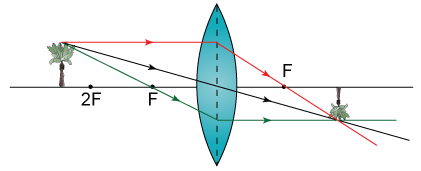
- Refracts two parallel rays to a point (the principal focus)
- Distance from principal focus to centre of the lens is the focal length.
- There is a principal focus on both sides of the lens.
- If the object is further from the lens than the principal focus it forms an - inverted - real image
- If the object is closer than the principal focus it forms an - upright - virtual image behind the object.
- This image is magnified.
- Magnification = image height / object height
- This image is magnified.
- If the object is closer than the principal focus it forms an - upright - virtual image behind the object.
- Refracts two parallel rays to a point (the principal focus)
- Diverging Lens
- Refracts two parallel rays away from a point (the principal focus)
- Centre of the lens to principal focus is the focal length.
- Image produces is ALWAYS virtual.
- Principal focus on both sides of the lens.
- Refracts two parallel rays away from a point (the principal focus)
- Converging Lens
- Using Lenses
- Use ray diagrams to find the image that different lenses produce with different objects and positions.
- Line 1 - Parallel to axis, refracted through F
- Line 2 - Passes straight through the centre of the lens
- Line 3 - Passes through F, refracted parallel to the axis.
- Line 2 - Passes straight through the centre of the lens
- The Eye
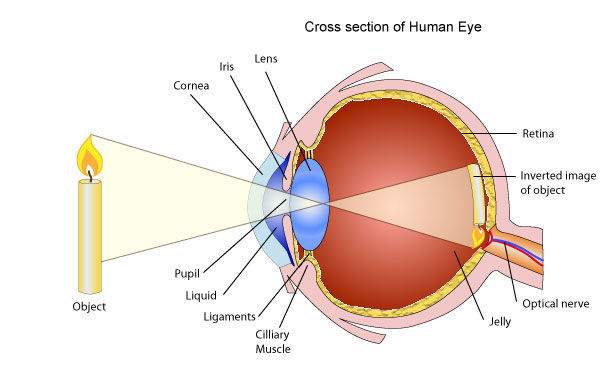
- Light enters the eye through the cornea.
- The cornea and the eye lens focus the light onto the retina.
- Iris adjusts the size of the pupil to control the amount of light entering.
- Ciliary muscles adjust the thickness of the lens to control focusing.
- Attached to the lens by suspensory ligaments.
- The cornea and the eye lens focus the light onto the retina.
- Normal human eye has a near point of 25cm and a far point of infinity. This is the range of vision.
- Lens Power
- P = 1/f
- Power = dioptres (D)
- Focal Length (m)
- Power = dioptres (D)
- P = 1/f
- Short Sightedness
- See close objects clearly but distance is blurred.
- Use diverging lens to correct sight.
- Because image is formed in front of the retina.
- See close objects clearly but distance is blurred.
- Long Sightedness
- See distance objects but close up is blurred.
- Use converging lens to correct sight.
- Because image is formed behind the retina.
- See distance objects but close up is blurred.
- The higher the refractive index used as glasses, the flatter and thinner the lens can be.
- Light enters the eye through the cornea.
- X-Rays
Imágenes y archivos del mapa
Información
- Descripción
- GCSE Physics Mapa Mental sobre AQA Physics 3 - Medical Applications of Physics, creado por 10jgorman el 14/02/2015.
- Creado por
- 10jgorman
- Visitas
- 351
- Etiquetas
- Valoración