
Mapa mental
Glycoconjugates
Contenido del mapa
Glycoconjugates
Glycopeptide
- Are peptides that contain carbohydrate moieties (glycans) covalently attached to the side chains of the amino acid residues that constitute the peptide.
- Play important roles in fertilization,the immune system, brain development, the endocrine system, and inflammation.
- The synthesis of glycopeptides provides biological probes for researchers to elucidate glycan function in nature and products that have useful therapeutic and biotechnological application.
- Glycopeptide linkage variety: N-Linked glycans, O-Linked glycans, C-Linked glycans
- The synthesis of glycopeptides provides biological probes for researchers to elucidate glycan function in nature and products that have useful therapeutic and biotechnological application.
- Play important roles in fertilization,the immune system, brain development, the endocrine system, and inflammation.
- Are peptides that contain carbohydrate moieties (glycans) covalently attached to the side chains of the amino acid residues that constitute the peptide.
Glycoprotein
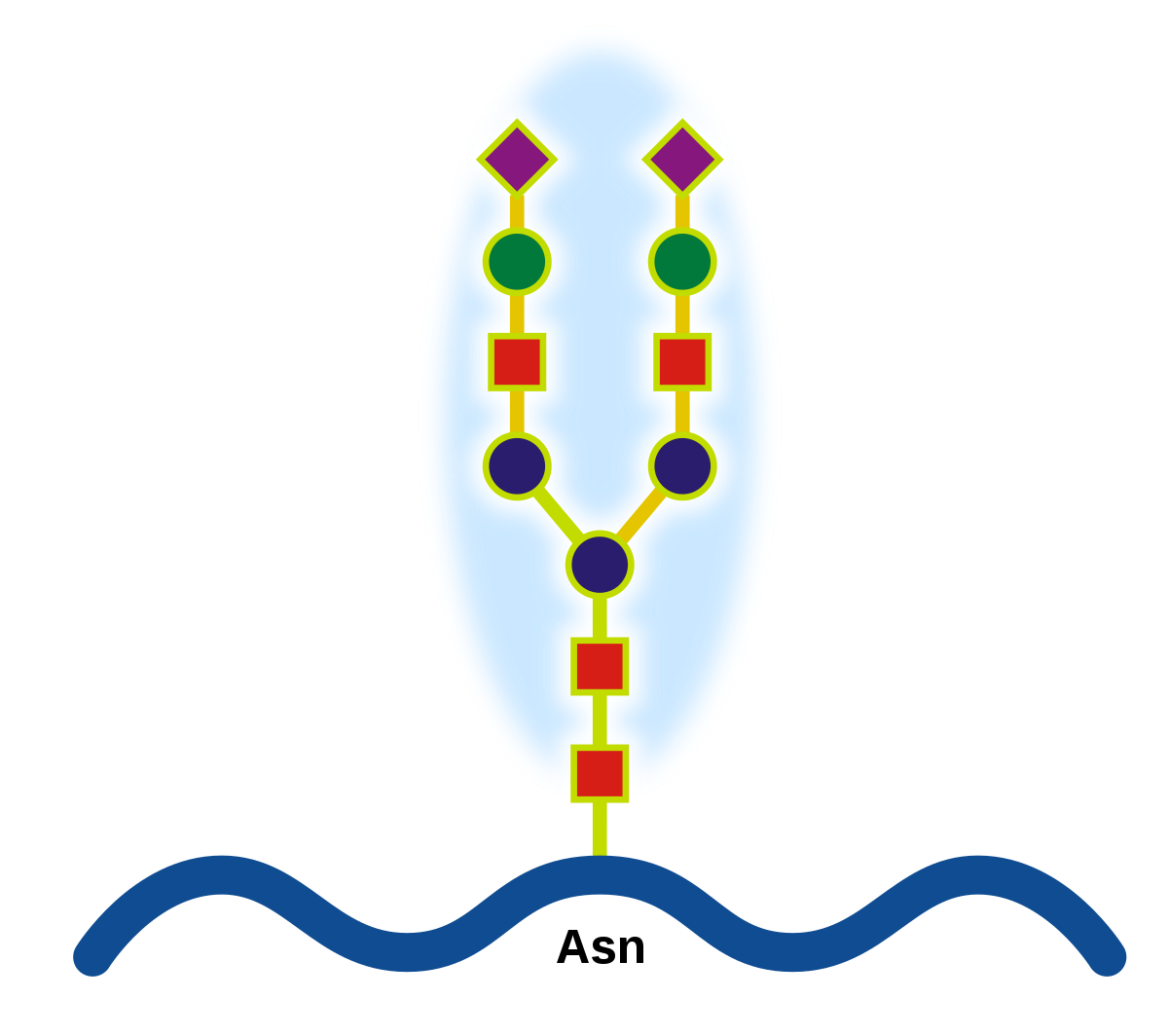
- Are proteins which contain oligosaccharide chains (glycans) covalently attached to amino acid side-chains. The carbohydrate is attached to the protein in a cotranslational or posttranslational modification. This process is known as glycosylation. Secreted extracellular proteins are often glycosylated
- In proteins that have segments extending extracellularly, the extracellular segments are also often glycosylated. Glycoproteins are also often important integral membrane proteins, where they play a role in cell–cell interactions.
- Hormones: that are glycoproteins include: Follicle-stimulating hormone Luteinizing hormone Thyroid-stimulating hormone Human chorionic gonadotropin Alpha-fetoprotein Erythropoietin (EPO)
- Types of glycosylation: There are several types of glycosylation, although the first two are the most common. In N-glycosylation, O-glycosylation,P-glycosylation, C-glycosylation, S-glycosylation.
- Distinguish endoplasmic reticulum-based glycosylation of the secretory system from reversible cytosolic-nuclear glycosylation
- Glycoproteins of the cytosol and nucleus can be modified through the reversible addition of a single GlcNAc residue that is considered reciprocal to phosphorylation and the functions of these are likely to be additional regulatory mechanism that controls phosphorylation-based signalling.
- Distinguish endoplasmic reticulum-based glycosylation of the secretory system from reversible cytosolic-nuclear glycosylation
- Types of glycosylation: There are several types of glycosylation, although the first two are the most common. In N-glycosylation, O-glycosylation,P-glycosylation, C-glycosylation, S-glycosylation.
- Hormones: that are glycoproteins include: Follicle-stimulating hormone Luteinizing hormone Thyroid-stimulating hormone Human chorionic gonadotropin Alpha-fetoprotein Erythropoietin (EPO)
- In proteins that have segments extending extracellularly, the extracellular segments are also often glycosylated. Glycoproteins are also often important integral membrane proteins, where they play a role in cell–cell interactions.
- Are proteins which contain oligosaccharide chains (glycans) covalently attached to amino acid side-chains. The carbohydrate is attached to the protein in a cotranslational or posttranslational modification. This process is known as glycosylation. Secreted extracellular proteins are often glycosylated
Glycolipid
- Are lipids with a carbohydrate attached by a glycosidic bond. It has a crucial to the immune response and in the connections that allow cells to connect to one another to form tissues.
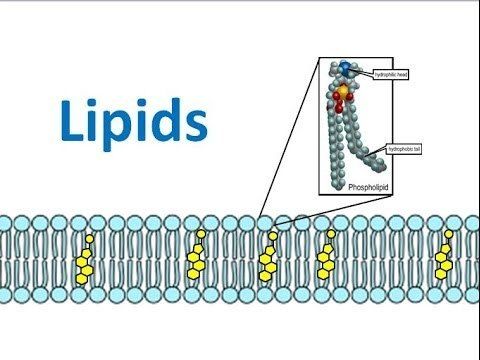
- Glycolipids are found on the surface of all eukaryotic cell membranes, in the phospholipid bilayer into the extracellular environment.
- The essential feature of a glycolipid is the presence of a monosaccharide or oligosaccharide bound to a lipid moiety.
- Metabolism: Glycosyltransferases and Glycoside hydrolases.
- Type of glycolipids: Glyceroglycolipids: a sub-group of glycolipids characterized by an acetylated or non-acetylated glycerol with at least one fatty acid as the lipid complex. Glyceroglycolipids are often associated with photosynthetic membranes and their functions. The subcategories of glyceroglycolipids depend on the carbohydrate attached.Galactolipids and Sulfolipid. Glycosphingolipids: a sub-group of glycolipids based on sphingolipids. Glycosphingolipids are mostly located in nervous tissue and are responsible for cell signaling. Cerebrosides, Gangliosides, globosides, Glycophosphosphingolipids and Glycophosphatidylinositols.
- A Glycoside is a molecule in which a sugar is bound to another functional group via a glycosidic bond. Glycosides play numerous important roles in living organisms. Many plants store chemicals in the form of inactive glycosides. These can be activated by enzyme hydrolysis, which causes the sugar part to be broken off, making the chemical available for use.
- Classification: By glycone/presence of sugar, By type of glycosidic bond, By aglycone: Alcoholic glycosides, Anthraquinone glycosides, Coumarin glycosides, etc.
- A Glycoside is a molecule in which a sugar is bound to another functional group via a glycosidic bond. Glycosides play numerous important roles in living organisms. Many plants store chemicals in the form of inactive glycosides. These can be activated by enzyme hydrolysis, which causes the sugar part to be broken off, making the chemical available for use.
- Type of glycolipids: Glyceroglycolipids: a sub-group of glycolipids characterized by an acetylated or non-acetylated glycerol with at least one fatty acid as the lipid complex. Glyceroglycolipids are often associated with photosynthetic membranes and their functions. The subcategories of glyceroglycolipids depend on the carbohydrate attached.Galactolipids and Sulfolipid. Glycosphingolipids: a sub-group of glycolipids based on sphingolipids. Glycosphingolipids are mostly located in nervous tissue and are responsible for cell signaling. Cerebrosides, Gangliosides, globosides, Glycophosphosphingolipids and Glycophosphatidylinositols.
- Metabolism: Glycosyltransferases and Glycoside hydrolases.
- The essential feature of a glycolipid is the presence of a monosaccharide or oligosaccharide bound to a lipid moiety.
- Glycolipids are found on the surface of all eukaryotic cell membranes, in the phospholipid bilayer into the extracellular environment.
- Are lipids with a carbohydrate attached by a glycosidic bond. It has a crucial to the immune response and in the connections that allow cells to connect to one another to form tissues.
Synthesis
- Glycolipid synthesis
- Glycolipids are glycoconjugates where sugars are covalently bonded to lipids. They have a natural ability to self-insert in cell membranes and have similar biological behavior as the other glycoconjugates.
- Glycolipids can be classified like oglycerolipids, glycophosphatidylinositols and glycosphingolipids. Many techniques of synthesis have been used.
- Chemoenzymatic approach has been reported recently by Stübs and co-workers for the synthesis of cholesteryl 6-O-acyl-β-D- galactopyranoside (ACGal). .
- Glycolipid is a specific and highly prevalent antigen frequently recognized by antibodies in late-stage Lyme disease (LD) .
- Has been synthesized β- galactosylceramide and glycolipid analogues by reaction of α-iodo glycosides with stannyl ceramides in the presence of TBAI as an activator. There is the low yield in the direct glycosylation of ceramides due to the low nucleophilicity of ceramides.
- Glycolipid is a specific and highly prevalent antigen frequently recognized by antibodies in late-stage Lyme disease (LD) .
- Chemoenzymatic approach has been reported recently by Stübs and co-workers for the synthesis of cholesteryl 6-O-acyl-β-D- galactopyranoside (ACGal). .
- Glycolipids can be classified like oglycerolipids, glycophosphatidylinositols and glycosphingolipids. Many techniques of synthesis have been used.
- Glycolipids are glycoconjugates where sugars are covalently bonded to lipids. They have a natural ability to self-insert in cell membranes and have similar biological behavior as the other glycoconjugates.
- Glycoprotein synthesis
- Natural glycoproteins are expressed as mixtures of glycoforms, they has the same protein backbone, but differ in the oligosaccharide components and sites of glycosylation. Different glycosylations behave differently.
- There is an inherent size limitation associated with glycoproteins synthesis.
- Segment condensation methods, have been used successfully to access to large glycoprotein structures.
- There is an inherent size limitation associated with glycoproteins synthesis.
- Natural glycoproteins are expressed as mixtures of glycoforms, they has the same protein backbone, but differ in the oligosaccharide components and sites of glycosylation. Different glycosylations behave differently.
- Glycopeptide synthesis
- Is made through the well-established methods of solid- phase peptide chemistry.
- The Cu(I)-catalyzed 1,3-dipolar cycloaddition reaction between azidoglycosides and acetylenic amino acids form triazole- linked glycopeptides.
- The oxazolines were used like ion intermediate formed during the transfer reaction. The N-linked triazole resembles the amide linkage of natural N-glycopeptides.
- Is important on the future design and synthesis of triazoles as amide isosteres, to obtain novel peptidomimetics with increased properties.
- There is a sistem for conversion of cysteine to serine residue after conventional NCL, expanding the application of NCL in glycopeptide synthesis.
- Is important on the future design and synthesis of triazoles as amide isosteres, to obtain novel peptidomimetics with increased properties.
- The oxazolines were used like ion intermediate formed during the transfer reaction. The N-linked triazole resembles the amide linkage of natural N-glycopeptides.
- The Cu(I)-catalyzed 1,3-dipolar cycloaddition reaction between azidoglycosides and acetylenic amino acids form triazole- linked glycopeptides.
- Is made through the well-established methods of solid- phase peptide chemistry.
- Because of multiple functional groups, carbohydrates can assemble linear or branch polymer structures. The monomeric units can be coupled by two linkages. The complexity can be functional to the hydroxyls groups ditional and to the synthesis of saccharides which needs protection/deprotection steps. Also is necessary mask hydroxyls groups to the formation of glycosides.
- There are 2 strategies can be used to synthesis of glycoconjugates. First, is the formation of the glycan-aglycone link by assembly of protected glycosylated building blocks.
- The second is a convergent approach in which building blocks are built independently and after is crated the link. This form gives instability to the glycosidic bond.
- There are 2 strategies can be used to synthesis of glycoconjugates. First, is the formation of the glycan-aglycone link by assembly of protected glycosylated building blocks.
- Glycolipid synthesis
Peptidoglycan
- Is a polymer consisting of sugars and amino acids that forms a mesh-like layer outside the plasma membrane of most bacteria, forming the cell wall.
- The sugar component consists of alternating residues of β-(1,4) linked N-acetylglucosamine (NAG) and N-acetylmuramic acid (NAM). Attached to the N-acetylmuramic acid is a peptide chain of three to five amino acids. The peptide chain can be cross-linked to the peptide chain of another strand forming the 3D mesh-like layer. Peptidoglycan serves a structural role in the bacterial cell wall, giving structural strength, as well as counteracting the osmotic pressure of the cytoplasm. Peptidoglycan is also involved in binary fission during bacterial cell reproduction.
- Stucture: The peptidoglycan layer in the bacterial cell wall is a crystal lattice structure formed from linear chains of two alternating amino sugars, namely N-acetylglucosamine (GlcNAc or NAGA) and N-acetylmuramic acid (MurNAc or NAMA).
- Biosynthesis: The peptidoglycan monomers are synthesized in the cytosol and are then attached to a membrane carrier bactoprenol. Bactoprenol transports peptidoglycan monomers across the cell membrane where they are inserted into the existing peptidoglycan.
- Stucture: The peptidoglycan layer in the bacterial cell wall is a crystal lattice structure formed from linear chains of two alternating amino sugars, namely N-acetylglucosamine (GlcNAc or NAGA) and N-acetylmuramic acid (MurNAc or NAMA).
- The sugar component consists of alternating residues of β-(1,4) linked N-acetylglucosamine (NAG) and N-acetylmuramic acid (NAM). Attached to the N-acetylmuramic acid is a peptide chain of three to five amino acids. The peptide chain can be cross-linked to the peptide chain of another strand forming the 3D mesh-like layer. Peptidoglycan serves a structural role in the bacterial cell wall, giving structural strength, as well as counteracting the osmotic pressure of the cytoplasm. Peptidoglycan is also involved in binary fission during bacterial cell reproduction.
- Is a polymer consisting of sugars and amino acids that forms a mesh-like layer outside the plasma membrane of most bacteria, forming the cell wall.
¿What is?
- Are relevant in biology. They are carbohydrates of varying size and complexity, covalently linked to non-sugar molecules like proteins, peptides and lipids. It has several functions in different biological processes. Especially the sugar portions which play al role in recognition.It are very complex and send biological messages.
Imágenes y archivos del mapa
Información
- Descripción
- Mapa Mental sobre Glycoconjugates, creado por Isabella Rojas el 13/10/2020.
- Creado por
- Isabella Rojas
- Visitas
- 0
- Valoración