
Mapa mental
4.2: Circular motion and oscillations
Contenido del mapa
4.2: Circular motion and oscillations
One radian - is the angle subtended at the centre of a circle by an arc of length equal to the circle's radius.
The period T - of of an object in circular motion is the time taken to complete one revolution. It's related to the speed v and radius r by equation: v = 2πr/T
- v = 2πr/T
A car going around a corner at constant speed is changing velocity because the direction of the velocity is changing, although its magnitude remains the constant. Vectors are needed to calculate numerical value for change in velocity.
Centripetal acceleration - The CA, a, of an object travelling in a circle of radius r, with constant speed v, is given by: a = v²/r
- CA - direction towards the centre of the circle
- a = v²/r
F = ma
- F = mv²/r
- T = mv²/r
- Tension = Force
- T = mv²/r
- F = mv²/r
Centripetal force - The resultant force on a object, acting towards the centre of the circle causing it to move in a circular path. Given by F = mv²/r
Examples of circular motion
- 1) ball on a string
- Smooth friction surface, circular path r and the force provided is through the tension in the string.
- T = mv²/r
- Smooth friction surface, circular path r and the force provided is through the tension in the string.
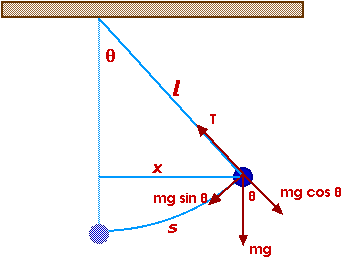
- 2) A pendulum
- Same as string with no frictional surface
- tanθ = v²/Rg
- g = a = 9.81ms
- tanθ = v²/Rg
- Same as string with no frictional surface
- 3) Theme park ride
- When a person is at the top of the ride, the weight is directed towards the centre of the circle. So accelertion = weight + contact force.
- When at bottom, weight acts in the opposite direction to acceleration. Therefore due to the centripetal force being of the same magnitude anywhere on the ride, the contact force of the seat must be greater. So contact force = centripetal force + weight.
- When a person is at the top of the ride, the weight is directed towards the centre of the circle. So accelertion = weight + contact force.
- 1) ball on a string
Gravitational field strength
- Field - A field is the region in which a force operates
- Gravitational field strength - The force acting per unit mass at any point.
- g = F/m
- The relationship of GFS and accelaration at free fall due to gravity are both equal to 9.81. However the difference is that they have different unit. GFS = Nkg^-1 and free fall = 9.81ms^-1.
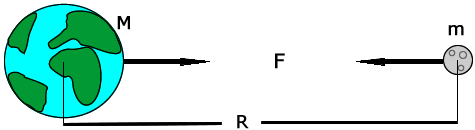
Newtons law of gravitation
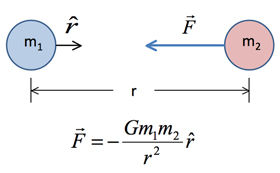
- The gravitational force of attraction between two bodies is directly proportional to the product of their masses and inversely proportional to the square of the distance between them.
- F = -GMm/r²
- minus sign only used to establish it is an attractive force, unlike magnetic that attract and repel.
- Large r, larger distance by squared amount. So triple radius means 1/9th of gravitational force on a object.
- F = -GMm/r²
- g = GM/r²
- Satellites
- Rotating around the Earth due to its distance from Earth.
- Kepler's third law
- T² is proportional to the r^3
- The period (T) squared of a planet is proportional to the mean radius (r) cubed.
- T² = (4π²r²/GM)
- Geostationary orbit
- 1) Orbit centred on the centre of the Earth
- 2) Travel west to east
- 3) Equator
- 4) Period 24 hours
- 2) Travel west to east
- Telecommunications
- Costly and high power (signals) needed to function
- High cost as lot of energy needed to break free of 'gravity well'
- Costly and high power (signals) needed to function
- Low-level satellites
- Less expensive
- Greater detail photos as lower radius (closer to earth)
- Higher intensity (power per unit area) can be achieved on Earth's surface.
- Greater detail photos as lower radius (closer to earth)
- Less expensive
- Weather, spying, mapping, global positioning.
- Movement of individual people outdoors, effect of deforestation, shrinking ice caps, drying of inland sea, urban expansion can be seen.
- 1) Orbit centred on the centre of the Earth
- Astronauts weightless due to no support force, accelerating towards the Earth (still experience gravity).
- Satellites
- The gravitational force of attraction between two bodies is directly proportional to the product of their masses and inversely proportional to the square of the distance between them.
Oscillations
- SHM - When the acceleration a of an object is proportional to its displacement x and the acceleration is in the opposite direction to the displacement.
- a ∝ -x
- a = -(2πf²) x
- x = Asin(2πft) OR x = Acos(2πft)
- a = -(2πf²) x
- a ∝ -x
- Free oscillations - Object oscillates without driving force acting. Objects undergoing FO vibrate at their natural frequency.
- Graphical analysis
- Displacement/time = sine curve... a/t = refelction in x... v/t = gradient of x/t.
- a/x = negative proportional
- v/x = Circle, A and v + or -
- a/x = negative proportional
- Displacement/time = sine curve... a/t = refelction in x... v/t = gradient of x/t.
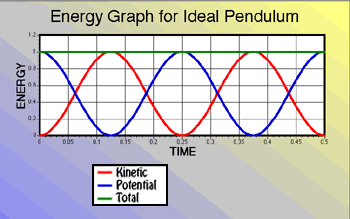
- Energy interchanges in SHM for pendulum. KE and GPE fluctuate. Total energy constant.
- Damping
- Damping - Oscillation in which the KE is converted into other forms and so the amplitude of the oscillations drop.
- Critical damping - D of oscillating systems when forces cause the system to return to the equilibrium position without oscillating. (e.g. pendulum through thick treacle).
- LightD and HeavyD (pendulum through air/water respectively).
- Critical damping - D of oscillating systems when forces cause the system to return to the equilibrium position without oscillating. (e.g. pendulum through thick treacle).
- Damping - Oscillation in which the KE is converted into other forms and so the amplitude of the oscillations drop.
- Resonance
- Resonance - When the driving frequency is equal to the natural frequency of an oscillating system. This causes a dramatic increase in the amplitiude of the oscillations.
- Effect of damping on resonance is that increasing the amount of damping reduces the amplitude and frequency of the driven oscillator.
- Uses
- Construction industry, so buildings don't collapse.
- Car industry, eliminate rattling/bouncing.
- Radio/television, adjusting resonant frequency to equal signal.
- Nuclei of atoms (MRI colour scanning) resonate in a field of suitable magnetic oscillations.
- Aircraft industry, wings don't bounce so much when landing or take off.
- Radio/television, adjusting resonant frequency to equal signal.
- Car industry, eliminate rattling/bouncing.
- Construction industry, so buildings don't collapse.
- Uses
- Effect of damping on resonance is that increasing the amount of damping reduces the amplitude and frequency of the driven oscillator.
- Resonance - When the driving frequency is equal to the natural frequency of an oscillating system. This causes a dramatic increase in the amplitiude of the oscillations.
- SHM - When the acceleration a of an object is proportional to its displacement x and the acceleration is in the opposite direction to the displacement.
Imágenes y archivos del mapa
Información
- Descripción
- A-level ((G484) Newtonian world) Physics Mapa Mental sobre 4.2: Circular motion and oscillations, creado por 08kclair el 06/06/2015.
- Creado por
- 08kclair
- Visitas
- 13
- Valoración