
Mapa mental
9.10 HOW DO MEIOSIS AND SEXUAL REPRODUCTION PRODUCE GENETIC VARIABILITY?
Contenido del mapa
9.10 HOW DO MEIOSIS AND SEXUAL REPRODUCTION PRODUCE GENETIC VARIABILITY?
The individual members of most species are genetically different from one another. The offspring of a single pair of parents are usually genetically different from one another and parents.
- Mutations occur randomly.
Shuffling of homologues creates novel combinations of chromosomes
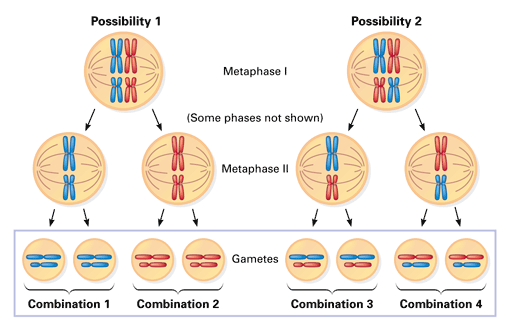
- One mechanism is the random distribution of maternal and paternal homologues to the daughter nuclei during meiosis I
- During metaphase I the paired of homologues line up at the center of the cell. But which homologs face which pole is random.
- In people, meiosis randomly shuffles 23 pairs of homologues chromosome, and theoretically produce more than 8 million (2^23) different combinations of maternal and paternal chromosomes in gametes.
- At metaphase I, the chromosomes can align in four possible configurations.
- Anaphase I can produce eight possible sets of chromosomes. (2^3 = 8).
- One mechanism is the random distribution of maternal and paternal homologues to the daughter nuclei during meiosis I
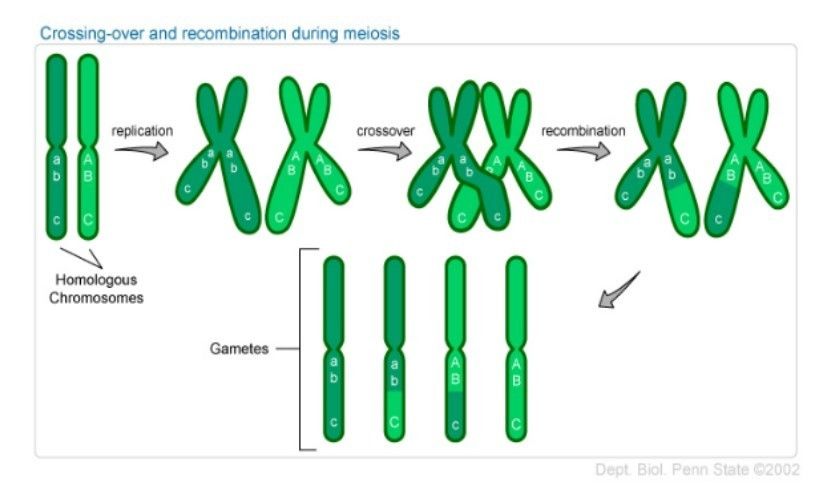
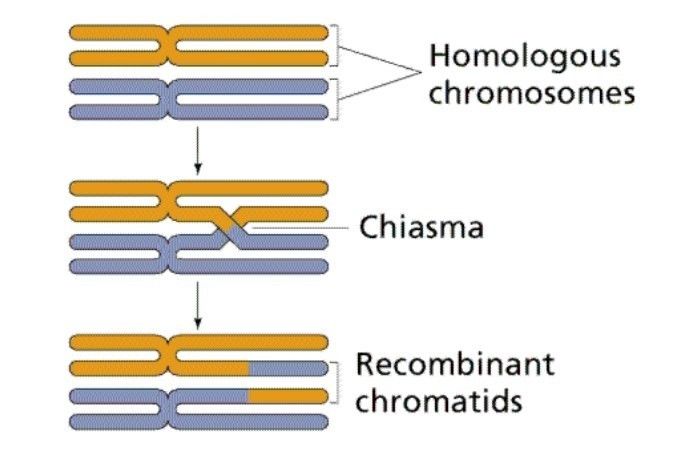
Crossing over creates chromosomes with a novel combination of genes
- Crossing over produces chromosomes with combinations of alleles that differ from those of either parent.
- Some of these new combinations may have never existed before because homologues chromosomes cross over in new and different places at each meiotic division.
- 1 in 8 million gametes could have the same combination of maternal and paternal chromosomes.
- Crossing over ensures that none of those chromosomes will be purely maternal or purely paternal.
- Every sperm and every egg is genetically unique.
- Crossing over ensures that none of those chromosomes will be purely maternal or purely paternal.
- Crossing over produces chromosomes with combinations of alleles that differ from those of either parent.
The fusion of gametes adds furthers genetic variability to the offspring
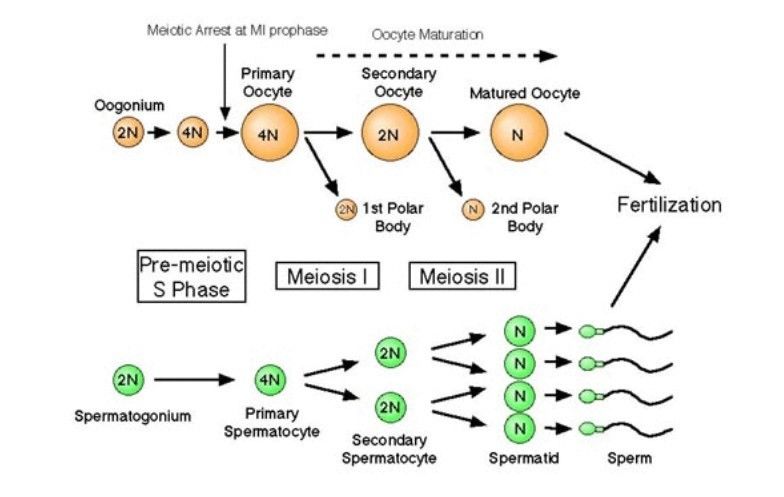
- At fertilization, two gametes, each containing a unique combination of alleles, fuse to form a diploid offspring.
- Theoretically, every human can produce about 8 million different gametes based on the random separation of homologues.
- Fusion of just two people could produce 8 million x 8 million, or 64 trillion, genetically different children.
- The chances that your parents could produce another child who is genetically identical the same as you are about 1/8,000,000 x 1/8,000,000 or 1 in 64 trillion.
Imágenes y archivos del mapa
Información
- Descripción
- Mapa Mental sobre 9.10 HOW DO MEIOSIS AND SEXUAL REPRODUCTION PRODUCE GENETIC VARIABILITY?, creado por Natalia Lehnhoff Faillace el 13/06/2021.
- Creado por
- Natalia Lehnhoff Faillace · jun 2021
- Actualizado
- 13 jun 2021
- Visitas
- 80
- Valoración