
Mapa mental
Psychology of Learning
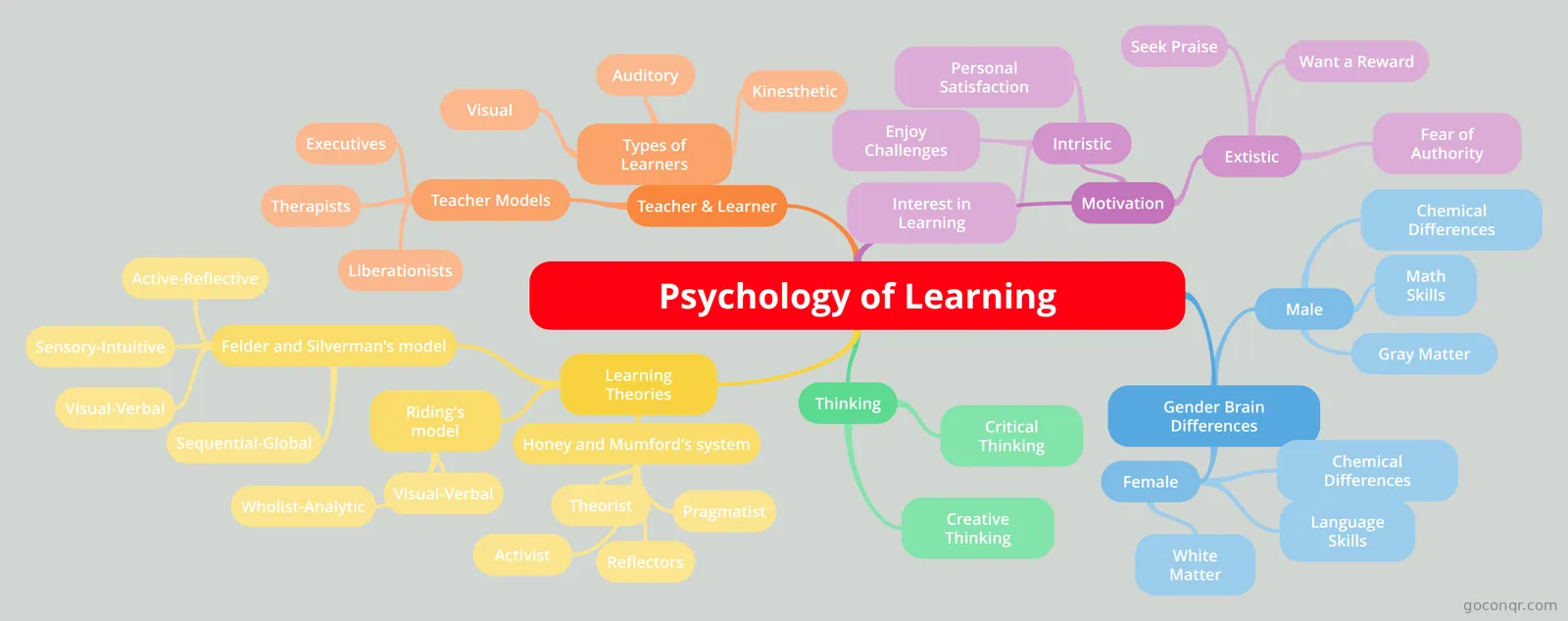
Mind map: Psychology of Learning
Contenido del mapa
Psychology of Learning
Learning Theories
- There are many theories when it comes to learning and learning styles and there" is no single criterion that consistently allows us to identify the most appropriate system for any given situation" (Jarvis, 2005, p. 75).
- Felder and Silverman's model
- The four dimensions proposed by Felder and Silverman which are currently being used are: Active-Reflective, Sensory-Intuitive, Visual-Verbal, and Sequential-Global (Jarvis, 2005, p. 81)
- Active-Reflective
- The reflective learner manipulates information internally and is able to benefit from lectures (Jarvis, 2005). This type can be connected to the auditory learner.
- Sensory-Intuitive
- The sensory learner relies on the evidence of their senses while the intuitive learner relies more on speculation, hunches, and imagination (Jarvis, 2005, p. 81).
- Visual-Verbal
- Visual learners benefit from the use of graphs, diagrams, and video while the verbal learner are more comfortable with lessons presented verbally (Jarvis, 2005).
- Sequential-Global
- The sequential learner prefers steady, logical steps while a global learner is comfortable with sudden leaps of understanding and are better at seeing the 'big picture' (Jarvis, 2005, p. 81).
- Riding's model
- Riding focused on two style dimensions he considered to have the strongest empirical support. The visual-verbal and the wholist-analytic which is coresponds to Felder and Silverman's global-sequential and sensing-intuitive (Jarvis, 2005, p. 82).
- Visual-Verbal
- Wholist-Analytic
- Honey and Mumford's system
- Honey and Mumford's Learning Style Questionnaire identifies four types of learners: activist, theorists, pragmatists, and reflectors (Jarvis, 2005).
- Activist
- The activist learning style is characterized by the enjoyment of new experiences. The activist is active and relies on intuition and dislikes structure (Jarvis, 2005, p. 83).
- Theorist
- Theorists are categorized by their reliance on logic and systematic planning. They dislike using intuition for making decisions.
- Pragmatist
- Pragmatists are down to earth, like working within a group, and are risk takers. They tend to avoid deep reflection (Jarvis, 2005, p. 83).
- Reflectors
- Reflectors prefer to observe and ascribe meaning and tend to formulate and test hypotheses (Jarvis, 2005, p. 83).
Thinking
- Critical Thinking
- Bloom term critical thinking as evaluation. The essential elements to critical thinking include learning when, how, and what to question and learning when and how to reason (Jarvis, 2005, p. 99).
- Creative Thinking
- Creativity corresponds to Bloom's category of synthesis, or ability to put ideas together (Jarvis, 2005, p. 99).
- Critical Thinking
Motivation
- "Motivation can be defined as 'the forces that account for the selection, persistence, intensity, and continuation of behaviour" (Jarvis, 2005, p. 118) In other words, it is what drives us to do (or not do) the things we do.
- Intristic
- Intristic motives come from within the individual.
- Personal Satisfaction
- The person seeks achievement for their own personal satisfaction and sense of accomplishment.
- Enjoy Challenges
- The learner enjoys the challenge and achieving their goal is the reward.
- Interest in Learning
- The learner is motivated due to an interest in the topic they are learning. The reward is gaining new knowledge.
- Extistic
- Extristic motivation comes from external rewards.
- Seek Praise
- Want a Reward
- The reward can be in the form of a good grade or a tangible item.
- Fear of Authority
- Beechick believes that a child who is taught a fear of God and their parents are more likely to be motivated to behave properly and get good grades in order to avoid disappointing God, parents, and teachers (1982, Chap. 4).
Gender Brain Differences
- Male
- Math Skills
- Boys have a larger Inferior-Parletal Lobule, an area thought to control mathematical processes, which explains why men tend to perform well in math.
- Gray Matter
- Boys uses more gray matter than boys and they predominantly use the left hemisphere to perform tasks which leads to compartmentalized learning and causes boys to be less likely to multi-task and makes transitioning from one task to another more difficult.
- Chemical Differences
- Boys have less serontonin and less oxytocin than girls and is the reason boys have a more difficult time sitting still and are more likely to be impulsive. This difference ties in to why boys are more likely to be kinesthetic learners than are girls.
- Math Skills
- Female
- Language Skills
- Girls have a larger hippocampus and have highly connected left and right hemispheres which contributes to better language skills.
- White Matter
- Girls use a higher amount of white matter which is one reason that girls tend to transition between tasks more quickly than boys and is also why girls tend to be better multi-taskers.
- Chemical Differences
- Girls produce more serontonin, oxytocin, and estrogen than do boys and are better at multi-tasking, transitioning between tasks, and sitting still. Girls are also less impulsive than are boys due to the differences in hormones.
- Language Skills
- Male
Teacher & Learner
- Teacher Models
- Fenstemacher and Soltis' classification of teachers (Jarvis, 2005)
- Executives
- This model of teacher views the teachers' role as one who orients their skills and knowledge in order to achieve optimum learning. The teacher puts empasis on lesson plans which deliver knowledge in an efficient manner (Jarvis, 2005, p. 7)
- Therapists
- The therapist model has roots in the psychodynamic tradition of education. This model sees the teacher as primarily responsible for the psychologically healthy development of learners (Jarvis, 2005, p. 7)
- Liberationists
- The liberationist model is concerned with helping the learner to become an independent freethinker and therefore they emphasize teaching thinking and learning skills (Jarvis, 2005, p.7).
- Types of Learners
- Cognitive style refers to ones way of thinking and is believed to be hard-wired into the individual (Jarvis, 2005, p. 74)
- Visual
- This type of learner learns by the use of graphics, watching demonstrations, and reading. They are less likely to learn by listening to lectures.
- Auditory
- The auditory learner learns by hearing. They would prefer to listen to material being read to them than to read it their self.
- Kinesthetic
- The kinesthetic learner has a need to move and learns best by using hands-on approaches. They prefer to 'do' something as opposed to seeing it be done or by having it explained to them.
- Teacher Models
Información
- Descripción
- Psychology of Learning: A Concept Map of Big Ideas
- Creado por
- itsme4462
- Visitas
- 60
- Etiquetas
- Valoración