
Mapa mental
Chemistry C1b- Cracking Crude Oil
Contenido del mapa
Chemistry C1b- Cracking Crude Oil
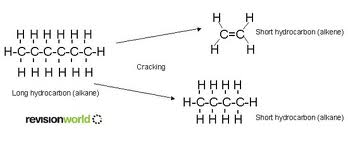
Cracking means splitting up long-chain hydrocarbons by passing vapour over a hot catalyst.
- ~Firstly you heat the long-chain hydrocarbons to vaporise it. ~Then the vapour is passed over a powdered catalyst at a temperature of about 400-700 degrees Celsius. ~Aluminium Oxide is the catalyst used. ~ The long-chain molecules split apart on the surface of the specks of catalyst.
Long-chain hydrocarbons form thick gloopy liquids which aren't useful, so a lot of the longer molecules produced from fractional distillation are turned into smaller ones by the process of cracking.
Some of the products of cracking are useful as fuels: such as petrol and paraffin. Cracking produces substances like ethane too, which are needed for making plastics.
Cracking is a thermal decomposition reaction - breaking down molecules by heating them.
Most of the products of cracking are alkanes and unsaturated hydrocarbons called alkenes.
Imágenes y archivos del mapa
Información
- Descripción
- Mapa Mental sobre Chemistry C1b- Cracking Crude Oil, creado por ellie.adams1 el 27/11/2013.
- Creado por
- ellie.adams1
- Visitas
- 246
- Valoración