
Mapa mental
Change Management
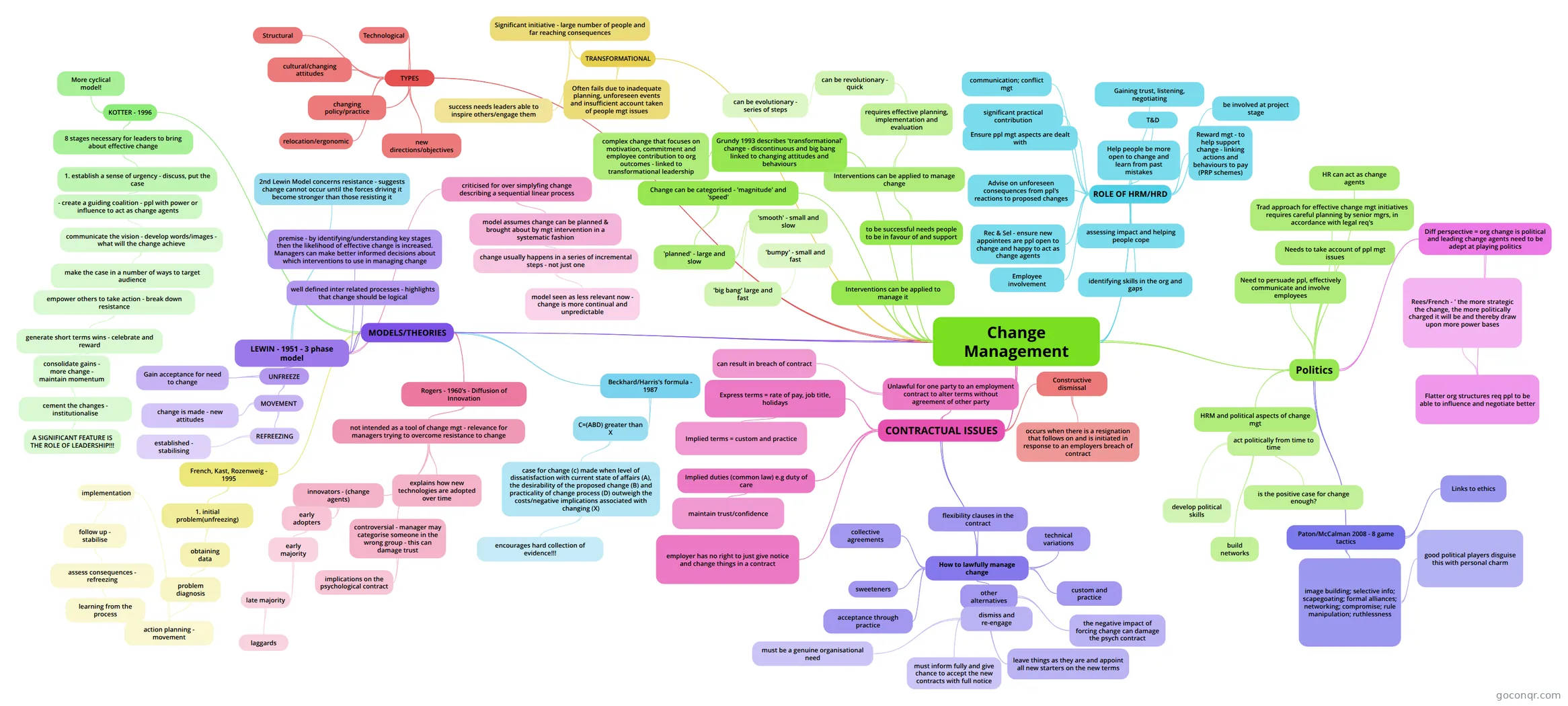
Mind map: Change management
Contenido del mapa
Change Management
to be successful needs people to be in favour of and support
- Interventions can be applied to manage change
- requires effective planning, implementation and evaluation
- can be revolutionary - quick
- can be evolutionary - series of steps
- can be revolutionary - quick
- requires effective planning, implementation and evaluation
- Interventions can be applied to manage change
Interventions can be applied to manage it
Grundy 1993 describes 'transformational' change - discontinuous and big bang linked to changing attitudes and behaviours
- complex change that focuses on motivation, commitment and employee contribution to org outcomes - linked to transformational leadership
Change can be categorised - 'magnitude' and 'speed'
- 'planned' - large and slow
- 'smooth' - small and slow
- 'big bang' large and fast
- 'bumpy' - small and fast
- 'big bang' large and fast
- 'smooth' - small and slow
- 'planned' - large and slow
TYPES
- Structural
- Technological
- new directions/objectives
- relocation/ergonomic
- cultural/changing attitudes
- changing policy/practice
TRANSFORMATIONAL
- Significant initiative - large number of people and far reaching consequences
- success needs leaders able to inspire others/engage them
- Often fails due to inadequate planning, unforeseen events and insufficient account taken of people mgt issues
- Significant initiative - large number of people and far reaching consequences
ROLE OF HRM/HRD
- Ensure ppl mgt aspects are dealt with
- Advise on unforeseen consequences from ppl's reactions to proposed changes
- significant practical contribution
- communication; conflict mgt
- Gaining trust, listening, negotiating
- T&D
- Help people be more open to change and learn from past mistakes
- Rec & Sel - ensure new appointees are ppl open to change and happy to act as change agents
- Reward mgt - to help support change - linking actions and behaviours to pay (PRP schemes)
- Employee involvement
- be involved at project stage
- identifying skills in the org and gaps
- assessing impact and helping people cope
MODELS/THEORIES
- LEWIN - 1951 - 3 phase model
- UNFREEZE
- MOVEMENT
- REFREEZING
- established - stabilising
- change is made - new attitudes
- REFREEZING
- Gain acceptance for need to change
- MOVEMENT
- well defined inter related processes - highlights that change should be logical
- criticised for over simplyfing change describing a sequential linear process
- model assumes change can be planned & brought about by mgt intervention in a systematic fashion
- change usually happens in a series of incremental steps - not just one
- model seen as less relevant now - change is more continual and unpredictable
- change usually happens in a series of incremental steps - not just one
- model assumes change can be planned & brought about by mgt intervention in a systematic fashion
- premise - by identifying/understanding key stages then the likelihood of effective change is increased. Managers can make better informed decisions about which interventions to use in managing change
- 2nd Lewin Model concerns resistance - suggests change cannot occur until the forces driving it become stronger than those resisting it
- UNFREEZE
- KOTTER - 1996
- 8 stages necessary for leaders to bring about effective change
- 1. establish a sense of urgency - discuss, put the case
- - create a guiding coalition - ppl with power or influence to act as change agents
- communicate the vision - develop words/images - what will the change achieve
- make the case in a number of ways to target audience
- empower others to take action - break down resistance
- generate short terms wins - celebrate and reward
- consolidate gains - more change - maintain momentum
- cement the changes - institutionalise
- A SIGNIFICANT FEATURE IS THE ROLE OF LEADERSHIP!!!
- cement the changes - institutionalise
- consolidate gains - more change - maintain momentum
- generate short terms wins - celebrate and reward
- empower others to take action - break down resistance
- make the case in a number of ways to target audience
- communicate the vision - develop words/images - what will the change achieve
- - create a guiding coalition - ppl with power or influence to act as change agents
- 1. establish a sense of urgency - discuss, put the case
- More cyclical model!
- 8 stages necessary for leaders to bring about effective change
- French, Kast, Rozenweig - 1995
- 1. initial problem(unfreezing)
- obtaining data
- problem diagnosis
- action planning - movement
- implementation
- follow up - stabilise
- assess consequences - refreezing
- learning from the process
- assess consequences - refreezing
- follow up - stabilise
- implementation
- action planning - movement
- problem diagnosis
- obtaining data
- 1. initial problem(unfreezing)
- Rogers - 1960's - Diffusion of Innovation
- not intended as a tool of change mgt - relevance for managers trying to overcome resistance to change
- explains how new technologies are adopted over time
- innovators - (change agents)
- early adopters
- early majority
- late majority
- laggards
- late majority
- early majority
- early adopters
- controversial - manager may categorise someone in the wrong group - this can damage trust
- implications on the psychological contract
- not intended as a tool of change mgt - relevance for managers trying to overcome resistance to change
- Beckhard/Harris's formula - 1987
- C=(ABD) greater than X
- case for change (c) made when level of dissatisfaction with current state of affairs (A), the desirability of the proposed change (B) and practicality of change process (D) outweigh the costs/negative implications associated with changing (X)
- encourages hard collection of evidence!!!
- case for change (c) made when level of dissatisfaction with current state of affairs (A), the desirability of the proposed change (B) and practicality of change process (D) outweigh the costs/negative implications associated with changing (X)
- C=(ABD) greater than X
- LEWIN - 1951 - 3 phase model
CONTRACTUAL ISSUES
- Unlawful for one party to an employment contract to alter terms without agreement of other party
- can result in breach of contract
- Express terms = rate of pay, job title, holidays
- Implied terms = custom and practice
- Implied duties (common law) e.g duty of care
- maintain trust/confidence
- employer has no right to just give notice and change things in a contract
- Constructive dismissal
- occurs when there is a resignation that follows on and is initiated in response to an employers breach of contract
- How to lawfully manage change
- flexibility clauses in the contract
- collective agreements
- sweeteners
- technical variations
- custom and practice
- acceptance through practice
- other alternatives
- leave things as they are and appoint all new starters on the new terms
- dismiss and re-engage
- must be a genuine organisational need
- must inform fully and give chance to accept the new contracts with full notice
- the negative impact of forcing change can damage the psych contract
- Unlawful for one party to an employment contract to alter terms without agreement of other party
Politics
- HRM and political aspects of change mgt
- act politically from time to time
- develop political skills
- is the positive case for change enough?
- build networks
- act politically from time to time
- Trad approach for effective change mgt initiatives requires careful planning by senior mgrs, in accordance with legal req's
- Needs to take account of ppl mgt issues
- Need to persuade ppl, effectively communicate and involve employees
- HR can act as change agents
- Diff perspective = org change is political and leading change agents need to be adept at playing politics
- Flatter org structures req ppl to be able to influence and negotiate better
- Rees/French - ' the more strategic the change, the more politically charged it will be and thereby draw upon more power bases
- Flatter org structures req ppl to be able to influence and negotiate better
- Paton/McCalman 2008 - 8 game tactics
- image building; selective info; scapegoating; formal alliances; networking; compromise; rule manipulation; ruthlessness
- good political players disguise this with personal charm
- Links to ethics
- image building; selective info; scapegoating; formal alliances; networking; compromise; rule manipulation; ruthlessness
- HRM and political aspects of change mgt
Información
- Descripción
- masters LO4 Promotion of Flexible Working & Change Mgt Mapa Mental sobre Change Management, creado por lknibb el 06/12/2013.
- Creado por
- lknibb
- Visitas
- 72
- Etiquetas
- Valoración