
Mapa mental
Causation
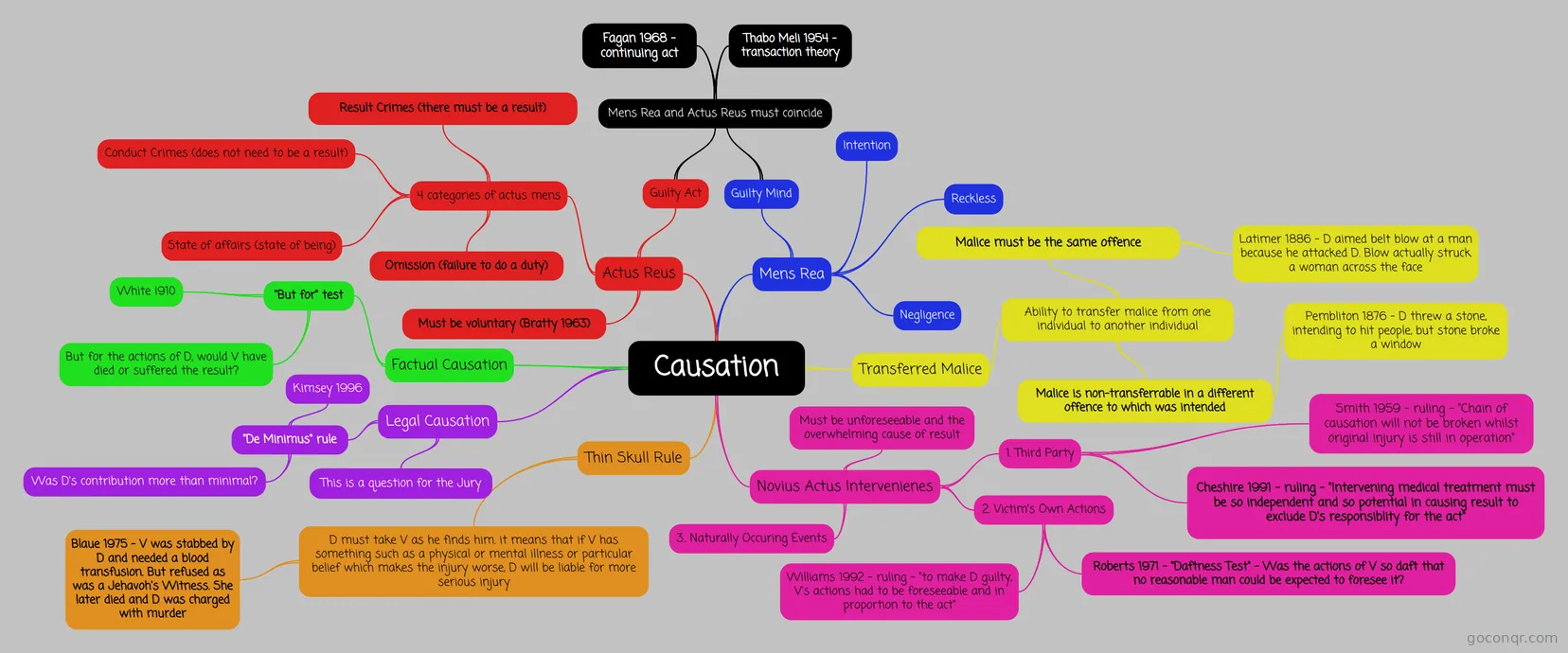
Mind map: Causation in criminal law
Contenido del mapa
Causation
Actus Reus
- Guilty Act
- Mens Rea and Actus Reus must coincide
- Fagan 1968 - continuing act
- Thabo Meli 1954 - transaction theory
- Mens Rea and Actus Reus must coincide
- 4 categories of actus mens
- Result Crimes (there must be a result)
- Conduct Crimes (does not need to be a result)
- State of affairs (state of being)
- Omission (failure to do a duty)
- Must be voluntary (Bratty 1963)
- Guilty Act
Mens Rea
- Guilty Mind
- Intention
- Negligence
- Reckless
- Guilty Mind
Transferred Malice
- Ability to transfer malice from one individual to another individual
- Malice must be the same offence
- Latimer 1886 - D aimed belt blow at a man because he attacked D. Blow actually struck a woman across the face
- Malice is non-transferrable in a different offence to which was intended
- Pembliton 1876 - D threw a stone, intending to hit people, but stone broke a window
- Malice must be the same offence
- Ability to transfer malice from one individual to another individual
Factual Causation
- "But for" test
- White !910
- But for the actions of D, would V have died or suffered the result?
- "But for" test
Legal Causation
- This is a question for the Jury
- "De Minimus" rule
- Kimsey 1996
- Was D's contribution more than minimal?
Novius Actus Intervenienes
- Must be unforeseeable and the overwhelming cause of result
- 3.. Naturally Occuring Events
- 1. Third Party
- Smith 1959 - ruling - "Chain of causation will not be broken whilst original injury is still in operation"
- Cheshire 1991 - ruling - "Intervening medical treatment must be so independent and so potential in causing result to exclude D's responsiblity for the act"
- 2. Victim's Own Actions
- Roberts 1971 - "Daftness Test" - Was the actions of V so daft that no reasonable man could be expected to foresee it?
- Williams 1992 - ruling - "to make D guilty, V's actions had to be foreseeable and in proportion to the act"
Thin Skull Rule
- D must take V as he finds him. it means that if V has something such as a physical or mental illness or particular belief which makes the injury worse, D will be liable for more serious injury
- Blaue 1975 - V was stabbed by D and needed a blood transfusion. But refused as was a Jehavoh's Witness. She later died and D was charged with murder
- D must take V as he finds him. it means that if V has something such as a physical or mental illness or particular belief which makes the injury worse, D will be liable for more serious injury
Información
- Descripción
- Mapa Mental sobre Causation, creado por Catherine Fairweather el 15/12/2015.
- Creado por
- Catherine Fairweather
- Visitas
- 86
- Etiquetas
- Valoración