
Mapa mental
FREE WILL & DETERMINISM
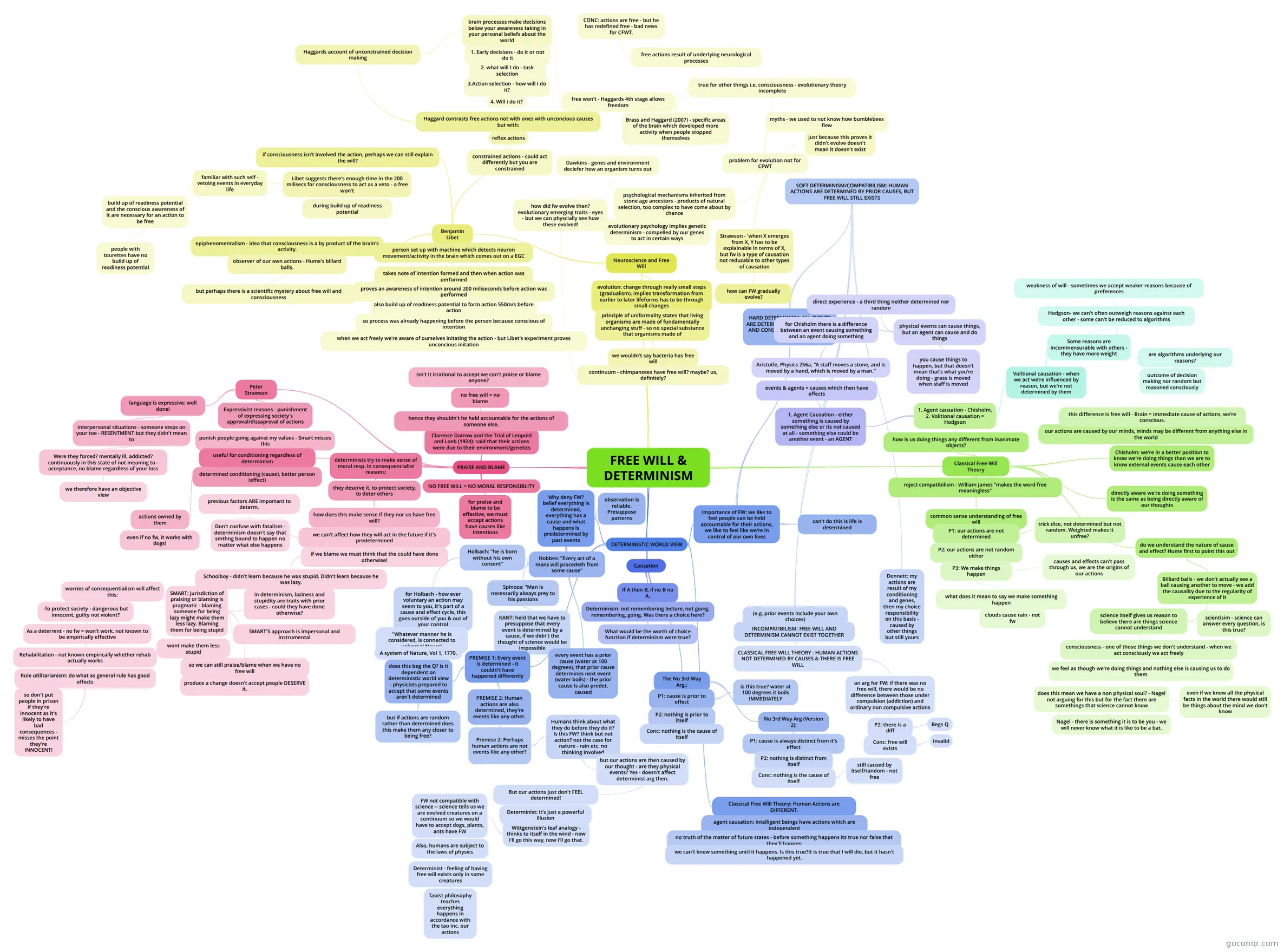
Mind map: free will and determinism
Contenido del mapa
FREE WILL & DETERMINISM
Causation
- If A then B, if no B no A.
- Determinism: not remembering lecture, not going. remembering, going. Was there a choice here?
- What would be the worth of choice function if determinism were true?
- Determinism: not remembering lecture, not going. remembering, going. Was there a choice here?
- If A then B, if no B no A.
DETERMINISTIC WORLD VIEW
- importance of FW: we like to feel people can be held accountable for their actions, we like to feel like we're in control of our own lives
- HARD DETERMINISM: ALL EVENTS ARE DETERMINED BY THEIR CAUSES AND CONSEQUENTLY THERE'S NO FREE WILL
- SOFT DETERMINISM/COMPATIBILISM: HUMAN ACTIONS ARE DETERMINED BY PRIOR CAUSES, BUT FREE WILL STILL EXISTS
- (e.g. prior events include your own choices)
- INCOMPATIBILISM: FREE WILL AND DETERMINISM CANNOT EXIST TOGETHER
- CLASSICAL FREE WILL THEORY : HUMAN ACTIONS NOT DETERMINED BY CAUSES & THERE IS FREE WILL
- an arg for FW: if there was no free will, there would be no difference between those under compulsion (addiction) and ordinary non compulsive actions
- P2: there is a diff
- Conc: free will exists
- Invalid
- Begs Q
- Conc: free will exists
- P2: there is a diff
- an arg for FW: if there was no free will, there would be no difference between those under compulsion (addiction) and ordinary non compulsive actions
- CLASSICAL FREE WILL THEORY : HUMAN ACTIONS NOT DETERMINED BY CAUSES & THERE IS FREE WILL
- Dennett: my actions are result of my conditioning and genes, then my choice responsibility on this basis - caused by other things but still yours
- SOFT DETERMINISM/COMPATIBILISM: HUMAN ACTIONS ARE DETERMINED BY PRIOR CAUSES, BUT FREE WILL STILL EXISTS
- can't do this is life is determined
- HARD DETERMINISM: ALL EVENTS ARE DETERMINED BY THEIR CAUSES AND CONSEQUENTLY THERE'S NO FREE WILL
- Why deny FW? belief everything is determined, everything has a cause and what happens is predetermined by past events
- Hobbes: "Every act of a mans will procedeth from some cause"
- Spinoza: "Man is necessarily always prey to his passions
- KANT: held that we have to presuppose that every event is determined by a cause, if we didn't the thought of science would be impossible
- Holbach: "he is born without his own consent"
- for Holbach - how ever voluntary an action may seem to you, it's part of a cause and effect cycle, this goes outside of you & out of your control
- "Whatever manner he is considered, is connected to universal Naure"
- A system of Nature, Vol 1, 1770.
- "Whatever manner he is considered, is connected to universal Naure"
- for Holbach - how ever voluntary an action may seem to you, it's part of a cause and effect cycle, this goes outside of you & out of your control
- Spinoza: "Man is necessarily always prey to his passions
- observation is reliable. Presuppose patterns
- every event has a prior cause (water at 100 degrees), that prior cause determines next event (water boils) - the prior cause is also predet. caused
- Hobbes: "Every act of a mans will procedeth from some cause"
- PREMISE 1: Every event is determined - it couldn't have happened differently
- PREMISE 2: Human actions are also determined, they're events like any other.
- Premise 2: Perhaps human actions are not events like any other?
- Humans think about what they do before they do it? Is this FW? think but not action? not the case for nature - rain etc. no thinking involved
- but our actions are then caused by our thought - are they physical events? Yes - doesn't affect determinist arg then.
- But our actions just don't FEEL determined!
- Determinist: it's just a powerful illusion
- Wittgenstein's leaf analogy - thinks to itself in the wind - now i'll go this way, now i'll go that.
- FW not compatible with science -- science tells us we are evolved creatures on a continuum so we would have to accept dogs, plants, ants have FW
- Also, humans are subject to the laws of physics
- Determinist - feeling of having free will exists only in some creatures
- Taoist philosophy teaches everything happens in accordance with the tao inc. our actions
- Determinist - feeling of having free will exists only in some creatures
- Also, humans are subject to the laws of physics
- FW not compatible with science -- science tells us we are evolved creatures on a continuum so we would have to accept dogs, plants, ants have FW
- Wittgenstein's leaf analogy - thinks to itself in the wind - now i'll go this way, now i'll go that.
- Determinist: it's just a powerful illusion
- But our actions just don't FEEL determined!
- but our actions are then caused by our thought - are they physical events? Yes - doesn't affect determinist arg then.
- Humans think about what they do before they do it? Is this FW? think but not action? not the case for nature - rain etc. no thinking involved
- Premise 2: Perhaps human actions are not events like any other?
- does this beg the Q? is it dependent on deterministic world view - physicists prepared to accept that some events aren't determined
- but if actions are random rather than determined does this make them any closer to being free?
- PREMISE 2: Human actions are also determined, they're events like any other.
- The No 3rd Way Arg.:
- P1: cause is prior to effect
- P2: nothing is prior to itself
- Conc: nothing is the cause of itself
- is this true? water at 100 degrees it boils IMMEDIATELY
- P2: nothing is prior to itself
- No 3rd Way Arg (Version 2):
- P1: cause is always distinct from it's effect
- P2: nothing is distinct from itself
- Conc: nothing is the cause of itself
- still caused by itself/random - not free
- Conc: nothing is the cause of itself
- P2: nothing is distinct from itself
- P1: cause is always distinct from it's effect
- P1: cause is prior to effect
- Classical Free Will Theory: Human Actions are DIFFERENT.
- agent causation: intelligent beings have actions which are independent
- no truth of the matter of future states - before something happens its true nor false that they'll happen
- we can't know something until it happens. Is this true?It is true that I will die, but it hasn't happened yet.
- no truth of the matter of future states - before something happens its true nor false that they'll happen
- agent causation: intelligent beings have actions which are independent
- importance of FW: we like to feel people can be held accountable for their actions, we like to feel like we're in control of our own lives
PRAISE AND BLAME
- NO FREE WILL = NO MORAL RESPONSIBLITY
- Clarence Darrow and the Trial of Leopold and Loeb (1924): said that their actions were due to their environment/genetics
- hence they shouldn't he held accountable for the actions of someone else.
- no free will = no blame
- isn't it irrational to accept we can't praise or blame anyone?
- determinists try to make sense of moral resp. in consequencialist reasons:
- they deserve it, to protect society, to deter others
- how does this make sense if they nor us have free will?
- we can't affect how they will act in the future if it's predetermined
- if we blame we must think that the could have done otherwise!
- Schoolboy - didn't learn because he was stupid. Didn't learn because he was lazy.
- in determinism, laziness and stupidity are traits with prior cases - could they have done otherwise?
- SMART: jurisdiction of praising or blaming is pragmatic - blaming someone for being lazy might make them less lazy. Blaming them for being stupid
- wont make them less stupid
- so we can still praise/blame when we have no free will
- produce a change doesn't accept people DESERVE it.
- worries of consequentialism will affect this:
- -To protect society - dangerous but innocent, guilty not violent?
- As a deterrent - no fw = won't work. not known to be empirically effective
- Rehabilitation - not known empirically whether rehab actually works
- Rule utilitarianism: do what as general rule has good effects
- so don't put people in prison if they're innocent as it's likely to have bad consequences - misses the point they're INNOCENT!
- Rule utilitarianism: do what as general rule has good effects
- Rehabilitation - not known empirically whether rehab actually works
- As a deterrent - no fw = won't work. not known to be empirically effective
- -To protect society - dangerous but innocent, guilty not violent?
- SMART'S approach is impersonal and instrumental
- Schoolboy - didn't learn because he was stupid. Didn't learn because he was lazy.
- Don't confuse with fatalism - determinism doesn't say that smthng bound to happen no matter what else happens
- previous factors ARE important to determ.
- if we blame we must think that the could have done otherwise!
- we can't affect how they will act in the future if it's predetermined
- how does this make sense if they nor us have free will?
- they deserve it, to protect society, to deter others
- for praise and blame to be effective, we must accept actions have causes like intentions
- Peter Strawson
- Expressivist reasons - punishment of expressing society's approval/dissaproval of actions
- punish people going against my values - Smart misses this
- language is expressive: well done!
- interpersonal situations - someone steps on your toe - RESENTMENT but they didn't mean to
- Were they forced? mentally ill, addicted? continuously in this state of not meaning to - acceptance, no blame regardless of your loss
- we therefore have an objective view
- Were they forced? mentally ill, addicted? continuously in this state of not meaning to - acceptance, no blame regardless of your loss
- interpersonal situations - someone steps on your toe - RESENTMENT but they didn't mean to
- Expressivist reasons - punishment of expressing society's approval/dissaproval of actions
- useful for conditioning regardless of determinism
- determined conditioning (cause), better person (effect)
- actions owned by them
- even if no fw, it works with dogs!
- actions owned by them
- determined conditioning (cause), better person (effect)
Classical Free Will Theory
- reject compatibilism - William James "makes the word free meaningless"
- common sense understanding of free will
- P1: our actions are not determined
- P2: our actions are not random either
- P3: We make things happen
- what does it mean to say we make something happen
- clouds cause rain - not fw
- causes and effects can't pass through us, we are the origins of our actions
- what does it mean to say we make something happen
- P3: We make things happen
- trick dice, not determined but not random. Weighted makes it unfree?
- P2: our actions are not random either
- P1: our actions are not determined
- do we understand the nature of cause and effect? Hume first to point this out
- Billiard balls - we don't actually see a ball causing another to move - we add the causality due to the regularity of experience of it
- science itself gives us reason to believe there are things science cannot understand
- consciousness - one of those things we don't understand - when we act consciously we act freely
- we feel as though we're doing things and nothing else is causing us to do them
- scientisim - science can answer every question, is this true?
- even if we knew all the physical facts in the world there would still be things about the mind we don't know
- does this mean we have a non physical soul? - Nagel not arguing for this but for the fact there are somethings that science cannot know
- Nagel - there is something it is to be you - we will never know what it is like to be a bat.
- does this mean we have a non physical soul? - Nagel not arguing for this but for the fact there are somethings that science cannot know
- even if we knew all the physical facts in the world there would still be things about the mind we don't know
- consciousness - one of those things we don't understand - when we act consciously we act freely
- science itself gives us reason to believe there are things science cannot understand
- Billiard balls - we don't actually see a ball causing another to move - we add the causality due to the regularity of experience of it
- directly aware we're doing something is the same as being directly aware of our thoughts
- Chisholm: we're in a better position to know we're doing things than we are to know external events cause each other
- our actions are caused by our minds, minds may be different from anything else in the world
- this difference is free will - Brain = immediate cause of actions, we're conscious.
- our actions are caused by our minds, minds may be different from anything else in the world
- how is us doing things any different from inanimate objects?
- 1. Agent causation - Chisholm, 2. Volitional causation = Hodgson
- 1. Agent Causation - either something is caused by something else or its not caused at all - something else could be another event - an AGENT
- events & agents = causes which then have effects
- Aristotle, Physics 256a, "A staff moves a stone, and is moved by a hand, which is moved by a man."
- for Chisholm there is a difference between an event causing something and an agent doing something
- physical events can cause things, but an agent can cause and do things
- you cause things to happen, but that doesn't mean that's what you're doing - grass is moved when staff is moved
- direct experience - a third thing neither determined nor random
- physical events can cause things, but an agent can cause and do things
- for Chisholm there is a difference between an event causing something and an agent doing something
- Aristotle, Physics 256a, "A staff moves a stone, and is moved by a hand, which is moved by a man."
- events & agents = causes which then have effects
- Volitional causation - when we act we're influenced by reason, but we're not determined by them
- Some reasons are incommensurable with others - they have more weight
- Hodgson- we can't often outweigh reasons against each other - some can't be reduced to algorithms
- are algorithms underlying our reasons?
- outcome of decision making nor random but reasoned consciously
- weakness of will - sometimes we accept weaker reasons because of preferences
- are algorithms underlying our reasons?
- Hodgson- we can't often outweigh reasons against each other - some can't be reduced to algorithms
- Some reasons are incommensurable with others - they have more weight
- 1. Agent Causation - either something is caused by something else or its not caused at all - something else could be another event - an AGENT
- 1. Agent causation - Chisholm, 2. Volitional causation = Hodgson
Neuroscience and Free Will
- evolution: change through really small steps (gradualism). implies transformation from earlier to later lifeforms has to be through small changes
- principle of uniformality states that living organisms are made of fundamentally unchanging stuff - so no special substance that organisms made of
- we wouldn't say bacteria has free will
- continuum - chimpanzees have free will? maybe? us, definitely?
- how did fw evolve then? evolutionary emerging traits - eyes - but we can physcially see how these evolved!
- continuum - chimpanzees have free will? maybe? us, definitely?
- we wouldn't say bacteria has free will
- how can FW gradually evolve?
- Strawson - 'when X emerges from X, Y has to be explainable in terms of X, but fw is a type of causation not reducable to other types of causation
- just because this proves it didn't evolve doesn't mean it doesn't exist
- myths - we used to not know how bumblebees flew
- problem for evolution not for CFWT
- true for other things i.e. consciousness - evolutionary theory incomplete
- psychological mechanisms inherited from stone age ancestors - products of natural selection, too complex to have come about by chance
- evolutionary psychology implies genetic determinism - compelled by our genes to act in certain ways
- Dawkins - genes and environment deciefer how an organism turns out
- evolutionary psychology implies genetic determinism - compelled by our genes to act in certain ways
- problem for evolution not for CFWT
- myths - we used to not know how bumblebees flew
- just because this proves it didn't evolve doesn't mean it doesn't exist
- Strawson - 'when X emerges from X, Y has to be explainable in terms of X, but fw is a type of causation not reducable to other types of causation
- principle of uniformality states that living organisms are made of fundamentally unchanging stuff - so no special substance that organisms made of
- Benjamin Libet
- person set up with machine which detects neuron movement/activity in the brain which comes out on a EGC
- takes note of intention formed and then when action was performed
- proves an awareness of intention around 200 miliseconds before action was performed
- also build up of readiness potential to form action 550m/s before action
- so process was already happening before the person because conscious of intention
- when we act freely we're aware of ourselves initating the action - but Libet's experiment proves unconcious initation
- so process was already happening before the person because conscious of intention
- also build up of readiness potential to form action 550m/s before action
- proves an awareness of intention around 200 miliseconds before action was performed
- takes note of intention formed and then when action was performed
- epiphenomentalism - idea that consciousness is a by product of the brain's activity.
- observer of our own actions - Hume's billard balls.
- but perhaps there is a scientific mystery about free will and consciousness
- observer of our own actions - Hume's billard balls.
- if consciousness isn't involved the action, perhaps we can still explain the will?
- Libet suggests there's enough time in the 200 milisecs for consciousness to act as a veto - a free won't
- during build up of readiness potential
- familiar with such self - vetoing events in everyday life
- build up of readiness potential and the conscious awareness of it are necessary for an action to be free
- people with tourettes have no build up of readiness potential
- build up of readiness potential and the conscious awareness of it are necessary for an action to be free
- Libet suggests there's enough time in the 200 milisecs for consciousness to act as a veto - a free won't
- Haggard contrasts free actions not with ones with unconcious causes but with:
- reflex actions
- constrained actions - could act differently but you are constrained
- Haggards account of unconstrained decision making
- brain processes make decisions below your awareness taking in your personal beliefs about the world
- 1. Early decisions - do it or not do it
- 2. what will I do - task selection
- 3.Action selection - how will I do it?
- 4. Will i do it?
- 3.Action selection - how will I do it?
- 2. what will I do - task selection
- free won't - Haggards 4th stage allows freedom
- Brass and Haggard (2007) - specific areas of the brain which developed more activity when people stopped themselves
- free actions result of underlying neurological processes
- CONC: actions are free - but he has redefined free - bad news for CFWT.
- free actions result of underlying neurological processes
- Brass and Haggard (2007) - specific areas of the brain which developed more activity when people stopped themselves
- 1. Early decisions - do it or not do it
- brain processes make decisions below your awareness taking in your personal beliefs about the world
- reflex actions
- person set up with machine which detects neuron movement/activity in the brain which comes out on a EGC
- evolution: change through really small steps (gradualism). implies transformation from earlier to later lifeforms has to be through small changes
Información
- Descripción
- Philosophy Mapa Mental sobre FREE WILL & DETERMINISM, creado por beth.kirby el 12/04/2013.
- Creado por
- beth.kirby
- Visitas
- 129
- Etiquetas
- Valoración