
Mapa mental
Physic Topic 2 - The Electromagnetic Spectrum
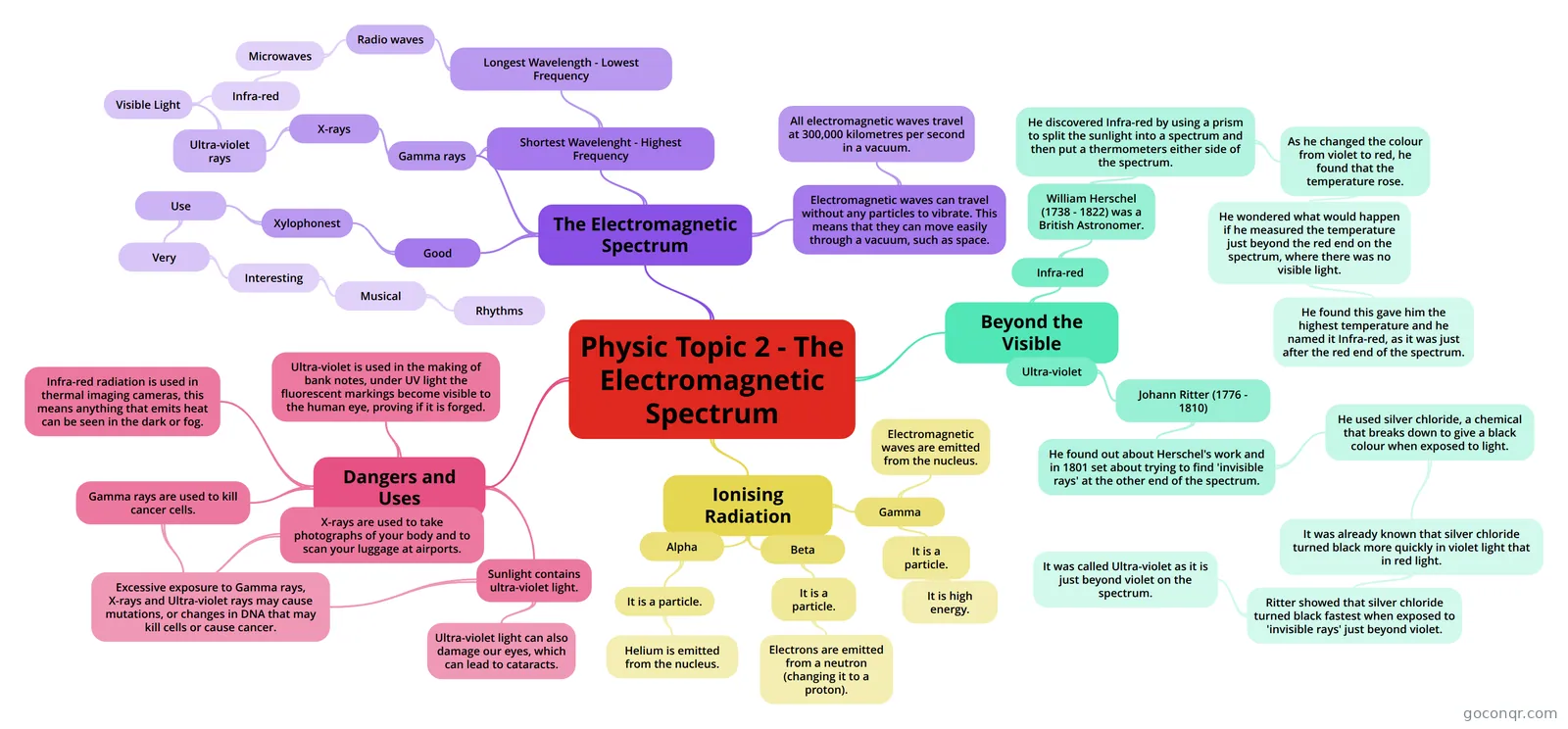
Mind map: The electromagnetic spectrum
Contenido del mapa
Physic Topic 2 - The Electromagnetic Spectrum
Beyond the Visible
- Infra-red
- William Herschel (1738 - 1822) was a British Astronomer.
- He discovered Infra-red by using a prism to split the sunlight into a spectrum and then put a thermometers either side of the spectrum.
- As he changed the colour from violet to red, he found that the temperature rose.
- He wondered what would happen if he measured the temperature just beyond the red end on the spectrum, where there was no visible light.
- He found this gave him the highest temperature and he named it Infra-red, as it was just after the red end of the spectrum.
- He wondered what would happen if he measured the temperature just beyond the red end on the spectrum, where there was no visible light.
- As he changed the colour from violet to red, he found that the temperature rose.
- He discovered Infra-red by using a prism to split the sunlight into a spectrum and then put a thermometers either side of the spectrum.
- William Herschel (1738 - 1822) was a British Astronomer.
- Ultra-violet
- Johann Ritter (1776 - 1810)
- He found out about Herschel's work and in 1801 set about trying to find 'invisible rays' at the other end of the spectrum.
- He used silver chloride, a chemical that breaks down to give a black colour when exposed to light.
- It was already known that silver chloride turned black more quickly in violet light that in red light.
- Ritter showed that silver chloride turned black fastest when exposed to 'invisible rays' just beyond violet.
- It was called Ultra-violet as it is just beyond violet on the spectrum.
- Ritter showed that silver chloride turned black fastest when exposed to 'invisible rays' just beyond violet.
- It was already known that silver chloride turned black more quickly in violet light that in red light.
- He used silver chloride, a chemical that breaks down to give a black colour when exposed to light.
- He found out about Herschel's work and in 1801 set about trying to find 'invisible rays' at the other end of the spectrum.
- Johann Ritter (1776 - 1810)
- Infra-red
The Electromagnetic Spectrum
- Shortest Wavelenght - Highest Frequency
- Longest Wavelength - Lowest Frequency
- Radio waves
- Gamma rays
- Longest Wavelength - Lowest Frequency
- Gamma rays
- X-rays
- Ultra-violet rays
- Visible Light
- Infra-red
- Microwaves
- Radio waves
- Microwaves
- Infra-red
- Visible Light
- Ultra-violet rays
- X-rays
- Good
- Xylophonest
- Use
- Very
- Interesting
- Musical
- Rhythms
- Musical
- Interesting
- Very
- Use
- Xylophonest
- Electromagnetic waves can travel without any particles to vibrate. This means that they can move easily through a vacuum, such as space.
- All electromagnetic waves travel at 300,000 kilometres per second in a vacuum.
- Shortest Wavelenght - Highest Frequency
Dangers and Uses
- Gamma rays are used to kill cancer cells.
- X-rays are used to take photographs of your body and to scan your luggage at airports.
- Exc
- Sunlight contains ultra-violet light.
- Ultra-violet light can also damage our eyes, which can lead to cataracts.
- Excessive exposure to Gamma rays, X-rays and Ultra-violet rays may cause mutations, or changes in DNA that may kill cells or cause cancer.
- Infra-red radiation is used in thermal imaging cameras, this means anything that emits heat can be seen in the dark or fog.
- Ultra-violet is used in the making of bank notes, under UV light the fluorescent markings become visible to the human eye, proving if it is forged.
- Gamma rays are used to kill cancer cells.
Ionising Radiation
- Gamma
- Electromagnetic waves are emitted from the nucleus.
- It is a particle.
- It is high energy.
- Alpha
- It is a particle.
- Helium is emitted from the nucleus.
- It is a particle.
- Beta
- It is a particle.
- Electrons are emitted from a neutron (changing it to a proton).
- It is a particle.
- Gamma
Información
- Descripción
- GCSE Physics Mapa Mental sobre Physic Topic 2 - The Electromagnetic Spectrum, creado por lydia_ward el 13/04/2013.
- Creado por
- lydia_ward
- Visitas
- 1.200
- Etiquetas
- Valoración