
Mapa mental
Physics Topic 3 - Waves and the Universe
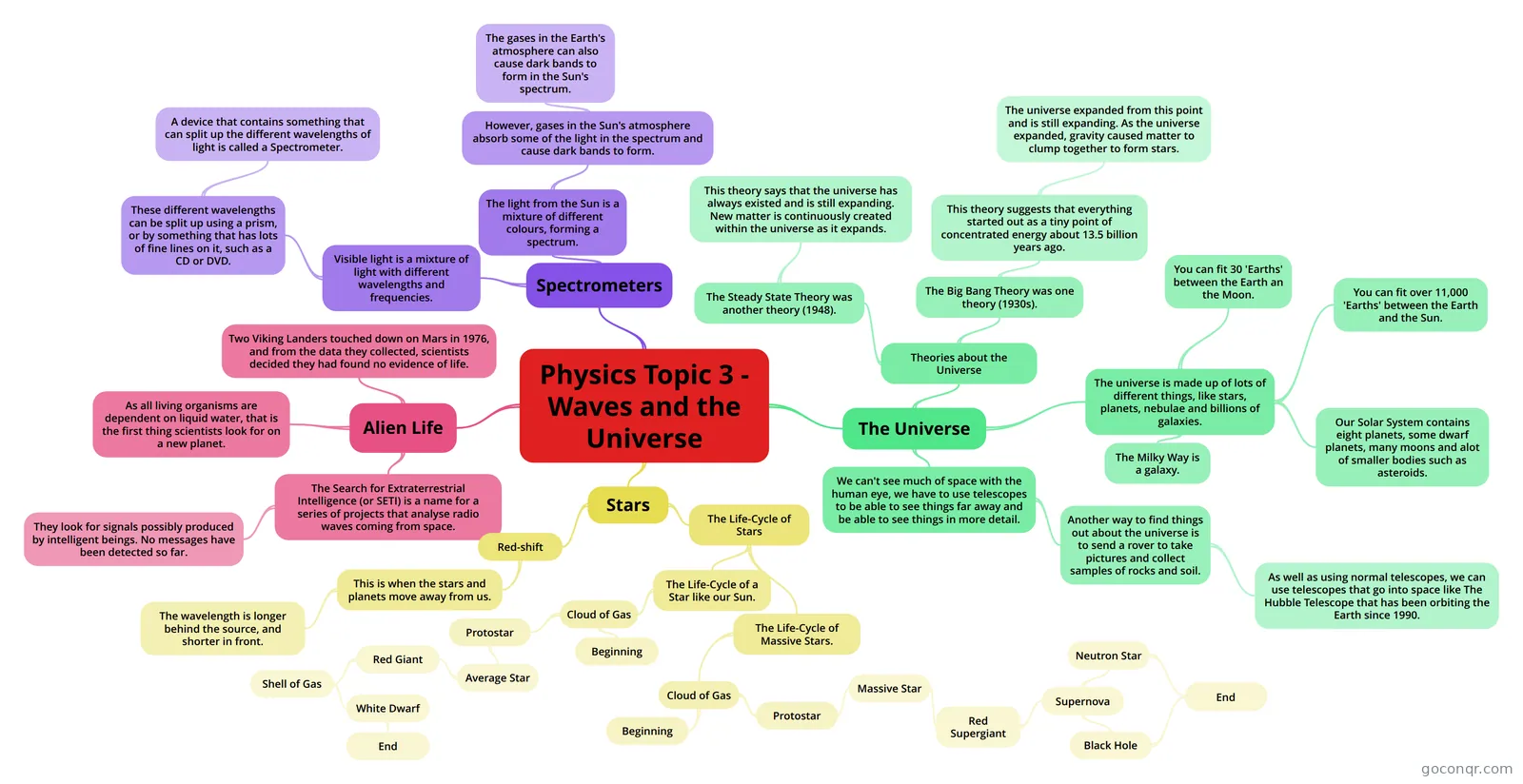
Mind map: waves and the universe physics
Contenido del mapa
Physics Topic 3 - Waves and the Universe
The Universe
- Theories about the Universe
- The Big Bang Theory was one theory (1930s).
- This theory suggests that everything started out as a tiny point of concentrated energy about 13.5 billion years ago.
- The universe expanded from this point and is still expanding. As the universe expanded, gravity caused matter to clump together to form stars.
- This theory suggests that everything started out as a tiny point of concentrated energy about 13.5 billion years ago.
- The Steady State Theory was another theory (1948).
- This theory says that the universe has always existed and is still expanding. New matter is continuously created within the universe as it expands.
- The Big Bang Theory was one theory (1930s).
- We can't see much of space with the human eye, we have to use telescopes to be able to see things far away and be able to see things in more detail.
- Another way to find things out about the universe is to send a rover to take pictures and collect samples of rocks and soil.
- As well as using normal telescopes, we can use telescopes that go into space like The Hubble Telescope that has been orbiting the Earth since 1990.
- Another way to find things out about the universe is to send a rover to take pictures and collect samples of rocks and soil.
- The universe is made up of lots of different things, like stars, planets, nebulae and billions of galaxies.
- The Milky Way is a galaxy.
- Our Solar System contains eight planets, some dwarf planets, many moons and alot of smaller bodies such as asteroids.
- You can fit 30 'Earths' between the Earth an the Moon.
- You can fit over 11,000 'Earths' between the Earth and the Sun.
- Theories about the Universe
Spectrometers
- The light from the Sun is a mixture of different colours, forming a spectrum.
- However, gases in the Sun's atmosphere absorb some of the light in the spectrum and cause dark bands to form.
- The gases in the Earth's atmosphere can also cause dark bands to form in the Sun's spectrum.
- However, gases in the Sun's atmosphere absorb some of the light in the spectrum and cause dark bands to form.
- Visible light is a mixture of light with different wavelengths and frequencies.
- These different wavelengths can be split up using a prism, or by something that has lots of fine lines on it, such as a CD or DVD.
- A device that contains something that can split up the different wavelengths of light is called a Spectrometer.
- These different wavelengths can be split up using a prism, or by something that has lots of fine lines on it, such as a CD or DVD.
- The light from the Sun is a mixture of different colours, forming a spectrum.
Alien Life
- Two Viking Landers touched down on Mars in 1976, and from the data they collected, scientists decided they had found no evidence of life.
- As all living organisms are dependent on liquid water, that is the first thing scientists look for on a new planet.
- The Search for Extraterrestrial Intelligence (or SETI) is a name for a series of projects that analyse radio waves coming from space.
- They look for signals possibly produced by intelligent beings. No messages have been detected so far.
Stars
- Red-shift
- This is when the stars and planets move away from us.
- The wavelength is longer behind the source, and shorter in front.
- This is when the stars and planets move away from us.
- The Life-Cycle of Stars
- The Life-Cycle of a Star like our Sun.
- Cloud of Gas
- Protostar
- Average Star
- Red Giant
- Shell of Gas
- White Dwarf
- End
- White Dwarf
- Shell of Gas
- Red Giant
- Average Star
- Beginning
- Protostar
- Cloud of Gas
- The Life-Cycle of Massive Stars.
- Cloud of Gas
- Beginning
- Protostar
- Massive Star
- Red Supergiant
- Supernova
- Neutron Star
- Black Hole
- End
- Neutron Star
- Supernova
- Red Supergiant
- Massive Star
- Cloud of Gas
- The Life-Cycle of a Star like our Sun.
- Red-shift
Información
- Descripción
- GCSE Physics Mapa Mental sobre Physics Topic 3 - Waves and the Universe, creado por lydia_ward el 13/04/2013.
- Creado por
- lydia_ward
- Visitas
- 770
- Etiquetas
- Valoración