
Mapa mental
Systemic lupus erythematosus
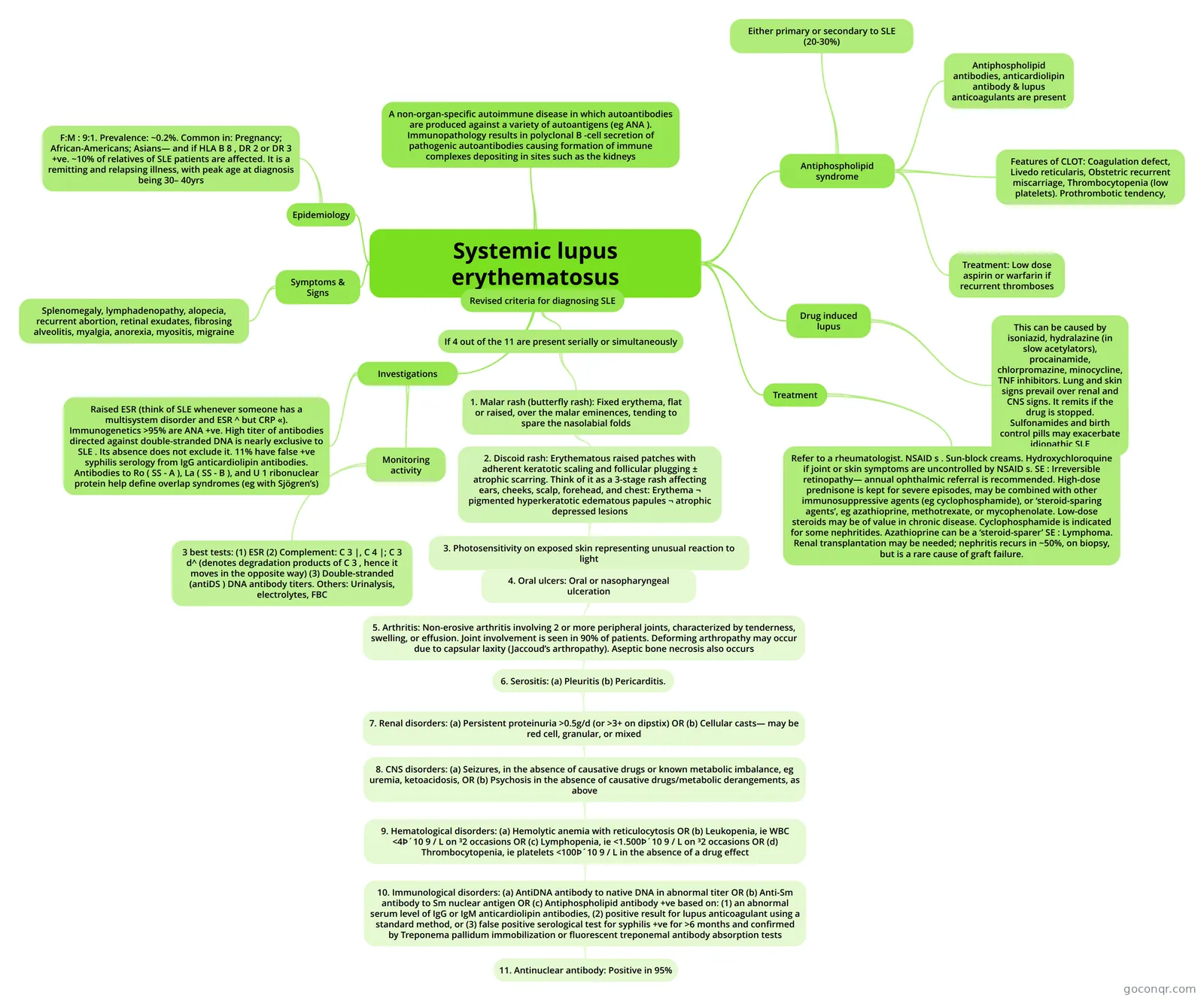
Mind map: Systemic lupus erythematosus
Contenido del mapa
Systemic lupus erythematosus
A non-organ-specific autoimmune disease in which autoantibodies are produced against a variety of autoantigens (eg ANA ). Immunopathology results in polyclonal B -cell secretion of pathogenic autoantibodies causing formation of immune complexes depositing in sites such as the kidneys
Epidemiology
- F:M : 9:1. Prevalence: ~0.2%. Common in: Pregnancy; African-Americans; Asians— and if HLA B 8 , DR 2 or DR 3 +ve. ~10% of relatives of SLE patients are affected. It is a remitting and relapsing illness, with peak age at diagnosis being 30– 40yrs
Symptoms & Signs
- Splenomegaly, lymphadenopathy, alopecia, recurrent abortion, retinal exudates, fibrosing alveolitis, myalgia, anorexia, myositis, migraine
Investigations
- Raised ESR (think of SLE whenever someone has a multisystem disorder and ESR ^ but CRP «). Immunogenetics >95% are ANA +ve. High titer of antibodies directed against double-stranded DNA is nearly exclusive to SLE . Its absence does not exclude it. 11% have false +ve syphilis serology from IgG anticardiolipin antibodies. Antibodies to Ro ( SS - A ), La ( SS - B ), and U 1 ribonuclear protein help define overlap syndromes (eg with Sjögren’s)
- Monitoring activity
- 3 best tests: (1) ESR (2) Complement: C 3 |, C 4 |; C 3 d^ (denotes degradation products of C 3 , hence it moves in the opposite way) (3) Double-stranded (antiDS ) DNA antibody titers. Others: Urinalysis, electrolytes, FBC
Drug induced lupus
- This can be caused by isoniazid, hydralazine (in slow acetylators), procainamide, chlorpromazine, minocycline, TNF inhibitors. Lung and skin signs prevail over renal and CNS signs. It remits if the drug is stopped. Sulfonamides and birth control pills may exacerbate idiopathic SLE
Antiphospholipid syndrome
- Either primary or secondary to SLE (20-30%)
- Antiphospholipid antibodies, anticardiolipin antibody & lupus anticoagulants are present
- Features of CLOT: Coagulation defect, Livedo reticularis, Obstetric recurrent miscarriage, Thrombocytopenia (low platelets). Prothrombotic tendency,
- Treatment: Low dose aspirin or warfarin if recurrent thromboses
Treatment
- Refer to a rheumatologist. NSAID s . Sun-block creams. Hydroxychloroquine if joint or skin symptoms are uncontrolled by NSAID s. SE : Irreversible retinopathy— annual ophthalmic referral is recommended. High-dose prednisone is kept for severe episodes, may be combined with other immunosuppressive agents (eg cyclophosphamide), or ‘steroid-sparing agents’, eg azathioprine, methotrexate, or mycophenolate. Low-dose steroids may be of value in chronic disease. Cyclophosphamide is indicated for some nephritides. Azathioprine can be a ‘steroid-sparer’ SE : Lymphoma. Renal transplantation may be needed; nephritis recurs in ~50%, on biopsy, but is a rare cause of graft failure.
Revised criteria for diagnosing SLE
- If 4 out of the 11 are present serially or simultaneously
- 1. Malar rash (butterfly rash): Fixed erythema, flat or raised, over the malar eminences, tending to spare the nasolabial folds
- 2. Discoid rash: Erythematous raised patches with adherent keratotic scaling and follicular plugging ± atrophic scarring. Think of it as a 3-stage rash affecting ears, cheeks, scalp, forehead, and chest: Erythema ¬ pigmented hyperkeratotic edematous papules ¬ atrophic depressed lesions
- 3. Photosensitivity on exposed skin representing unusual reaction to light
- 4. Oral ulcers: Oral or nasopharyngeal ulceration
- 5. Arthritis: Non-erosive arthritis involving 2 or more peripheral joints, characterized by tenderness, swelling, or effusion. Joint involvement is seen in 90% of patients. Deforming arthropathy may occur due to capsular laxity (Jaccoud’s arthropathy). Aseptic bone necrosis also occurs
- 6. Serositis: (a) Pleuritis (b) Pericarditis.
- 7. Renal disorders: (a) Persistent proteinuria >0.5g/d (or >3+ on dipstix) OR (b) Cellular casts— may be red cell, granular, or mixed
- 8. CNS disorders: (a) Seizures, in the absence of causative drugs or known metabolic imbalance, eg uremia, ketoacidosis, OR (b) Psychosis in the absence of causative drugs/metabolic derangements, as above
- 9. Hematological disorders: (a) Hemolytic anemia with reticulocytosis OR (b) Leukopenia, ie WBC <4Þ´10 9 / L on ³2 occasions OR (c) Lymphopenia, ie <1.500Þ´10 9 / L on ³2 occasions OR (d) Thrombocytopenia, ie platelets <100Þ´10 9 / L in the absence of a drug effect
- 10. Immunological disorders: (a) AntiDNA antibody to native DNA in abnormal titer OR (b) Anti-Sm antibody to Sm nuclear antigen OR (c) Antiphospholipid antibody +ve based on: (1) an abnormal serum level of IgG or IgM anticardiolipin antibodies, (2) positive result for lupus anticoagulant using a standard method, or (3) false positive serological test for syphilis +ve for >6 months and confirmed by Treponema pallidum immobilization or fluorescent treponemal antibody absorption tests
- 11. Antinuclear antibody: Positive in 95%
- 10. Immunological disorders: (a) AntiDNA antibody to native DNA in abnormal titer OR (b) Anti-Sm antibody to Sm nuclear antigen OR (c) Antiphospholipid antibody +ve based on: (1) an abnormal serum level of IgG or IgM anticardiolipin antibodies, (2) positive result for lupus anticoagulant using a standard method, or (3) false positive serological test for syphilis +ve for >6 months and confirmed by Treponema pallidum immobilization or fluorescent treponemal antibody absorption tests
- 9. Hematological disorders: (a) Hemolytic anemia with reticulocytosis OR (b) Leukopenia, ie WBC <4Þ´10 9 / L on ³2 occasions OR (c) Lymphopenia, ie <1.500Þ´10 9 / L on ³2 occasions OR (d) Thrombocytopenia, ie platelets <100Þ´10 9 / L in the absence of a drug effect
- 8. CNS disorders: (a) Seizures, in the absence of causative drugs or known metabolic imbalance, eg uremia, ketoacidosis, OR (b) Psychosis in the absence of causative drugs/metabolic derangements, as above
- 7. Renal disorders: (a) Persistent proteinuria >0.5g/d (or >3+ on dipstix) OR (b) Cellular casts— may be red cell, granular, or mixed
- 6. Serositis: (a) Pleuritis (b) Pericarditis.
- 5. Arthritis: Non-erosive arthritis involving 2 or more peripheral joints, characterized by tenderness, swelling, or effusion. Joint involvement is seen in 90% of patients. Deforming arthropathy may occur due to capsular laxity (Jaccoud’s arthropathy). Aseptic bone necrosis also occurs
- 4. Oral ulcers: Oral or nasopharyngeal ulceration
- 3. Photosensitivity on exposed skin representing unusual reaction to light
- 2. Discoid rash: Erythematous raised patches with adherent keratotic scaling and follicular plugging ± atrophic scarring. Think of it as a 3-stage rash affecting ears, cheeks, scalp, forehead, and chest: Erythema ¬ pigmented hyperkeratotic edematous papules ¬ atrophic depressed lesions
- 1. Malar rash (butterfly rash): Fixed erythema, flat or raised, over the malar eminences, tending to spare the nasolabial folds
- If 4 out of the 11 are present serially or simultaneously
Información
- Descripción
- Mapa Mental sobre Systemic lupus erythematosus, creado por emailk8 el 11/01/2014.
- Creado por
- emailk8
- Visitas
- 82
- Valoración