
Mapa mental
Physics P2
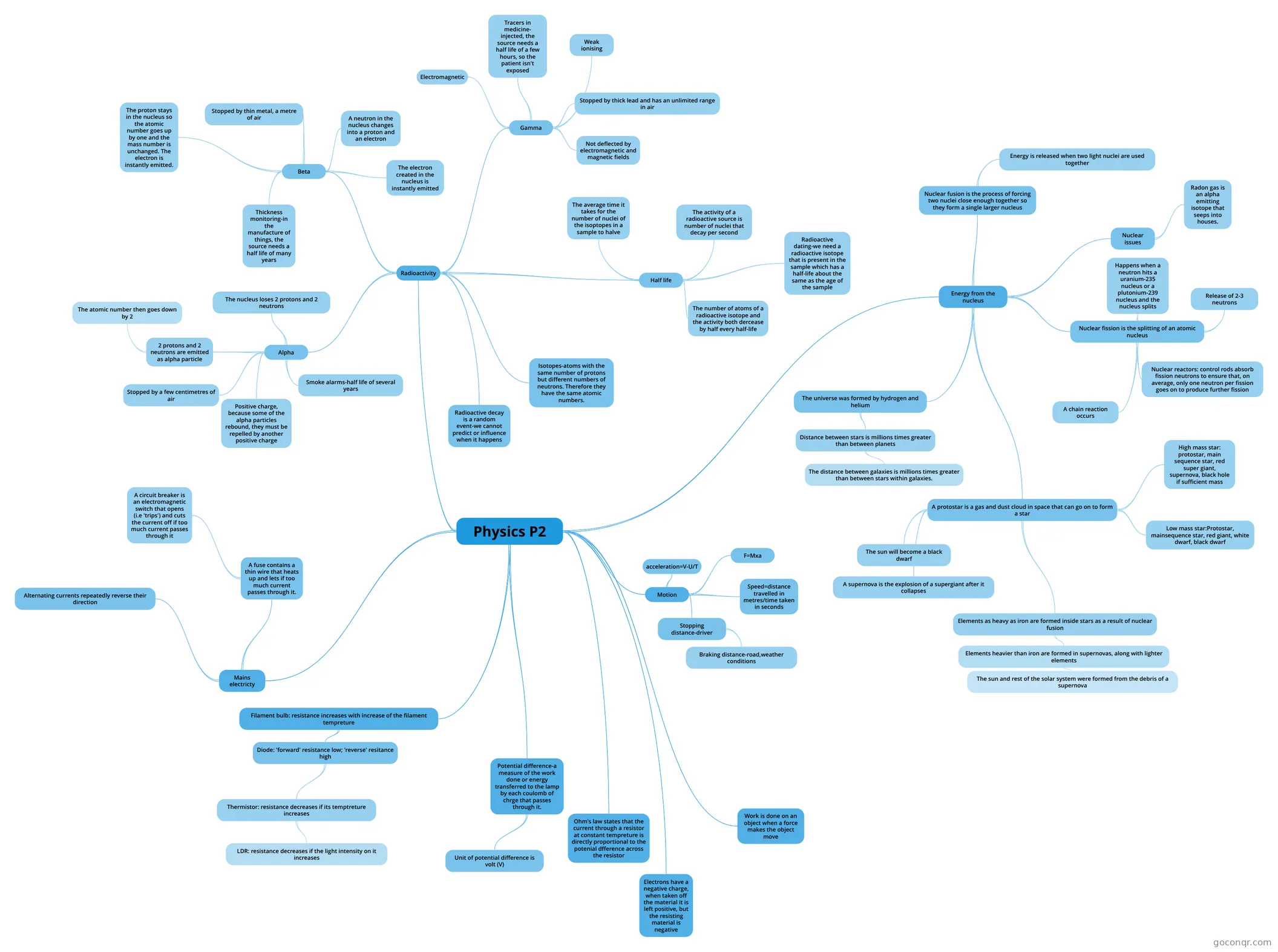
Mind map: physics P2
Contenido del mapa
Physics P2
Motion
- acceleration=V-U/T
- F=Mxa
- Speed=distance travelled in metres/time taken in seconds
- Stopping distance-driver
- Braking distance-road,weather conditions
Work is done on an object when a force makes the object move
Electrons have a negative charge, when taken off the material it is left positive, but the resisting material is negative
Ohm's law states that the current through a resistor at constant tempreture is directly proportional to the potenial dfference across the resistor
Potential difference-a measure of the work done or energy transferred to the lamp by each coulomb of chrge that passes through it.
- Unit of potential difference is volt (V)
Filament bulb: resistance increases with increase of the filament tempreture
- Diode: 'forward' resistance low; 'reverse' resitance high
- Thermistor: resistance decreases if its temptreture increases
- LDR: resistance decreases if the light intensity on it increases
- Thermistor: resistance decreases if its temptreture increases
- Diode: 'forward' resistance low; 'reverse' resitance high
Mains electricty
- Alternating currents repeatedly reverse their direction
- A fuse contains a thin wire that heats up and lets if too much current passes through it.
- A circuit breaker is an electromagnetic switch that opens (i.e 'trips') and cuts the current off if too much current passes through it
Radioactivity
- Gamma
- Stopped by thick lead and has an unlimited range in air
- Electromagnetic
- Weak ionising
- Not deflected by electromagnetic and magnetic fields
- Tracers in medicine- injected, the source needs a half life of a few hours, so the patient isn't exposed
- Beta
- A neutron in the nucleus changes into a proton and an electron
- The electron created in the nucleus is instantly emitted
- The proton stays in the nucleus so the atomic number goes up by one and the mass number is unchanged. The electron is instantly emitted.
- Stopped by thin metal, a metre of air
- Thickness monitoring-in the manufacture of things, the source needs a half life of many years
- Alpha
- Positive charge, because some of the alpha particles rebound, they must be repelled by another positive charge
- The nucleus loses 2 protons and 2 neutrons
- 2 protons and 2 neutrons are emitted as alpha particle
- The atomic number then goes down by 2
- Stopped by a few centimetres of air
- Smoke alarms-half life of several years
- Radioactive decay is a random event-we cannot predict or influence when it happens
- Isotopes-atoms with the same number of protons but different numbers of neutrons. Therefore they have the same atomic numbers.
- Half life
- The average time it takes for the number of nuclei of the isoptopes in a sample to halve
- The activity of a radioactive source is number of nuclei that decay per second
- The number of atoms of a radioactive isotope and the activity both dercease by half every half-life
- Radioactive dating-we need a radioactive isotope that is present in the sample which has a half-life about the same as the age of the sample
- Gamma
Energy from the nucleus
- Nuclear fission is the splitting of an atomic nucleus
- Release of 2-3 neutrons
- Happens when a neutron hits a uranium-235 nucleus or a plutonium-239 nucleus and the nucleus splits
- A chain reaction occurs
- Nuclear reactors: control rods absorb fission neutrons to ensure that, on average, only one neutron per fission goes on to produce further fission
- Nuclear fusion is the process of forcing two nuclei close enough together so they form a single larger nucleus
- Energy is released when two light nuclei are used together
- Nuclear issues
- Radon gas is an alpha emitting isotope that seeps into houses.
- The universe was formed by hydrogen and helium
- Distance between stars is millions times greater than between planets
- The distance between galaxies is millions times greater than between stars within galaxies.
- Distance between stars is millions times greater than between planets
- A protostar is a gas and dust cloud in space that can go on to form a star
- Low mass star:Protostar, mainsequence star, red giant, white dwarf, black dwarf
- High mass star: protostar, main sequence star, red super giant, supernova, black hole if sufficient mass
- The sun will become a black dwarf
- A supernova is the explosion of a supergiant after it collapses
- Elements as heavy as iron are formed inside stars as a result of nuclear fusion
- Elements heavier than iron are formed in supernovas, along with lighter elements
- The sun and rest of the solar system were formed from the debris of a supernova
- Elements heavier than iron are formed in supernovas, along with lighter elements
- Nuclear fission is the splitting of an atomic nucleus
Información
- Descripción
- Physics Mapa Mental sobre Physics P2, creado por matthewbrookenay el 29/04/2013.
- Creado por
- matthewbrookenay
- Visitas
- 213
- Etiquetas
- Valoración