
Mapa mental
Electrons, bonding and structure
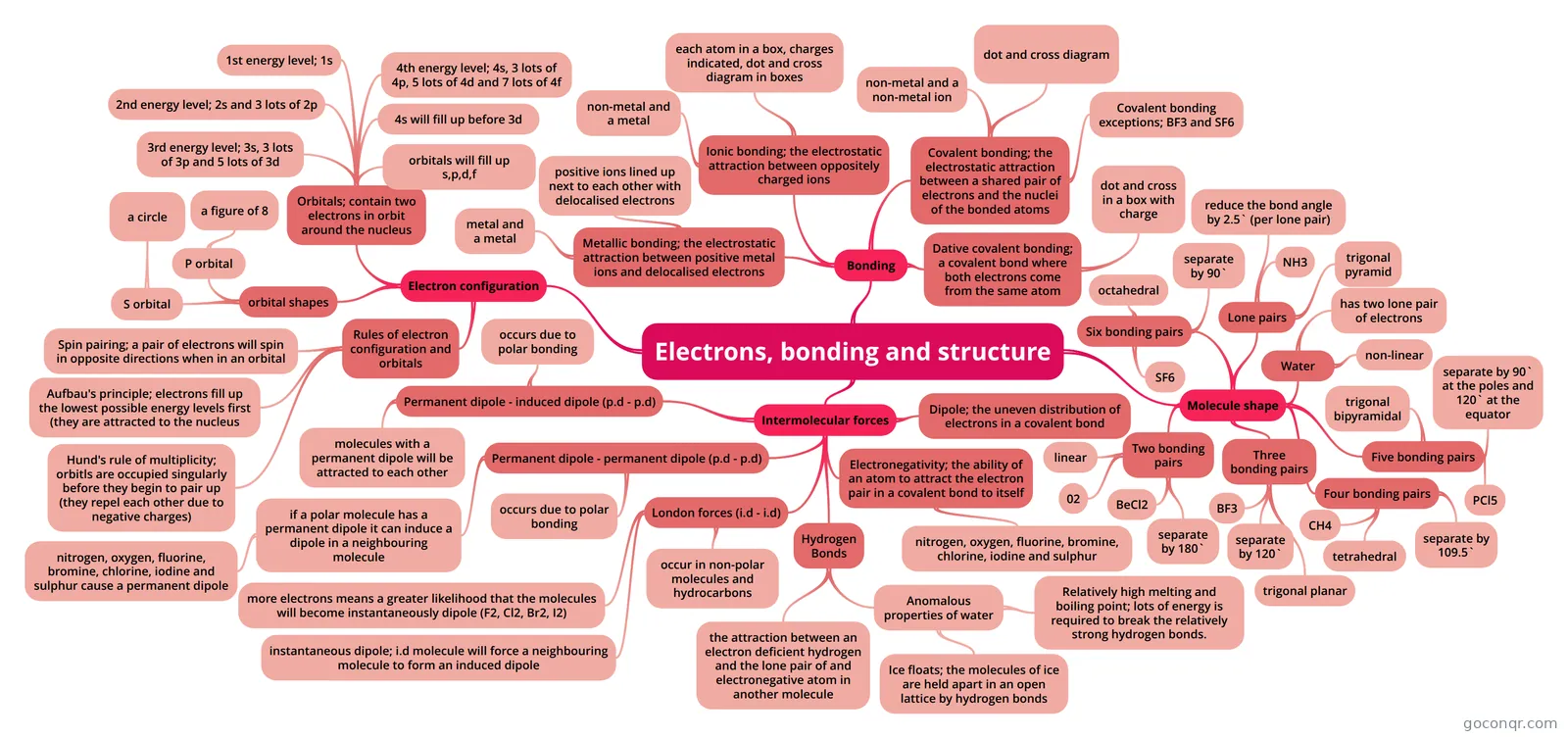
Mind map: Electrons, bonding and structure
Contenido del mapa
Electrons, bonding and structure
Electron configuration
- Orbitals; contain two electrons in orbit around the nucleus
- 1st energy level; 1s
- 2nd energy level; 2s and 3 lots of 2p
- 3rd energy level; 3s, 3 lots of 3p and 5 lots of 3d
- 4th energy level; 4s, 3 lots of 4p, 5 lots of 4d and 7 lots of 4f
- 4s will fill up before 3d
- orbitals will fill up s,p,d,f
- Rules of electron configuration and orbitals
- Aufbau's principle; electrons fill up the lowest possible energy levels first (they are attracted to the nucleus
- Hund's rule of multiplicity; orbitls are occupied singularly before they begin to pair up (they repel each other due to negative charges)
- Spin pairing; a pair of electrons will spin in opposite directions when in an orbital
- orbital shapes
- S orbital
- a circle
- P orbital
- a figure of 8
- S orbital
- Orbitals; contain two electrons in orbit around the nucleus
Bonding
- Metallic bonding; the electrostatic attraction between positive metal ions and delocalised electrons
- positive ions lined up next to each other with delocalised electrons
- metal and a metal
- Covalent bonding; the electrostatic attraction between a shared pair of electrons and the nuclei of the bonded atoms
- non-metal and a non-metal ion
- dot and cross diagram
- Covalent bonding exceptions; BF3 and SF6
- Ionic bonding; the electrostatic attraction between oppositely charged ions
- non-metal and a metal
- each atom in a box, charges indicated, dot and cross diagram in boxes
- Dative covalent bonding; a covalent bond where both electrons come from the same atom
- dot and cross in a box with charge
- Metallic bonding; the electrostatic attraction between positive metal ions and delocalised electrons
Molecule shape
- Two bonding pairs
- separate by 180`
- linear
- BeCl2
- 02
- Three bonding pairs
- separate by 120`
- BF3
- trigonal planar
- Four bonding pairs
- separate by 109.5`
- CH4
- tetrahedral
- Five bonding pairs
- separate by 90` at the poles and 120` at the equator
- PCl5
- trigonal bipyramidal
- Six bonding pairs
- separate by 90`
- octahedral
- SF6
- Lone pairs
- reduce the bond angle by 2.5` (per lone pair)
- NH3
- trigonal pyramid
- Water
- non-linear
- has two lone pair of electrons
- Two bonding pairs
Intermolecular forces
- London forces (i.d - i.d)
- occur in non-polar molecules and hydrocarbons
- instantaneous dipole; i.d molecule will force a neighbouring molecule to form an induced dipole
- more electrons means a greater likelihood that the molecules will become instantaneously dipole (F2, Cl2, Br2, I2)
- Permanent dipole - induced dipole (p.d - p.d)
- molecules with a permanent dipole will be attracted to each other
- occurs due to polar bonding
- Permanent dipole - permanent dipole (p.d - p.d)
- occurs due to polar bonding
- if a polar molecule has a permanent dipole it can induce a dipole in a neighbouring molecule
- nitrogen, oxygen, fluorine, bromine, chlorine, iodine and sulphur cause a permanent dipole
- Hydrogen Bonds
- the attraction between an electron deficient hydrogen and the lone pair of and electronegative atom in another molecule
- Anomalous properties of water
- Relatively high melting and boiling point; lots of energy is required to break the relatively strong hydrogen bonds.
- Ice floats; the molecules of ice are held apart in an open lattice by hydrogen bonds
- Dipole; the uneven distribution of electrons in a covalent bond
- Electronegativity; the ability of an atom to attract the electron pair in a covalent bond to itself
- nitrogen, oxygen, fluorine, bromine, chlorine, iodine and sulphur
- London forces (i.d - i.d)
Información
- Descripción
- a mind map all about the electrons, bonding and structure of atoms and molecules as taught by the ocr chemistry a level (foundations in chemistry - module two)
- Creado por
- Raisha Gibbs
- Visitas
- 119
- Etiquetas
- Valoración