
Mapa mental
Skeletal and muscular systems
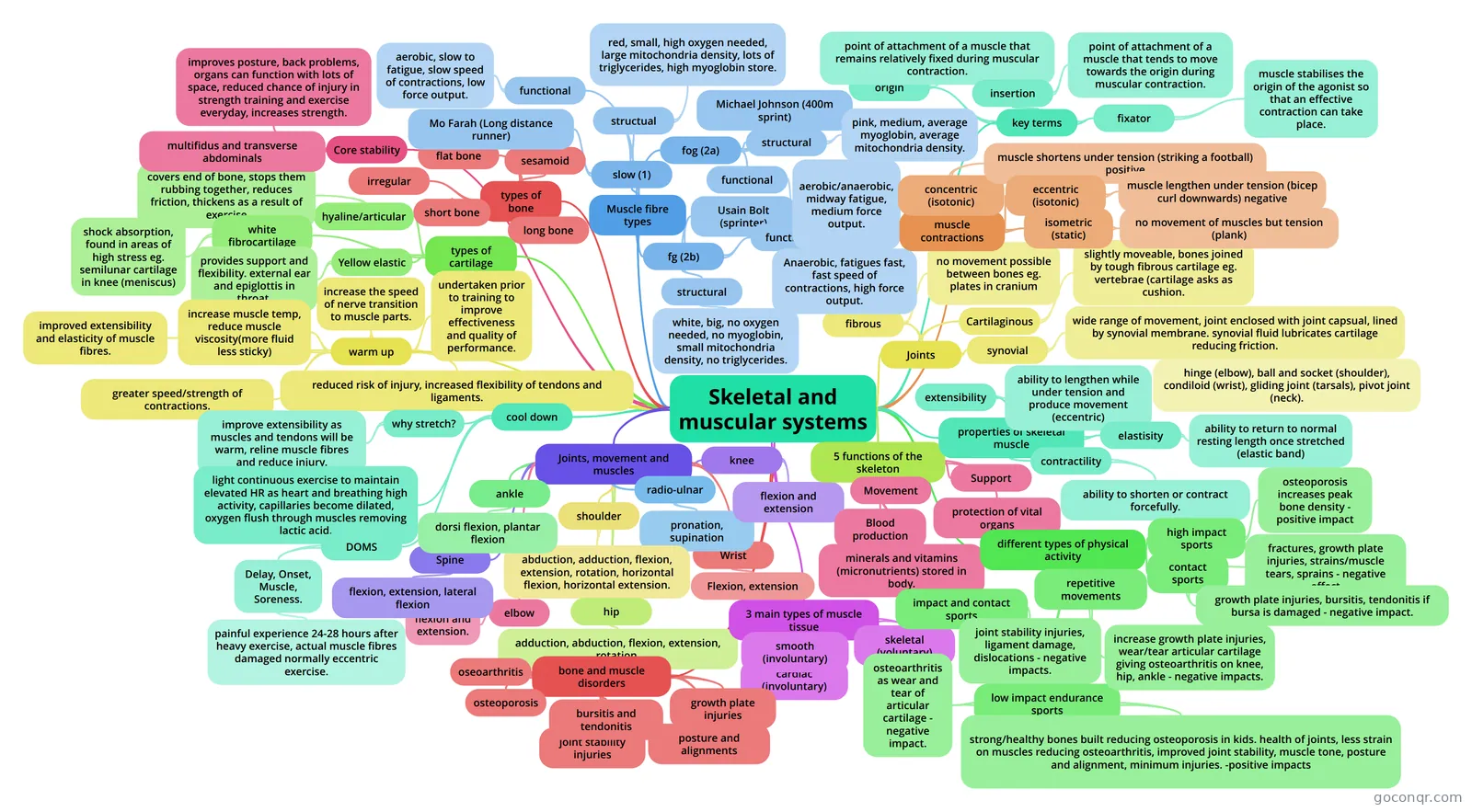
Mind map: Skeletal and muscular systems
Contenido del mapa
Skeletal and muscular systems
Joints, movement and muscles
- Wrist
- Flexion, extension
- radio-ulnar
- pronation, supination
- elbow
- flexion and extension.
- shoulder
- abduction, adduction, flexion, extension, rotation, horizontal flexion, horizontal extension.
- Spine
- flexion, extension, lateral flexion
- hip
- adduction, abduction, flexion, extension, rotation.
- knee
- flexion and extension
- ankle
- dorsi flexion, plantar flexion
- Wrist
5 functions of the skeleton
- protection of vital organs
- Movement
- minerals and vitamins (micronutrients) stored in body.
- Blood production
- Support
types of bone
- long bone
- short bone
- flat bone
- irregular
- sesamoid
Joints
- fibrous
- no movement possible between bones eg. plates in cranium
- Cartilaginous
- slightly moveable, bones joined by tough fibrous cartilage eg. vertebrae (cartilage asks as cushion.
- synovial
- wide range of movement, joint enclosed with joint capsual, lined by synovial membrane. synovial fluid lubricates cartilage reducing friction.
- hinge (elbow), ball and socket (shoulder), condiloid (wrist), gliding joint (tarsals), pivot joint (neck).
- wide range of movement, joint enclosed with joint capsual, lined by synovial membrane. synovial fluid lubricates cartilage reducing friction.
- fibrous
types of cartilage
- hyaline/articular
- covers end of bone, stops them rubbing together, reduces friction, thickens as a result of exercise
- white fibrocartilage
- shock absorption, found in areas of high stress eg. semilunar cartilage in knee (meniscus)
- Yellow elastic
- provides support and flexibility. external ear and epiglottis in throat.
- hyaline/articular
properties of skeletal muscle
- extensibility
- ability to lengthen while under tension and produce movement (eccentric)
- elastisity
- ability to return to normal resting length once stretched (elastic band)
- contractility
- ability to shorten or contract forcefully.
- extensibility
3 main types of muscle tissue
- skeletal (voluntary)
- cardiac (involuntary)
- smooth (involuntary)
Core stability
- multifidus and transverse abdominals
- improves posture, back problems, organs can function with lots of space, reduced chance of injury in strength training and exercise everyday, increases strength.
Muscle fibre types
- slow (1)
- Mo Farah (Long distance runner)
- structual
- red, small, high oxygen needed, large mitochondria density, lots of triglycerides, high myoglobin store.
- functional
- aerobic, slow to fatigue, slow speed of contractions, low force output.
- fog (2a)
- Michael Johnson (400m sprint)
- structural
- pink, medium, average myoglobin, average mitochondria density.
- functional
- aerobic/anaerobic, midway fatigue, medium force output.
- fg (2b)
- Usain Bolt (sprinter)
- structural
- white, big, no oxygen needed, no myoglobin, small mitochondria density, no triglycerides.
- functional
- Anaerobic, fatigues fast, fast speed of contractions, high force output.
- slow (1)
muscle contractions
- concentric (isotonic)
- muscle shortens under tension (striking a football) positive
- eccentric (isotonic)
- muscle lengthen under tension (bicep curl downwards) negative
- isometric (static)
- no movement of muscles but tension (plank)
- concentric (isotonic)
key terms
- origin
- point of attachment of a muscle that remains relatively fixed during muscular contraction.
- insertion
- point of attachment of a muscle that tends to move towards the origin during muscular contraction.
- fixator
- muscle stabilises the origin of the agonist so that an effective contraction can take place.
- origin
warm up
- undertaken prior to training to improve effectiveness and quality of performance.
- increase the speed of nerve transition to muscle parts.
- increase muscle temp, reduce muscle viscosity(more fluid less sticky)
- improved extensibility and elasticity of muscle fibres.
- greater speed/strength of contractions.
- reduced risk of injury, increased flexibility of tendons and ligaments.
cool down
- why stretch?
- improve extensibility as muscles and tendons will be warm, reline muscle fibres and reduce injury.
- light continuous exercise to maintain elevated HR as heart and breathing high activity, capillaries become dilated, oxygen flush through muscles removing lactic acid.
- DOMS
- Delay, Onset, Muscle, Soreness.
- painful experience 24-28 hours after heavy exercise, actual muscle fibres damaged normally eccentric exercise.
- Delay, Onset, Muscle, Soreness.
- why stretch?
bone and muscle disorders
- osteoporosis
- oseoarthritis
- growth plate injuries
- posture and alignments
- joint stability injuries
- bursitis and tendonitis
different types of physical activity
- high impact sports
- osteoporosis increases peak bone density - positive impact
- fractures, growth plate injuries, strains/muscle tears, sprains - negative effect
- low impact endurance sports
- strong/healthy bones built reducing osteoporosis in kids. health of joints, less strain on muscles reducing osteoarthritis, improved joint stability, muscle tone, posture and alignment, minimum injuries. -positive impacts
- osteoarthritis as wear and tear of articular cartilage - negative impact.
- contact sports
- growth plate injuries, bursitis, tendonitis if bursa is damaged - negative impact.
- repetitive movements
- increase growth plate injuries, wear/tear articular cartilage giving osteoarthritis on knee, hip, ankle - negative impacts.
- impact and contact sports
- joint stability injuries, ligament damage, dislocations - negative impacts.
- high impact sports
Información
- Descripción
- Mapa Mental sobre Skeletal and muscular systems, creado por rebeccalock184 el 30/03/2014.
- Creado por
- rebeccalock184
- Visitas
- 25
- Valoración