
Mapa mental
Sound and Ultrasound
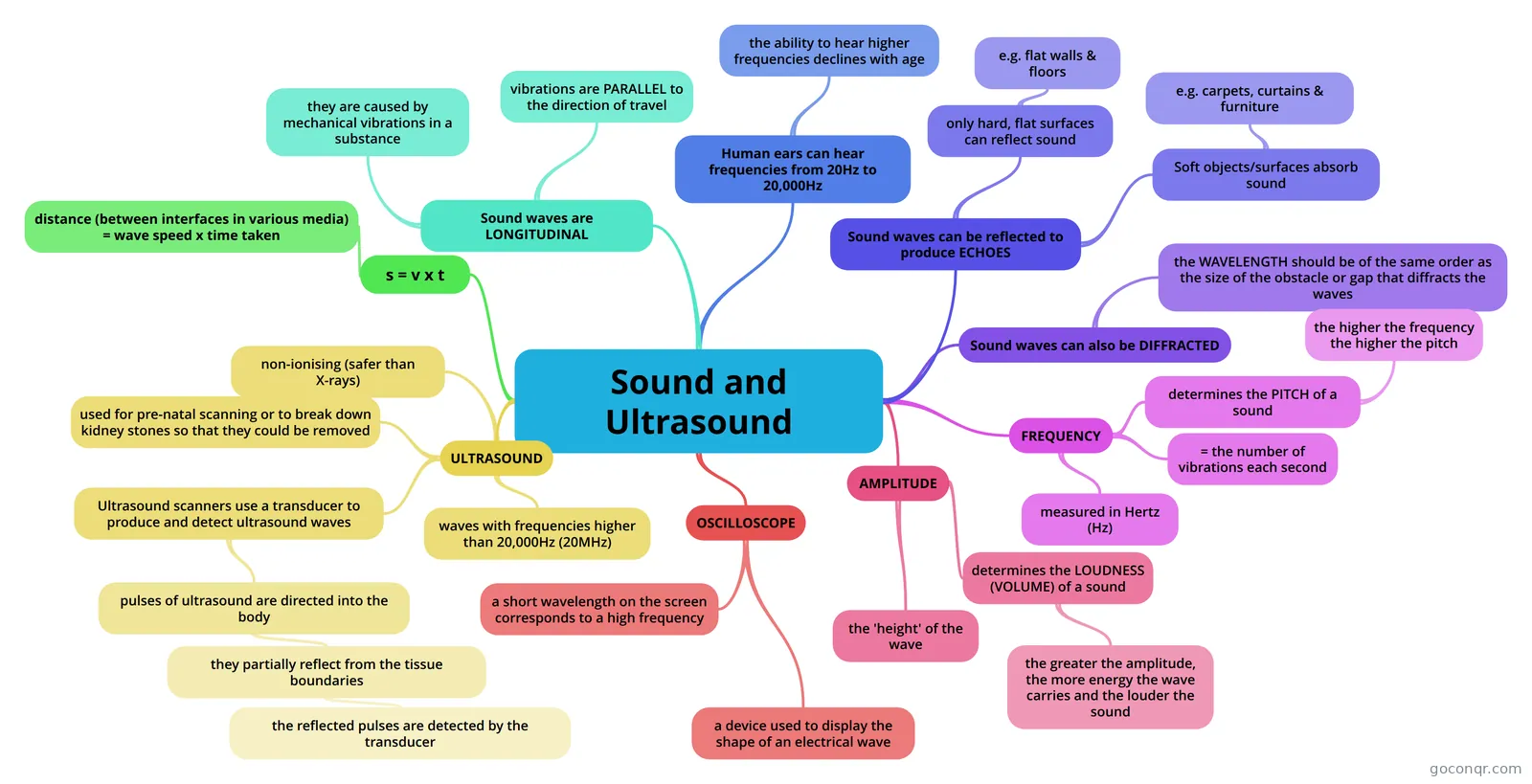
Mind map: Sound and ultrasound
Contenido del mapa
Sound and Ultrasound
Sound waves are LONGITUDINAL
- they are caused by mechanical vibrations in a substance
- vibrations are PARALLEL to the direction of travel
Human ears can hear frequencies from 20Hz to 20,000Hz
- the ability to hear higher frequencies declines with age
Sound waves can be reflected to produce ECHOES
- When calculating the distance of a reflecting surface from a person, remember that an echo goes there and back (divide by two) E.G. Sound travels at 340m/s. A person hears an echo 0.4 seconds after shouting - how far away is the reflecting surface? (340 x 0.4) = 136 136/2 = 68m
- only hard, flat surfaces can reflect sound
- e.g. flat walls & floors
- Soft objects/surfaces absorb sound
- e.g. carpets, curtains & furniture
Sound waves can also be DIFFRACTED
- the WAVELENGTH should be of the same order as the size of the obstacle or gap that diffracts the waves
FREQUENCY
- determines the PITCH of a sound
- the higher the frequency the higher the pitch
- = the number of vibrations each second
- measured in Hertz (Hz)
- determines the PITCH of a sound
AMPLITUDE
- determines the LOUDNESS (VOLUME) of a sound
- the greater the amplitude, the more energy the wave carries and the louder the sound
- the 'height' of the wave
- determines the LOUDNESS (VOLUME) of a sound
OSCILLOSCOPE
- a device used to display the shape of an electrical wave
- a short wavelength on the screen corresponds to a high frequency
ULTRASOUND
- waves with frequencies higher than 20,000Hz (20MHz)
- non-ionising (safer than X-rays)
- used for pre-natal scanning or to break down kidney stones so that they could be removed
- Ultrasound scanners use a transducer to produce and detect ultrasound waves
- Again, the echoes are going there AND back, so the calculations will probably be halved again
- pulses of ultrasound are directed into the body
- they partially reflect from the tissue boundaries
- the reflected pulses are detected by the transducer
- they partially reflect from the tissue boundaries
s = v x t
- distance (between interfaces in various media) = wave speed x time taken
Información
- Descripción
- Cambridge IGCSE (2.Waves) Physics Mapa Mental sobre Sound and Ultrasound, creado por franfrog10 el 31/03/2014.
- Creado por
- franfrog10
- Visitas
- 62
- Etiquetas
- Valoración