
Mapa mental
Fourier Analysis
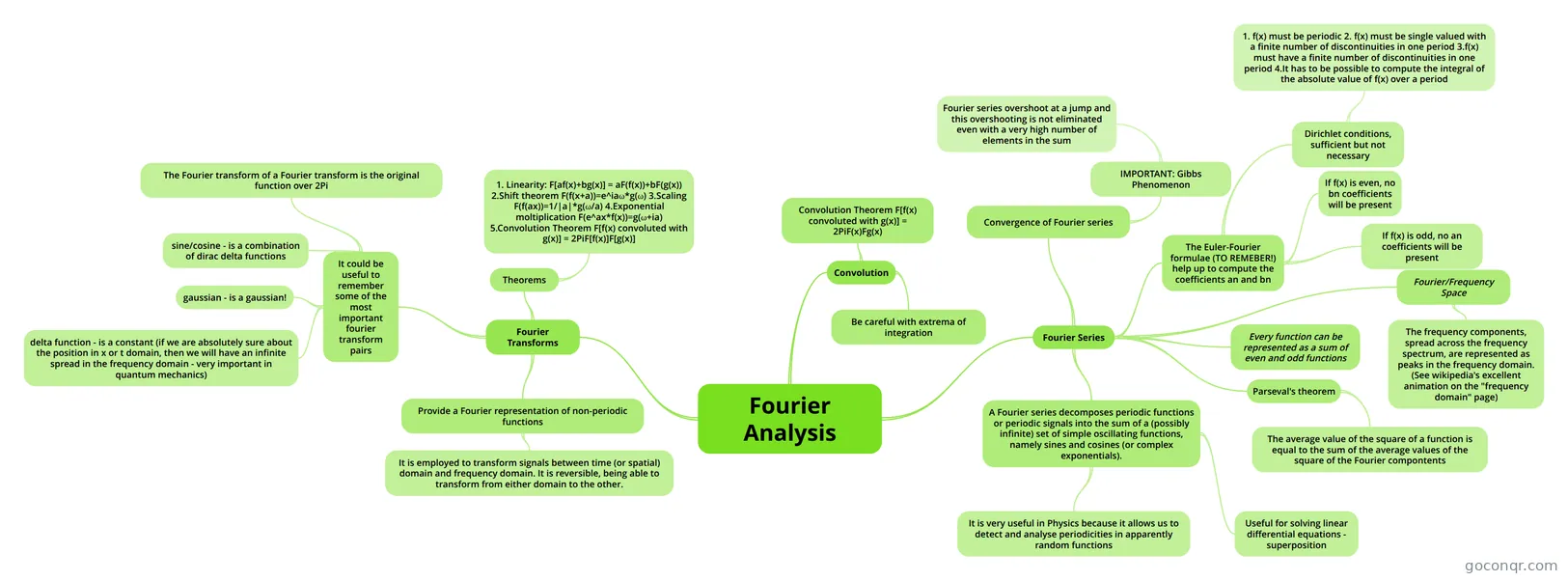
Mind map: Fourier analysis
Contenido del mapa
Fourier Analysis
Fourier Series
- A Fourier series decomposes periodic functions or periodic signals into the sum of a (possibly infinite) set of simple oscillating functions, namely sines and cosines (or complex exponentials).
- It is very useful in Physics because it allows us to detect and analyse periodicities in apparently random functions
- Useful for solving linear differential equations - superposition
- Every function can be represented as a sum of even and odd functions
- The Euler-Fourier formulae (TO REMEBER!) help up to compute the coefficients an and bn
- If f(x) is odd, no an coefficients will be present
- If f(x) is even, no bn coefficients will be present
- Dirichlet conditions, sufficient but not necessary
- 1. f(x) must be periodic 2. f(x) must be single valued with a finite number of discontinuities in one period 3.f(x) must have a finite number of discontinuities in one period 4.It has to be possible to compute the integral of the absolute value of f(x) over a period
- Convergence of Fourier series
- IMPORTANT: Gibbs Phenomenon
- Fourier series overshoot at a jump and this overshooting is not eliminated even with a very high number of elements in the sum
- IMPORTANT: Gibbs Phenomenon
- Fourier/Frequency Space
- The frequency components, spread across the frequency spectrum, are represented as peaks in the frequency domain. (See wikipedia's excellent animation on the "frequency domain" page)
- Parseval's theorem
- The average value of the square of a function is equal to the sum of the average values of the square of the Fourier compontents
- A Fourier series decomposes periodic functions or periodic signals into the sum of a (possibly infinite) set of simple oscillating functions, namely sines and cosines (or complex exponentials).
Fourier Transforms
- Provide a Fourier representation of non-periodic functions
- It is employed to transform signals between time (or spatial) domain and frequency domain. It is reversible, being able to transform from either domain to the other.
- It could be useful to remember some of the most important fourier transform pairs
- sine/cosine - is a combination of dirac delta functions
- delta function - is a constant (if we are absolutely sure about the position in x or t domain, then we will have an infinite spread in the frequency domain - very important in quantum mechanics)
- gaussian - is a gaussian!
- The Fourier transform of a Fourier transform is the original function over 2Pi
- Theorems
- 1. Linearity: F[af(x)+bg(x)] = aF(f(x))+bF(g(x)) 2.Shift theorem F(f(x+a))=e^iaω*g(ω) 3.Scaling F(f(ax))=1/|a|*g(ω/a) 4.Exponential moltiplication F(e^ax*f(x))=g(ω+ia) 5.Convolution Theorem F[f(x) convoluted with g(x)] = 2PiF[f(x)]F[g(x)]
- Provide a Fourier representation of non-periodic functions
Convolution
- Convolution Theorem F[f(x) convoluted with g(x)] = 2PiF(x)Fg(x)
- Be careful with extrema of integration
Información
- Descripción
- Mapa Mental sobre Fourier Analysis, creado por lucio_milanese el 31/03/2014.
- Creado por
- lucio_milanese
- Visitas
- 743
- Valoración