
Mapa mental
Statistical Physics
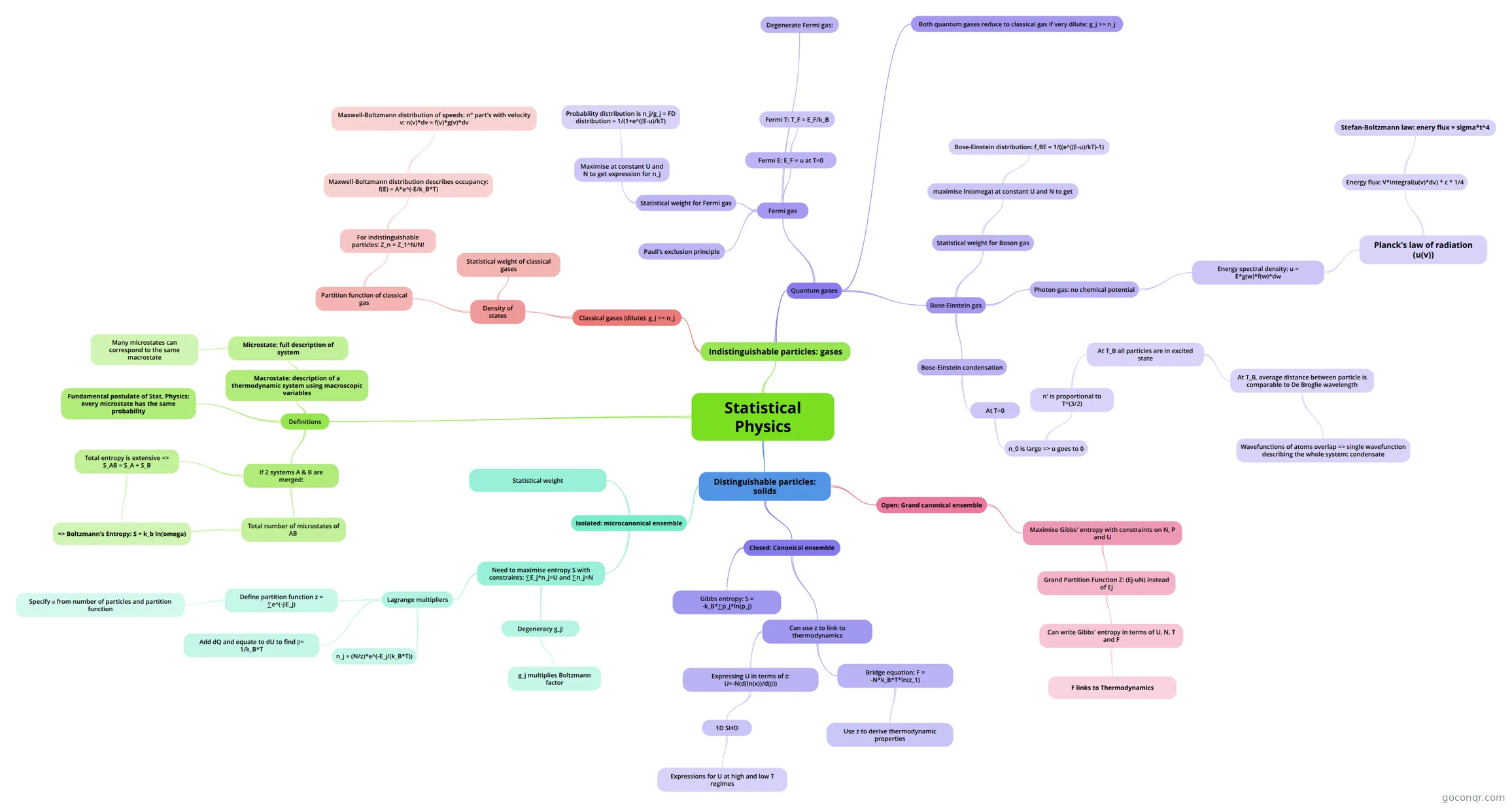
Mind map: Statistical physics
Contenido del mapa
Statistical Physics
Definitions
- Macrostate: description of a thermodynamic system using macroscopic variables
- Microstate: full description of system
- Many microstates can correspond to the same macrostate
- Microstate: full description of system
- Fundamental postulate of Stat. Physics: every microstate has the same probability
- If 2 systems A & B are merged:
- Total entropy is extensive => S_AB = S_A + S_B
- => Boltzmann's Entropy: S = k_b ln(omega)
- Total number of microstates of AB
- Total entropy is extensive => S_AB = S_A + S_B
- Macrostate: description of a thermodynamic system using macroscopic variables
Distinguishable particles: solids
- Isolated: microcanonical ensemble
- Statistical weight
- Need to maximise entropy S with constraints: ∑E_j*n_j=U and ∑n_j=N
- Lagrange multipliers
- Define partition function z = ∑e^(-βE_j)
- Specify α from number of particles and partition function
- Add dQ and equate to dU to find β= 1/k_B*T
- n_j = (N/z)*e^(-E_j/(k_B*T))
- Define partition function z = ∑e^(-βE_j)
- Degeneracy g_j:
- g_j multiplies Boltzmann factor
- Lagrange multipliers
- Closed: Canonical ensemble
- Heat baths: heat can leave or enter. e.g. Glass of water, single atom in solid. T is constant
- Gibbs entropy: S = -k_B*∑p_j*ln(p_j)
- Can use z to link to thermodynamics
- Expressing U in terms of z: U=-N(d(ln(x))/d(β))
- 1D SHO
- Expressions for U at high and low T regimes
- 1D SHO
- Bridge equation: F = -N*k_B*T*ln(z_1)
- Use z to derive thermodynamic properties
- Expressing U in terms of z: U=-N(d(ln(x))/d(β))
- Open: Grand canonical ensemble
- Maximise Gibbs' entropy with constraints on N, P and U
- Grand Partition Function Z: (Ej-uN) instead of Ej
- Can write Gibbs' entropy in terms of U, N, T and F
- F links to Thermodynamics
- Can write Gibbs' entropy in terms of U, N, T and F
- Grand Partition Function Z: (Ej-uN) instead of Ej
- Maximise Gibbs' entropy with constraints on N, P and U
- Isolated: microcanonical ensemble
Indistinguishable particles: gases
- Classical gases (dilute): g_J >> n_j
- Density of states
- Partition function of classical gas
- For indistinguishable particles: Z_n = Z_1^N/N!
- Maxwell-Boltzmann distribution describes occupancy: f(E) = A*e^(-E/k_B*T)
- Maxwell-Boltzmann distribution of speeds: n° part's with velocity v: n(v)*dv = f(v)*g(v)*dv
- Maxwell-Boltzmann distribution describes occupancy: f(E) = A*e^(-E/k_B*T)
- For indistinguishable particles: Z_n = Z_1^N/N!
- Statistical weight of classical gases
- product((g_j^(n_j))/n_j!)
- Partition function of classical gas
- Density of states
- Quantum gases
- Fermi gas
- Statistical weight for Fermi gas
- omega = product(g_j!/n_j!(g_j-n_j)!)
- Maximise at constant U and N to get expression for n_j
- Probability distribution is n_j/g_j = FD distribution = 1/(1+e^((E-u)/kT)
- Pauli's exclusion principle
- Degenerate Fermi gas:
- Fermi E: E_F = u at T=0
- Fermi T: T_F = E_F/k_B
- Statistical weight for Fermi gas
- Bose-Einstein gas
- Statistical weight for Boson gas
- omega = product((n_j+g_j-1)!/(n_j!*(g_j-1)!) which is approximately product(n_j+g_j)!/(n_j!*g_j!)
- maximise ln(omega) at constant U and N to get
- Bose-Einstein distribution: f_BE = 1/((e^((E-u)/kT)-1)
- Photon gas: no chemical potential
- Energy spectral density: u = E*g(w)*f(w)*dw
- E = h_bar w. g(w)dw = V/(2pi)^3 * 4*pi*k^2 dw f(w) = 1/(e^(h_bar*omega/kT)-1)
- Planck's law of radiation (u(v))
- Energy flux: V*integral(u(v)*dv) * c * 1/4
- Note: integral for u gives pi^4/15
- Stefan-Boltzmann law: enery flux = sigma*t^4
- Energy flux: V*integral(u(v)*dv) * c * 1/4
- Energy spectral density: u = E*g(w)*f(w)*dw
- Bose-Einstein condensation
- At T=0
- n_0 is large => u goes to 0
- n' is proportional to T^(3/2)
- And n'/N = (T/T_B)^(3/2), where T_B is Bose Temperature
- At T_B all particles are in excited state
- At T_B, average distance between particle is comparable to De Broglie wavelength
- Wavefunctions of atoms overlap => single wavefunction describing the whole system: condensate
- At T_B, average distance between particle is comparable to De Broglie wavelength
- n' is proportional to T^(3/2)
- n_0 is large => u goes to 0
- At T=0
- Statistical weight for Boson gas
- Both quantum gases reduce to classical gas if very dilute: g_j >> n_j
- Fermi gas
- Classical gases (dilute): g_J >> n_j
Información
- Descripción
- Graduação Thermodynamics & Stat. Physics Mapa Mental sobre Statistical Physics, creado por eg612 el 08/04/2014.
- Creado por
- eg612
- Visitas
- 289
- Etiquetas
- Valoración