
Mapa mental
Topic 1 - Agency - Additional articles
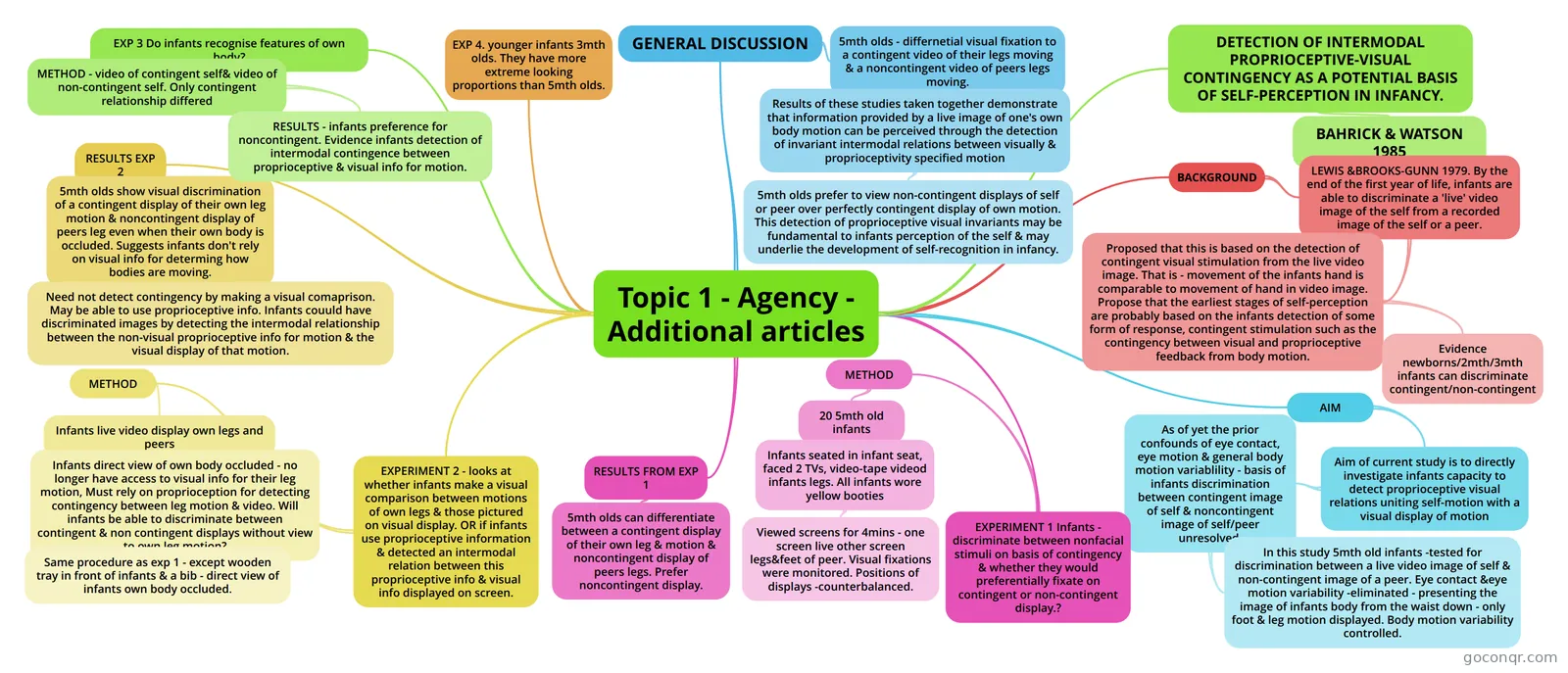
Mind map: proprioceptive-visual contingency in infancy
Contenido del mapa
Topic 1 - Agency - Additional articles
DETECTION OF INTERMODAL PROPRIOCEPTIVE-VISUAL CONTINGENCY AS A POTENTIAL BASIS OF SELF-PERCEPTION IN INFANCY.
- BAHRICK & WATSON 1985
BACKGROUND
- LEWIS &BROOKS-GUNN 1979. By the end of the first year of life, infants are able to discriminate a 'live' video image of the self from a recorded image of the self or a peer.
- Proposed that this is based on the detection of contingent visual stimulation from the live video image. That is - movement of the infants hand is comparable to movement of hand in video image. Propose that the earliest stages of self-perception are probably based on the infants detection of some form of response, contingent stimulation such as the contingency between visual and proprioceptive feedback from body motion.
- Evidence newborns/2mth/3mth infants can discriminate contingent/non-contingent
- Proposed that this is based on the detection of contingent visual stimulation from the live video image. That is - movement of the infants hand is comparable to movement of hand in video image. Propose that the earliest stages of self-perception are probably based on the infants detection of some form of response, contingent stimulation such as the contingency between visual and proprioceptive feedback from body motion.
- LEWIS &BROOKS-GUNN 1979. By the end of the first year of life, infants are able to discriminate a 'live' video image of the self from a recorded image of the self or a peer.
AIM
- Aim of current study is to directly investigate infants capacity to detect proprioceptive visual relations uniting self-motion with a visual display of motion
- As of yet the prior confounds of eye contact, eye motion & general body motion variablility - basis of infants discrimination between contingent image of self & noncontingent image of self/peer unresolved.
- In this study 5mth old infants -tested for discrimination between a live video image of self & non-contingent image of a peer. Eye contact &eye motion variability -eliminated - presenting the image of infants body from the waist down - only foot & leg motion displayed. Body motion variability controlled.
- As of yet the prior confounds of eye contact, eye motion & general body motion variablility - basis of infants discrimination between contingent image of self & noncontingent image of self/peer unresolved.
- Aim of current study is to directly investigate infants capacity to detect proprioceptive visual relations uniting self-motion with a visual display of motion
EXPERIMENT 1 Infants - discriminate between nonfacial stimuli on basis of contingency & whether they would preferentially fixate on contingent or non-contingent display.?
- METHOD
- 20 5mth old infants
- Infants seated in infant seat, faced 2 TVs, video-tape videod infants legs. All infants wore yellow booties
- Viewed screens for 4mins - one screen live other screen legs&feet of peer. Visual fixations were monitored. Positions of displays -counterbalanced.
- Infants seated in infant seat, faced 2 TVs, video-tape videod infants legs. All infants wore yellow booties
- 20 5mth old infants
- METHOD
RESULTS FROM EXP 1
- 5mth olds can differentiate between a contingent display of their own leg & motion & noncontingent display of peers legs. Prefer noncontingent display.
EXPERIMENT 2 - looks at whether infants make a visual comparison between motions of own legs & those pictured on visual display. OR if infants use proprioceptive information & detected an intermodal relation between this proprioceptive info & visual info displayed on screen.
- METHOD
- Infants live video display own legs and peers
- Infants direct view of own body occluded - no longer have access to visual info for their leg motion, Must rely on proprioception for detecting contingency between leg motion & video. Will infants be able to discriminate between contingent & non contingent displays without view to own leg motion?
- Same procedure as exp 1 - except wooden tray in front of infants & a bib - direct view of infants own body occluded.
- Infants direct view of own body occluded - no longer have access to visual info for their leg motion, Must rely on proprioception for detecting contingency between leg motion & video. Will infants be able to discriminate between contingent & non contingent displays without view to own leg motion?
- Infants live video display own legs and peers
- METHOD
RESULTS EXP 2
- 5mth olds show visual discrimination of a contingent display of their own leg motion & noncontingent display of peers leg even when their own body is occluded. Suggests infants don't rely on visual info for determing how bodies are moving.
- Need not detect contingency by making a visual comaprison. May be able to use proprioceptive info. Infants couuld have discriminated images by detecting the intermodal relationship between the non-visual proprioceptive info for motion & the visual display of that motion.
- 5mth olds show visual discrimination of a contingent display of their own leg motion & noncontingent display of peers leg even when their own body is occluded. Suggests infants don't rely on visual info for determing how bodies are moving.
EXP 3 Do infants recognise features of own body?
- METHOD - video of contingent self& video of non-contingent self. Only contingent relationship differed
- RESULTS - infants preference for noncontingent. Evidence infants detection of intermodal contingence between proprioceptive & visual info for motion.
- METHOD - video of contingent self& video of non-contingent self. Only contingent relationship differed
EXP 4. younger infants 3mth olds. They have more extreme looking proportions than 5mth olds.
GENERAL DISCUSSION
- 5mth olds - differnetial visual fixation to a contingent video of their legs moving & a noncontingent video of peers legs moving.
- Results of these studies taken together demonstrate that information provided by a live image of one's own body motion can be perceived through the detection of invariant intermodal relations between visually & proprioceptivity specified motion
- 5mth olds prefer to view non-contingent displays of self or peer over perfectly contingent display of own motion. This detection of proprioceptive visual invariants may be fundamental to infants perception of the self & may underlie the development of self-recognition in infancy.
- Results of these studies taken together demonstrate that information provided by a live image of one's own body motion can be perceived through the detection of invariant intermodal relations between visually & proprioceptivity specified motion
- 5mth olds - differnetial visual fixation to a contingent video of their legs moving & a noncontingent video of peers legs moving.
Información
- Descripción
- University Self awareness Mapa Mental sobre Topic 1 - Agency - Additional articles, creado por Rachel Burns el 15/04/2014.
- Creado por
- Rachel Burns
- Visitas
- 2.082
- Valoración