
Mapa mental
Unit 2: Introduction to Stoichiometry
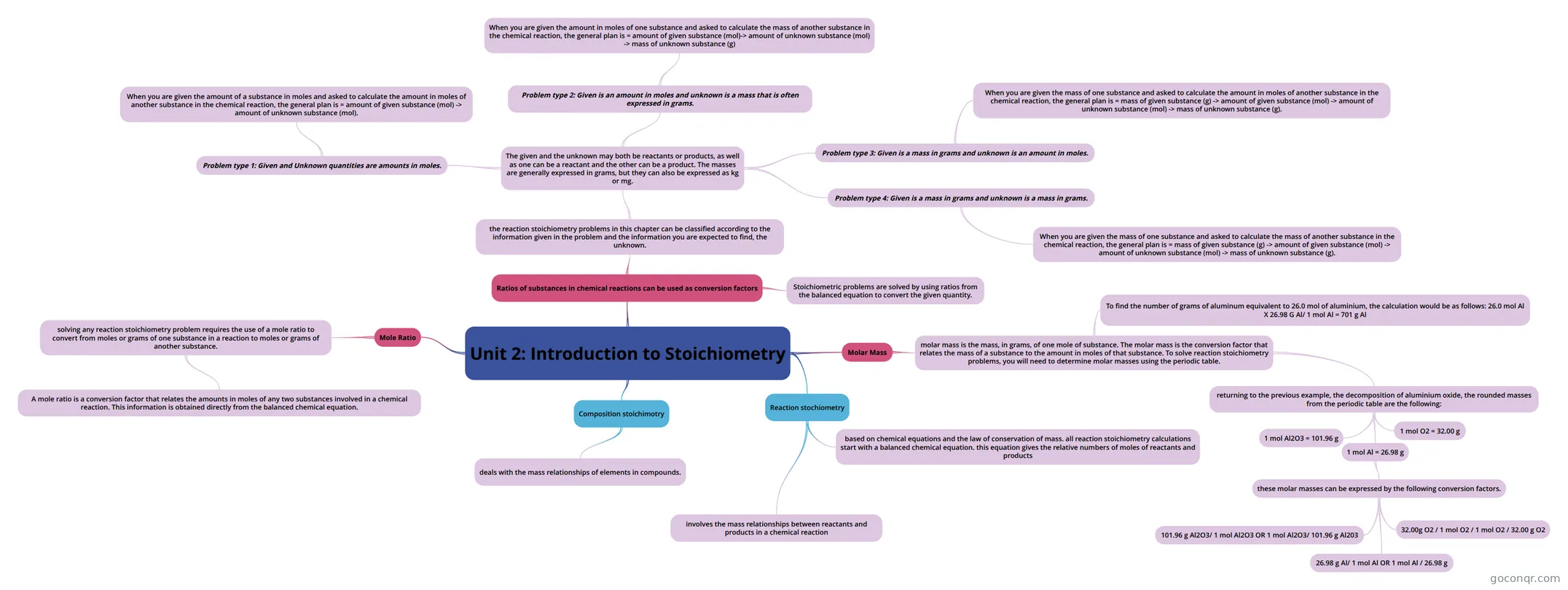
Mind map: Introduction to stoichiometry
Contenido del mapa
Unit 2: Introduction to Stoichiometry
Composition stoichimotry
- deals with the mass relationships of elements in compounds.
Ratios of substances in chemical reactions can be used as conversion factors
- the reaction stoichiometry problems in this chapter can be classified according to the information given in the problem and the information you are expected to find, the unknown.
- The given and the unknown may both be reactants or products, as well as one can be a reactant and the other can be a product. The masses are generally expressed in grams, but they can also be expressed as kg or mg.
- Problem type 1: Given and Unknown quantities are amounts in moles.
- When you are given the amount of a substance in moles and asked to calculate the amount in moles of another substance in the chemical reaction, the general plan is = amount of given substance (mol) -> amount of unknown substance (mol).
- Problem type 2: Given is an amount in moles and unknown is a mass that is often expressed in grams.
- When you are given the amount in moles of one substance and asked to calculate the mass of another substance in the chemical reaction, the general plan is = amount of given substance (mol)-> amount of unknown substance (mol) -> mass of unknown substance (g)
- Problem type 3: Given is a mass in grams and unknown is an amount in moles.
- When you are given the mass of one substance and asked to calculate the amount in moles of another substance in the chemical reaction, the general plan is = mass of given substance (g) -> amount of given substance (mol) -> amount of unknown substance (mol) -> mass of unknown substance (g).
- Problem type 4: Given is a mass in grams and unknown is a mass in grams.
- When you are given the mass of one substance and asked to calculate the mass of another substance in the chemical reaction, the general plan is = mass of given substance (g) -> amount of given substance (mol) -> amount of unknown substance (mol) -> mass of unknown substance (g).
- Problem type 1: Given and Unknown quantities are amounts in moles.
- The given and the unknown may both be reactants or products, as well as one can be a reactant and the other can be a product. The masses are generally expressed in grams, but they can also be expressed as kg or mg.
- Stoichiometric problems are solved by using ratios from the balanced equation to convert the given quantity.
- the reaction stoichiometry problems in this chapter can be classified according to the information given in the problem and the information you are expected to find, the unknown.
Reaction stochiometry
- involves the mass relationships between reactants and products in a chemical reaction
- based on chemical equations and the law of conservation of mass. all reaction stoichiometry calculations start with a balanced chemical equation. this equation gives the relative numbers of moles of reactants and products
Mole Ratio
- solving any reaction stoichiometry problem requires the use of a mole ratio to convert from moles or grams of one substance in a reaction to moles or grams of another substance.
- A mole ratio is a conversion factor that relates the amounts in moles of any two substances involved in a chemical reaction. This information is obtained directly from the balanced chemical equation.
- solving any reaction stoichiometry problem requires the use of a mole ratio to convert from moles or grams of one substance in a reaction to moles or grams of another substance.
Molar Mass
- molar mass is the mass, in grams, of one mole of substance. The molar mass is the conversion factor that relates the mass of a substance to the amount in moles of that substance. To solve reaction stoichiometry problems, you will need to determine molar masses using the periodic table.
- returning to the previous example, the decomposition of aluminium oxide, the rounded masses from the periodic table are the following:
- 1 mol Al2O3 = 101.96 g
- 1 mol Al = 26.98 g
- these molar masses can be expressed by the following conversion factors.
- 101.96 g Al2O3/ 1 mol Al2O3 OR 1 mol Al2O3/ 101.96 g Al203
- 26.98 g Al/ 1 mol Al OR 1 mol Al / 26.98 g
- 32.00g O2 / 1 mol O2 / 1 mol O2 / 32.00 g O2
- these molar masses can be expressed by the following conversion factors.
- 1 mol O2 = 32.00 g
- To find the number of grams of aluminum equivalent to 26.0 mol of aluminium, the calculation would be as follows: 26.0 mol Al X 26.98 G Al/ 1 mol Al = 701 g Al
- returning to the previous example, the decomposition of aluminium oxide, the rounded masses from the periodic table are the following:
- molar mass is the mass, in grams, of one mole of substance. The molar mass is the conversion factor that relates the mass of a substance to the amount in moles of that substance. To solve reaction stoichiometry problems, you will need to determine molar masses using the periodic table.
Información
- Descripción
- Mapa Mental sobre Unit 2: Introduction to Stoichiometry, creado por Alexia Charlize el 24/02/2017.
- Creado por
- Alexia Charlize
- Visitas
- 50
- Valoración