
Mapa mental
King Lear: Themes
Contenido del mapa
King Lear: Themes
Nature
- ""By disrupting the accepted hierarchy in resigning his kingship, Lear has meddled with the proper of the universe which sees subjects obey their king, children respect their parents and humans behave better than animals" - Shakespeare for grown-ups
- Lear initally states that humans are superior creatures with more complex needs than animals, but then as the play progresses with every poor decision he makes, he becomes less human and more bestial - possibly God/pagan gods spiting him for his hubristic words, and as a result of his hamartia he come becoming like the faunal he insulted as part of his peripeteia
- "Allow not nature more than nature needs,/Man's life's as cheap as beast's" ( If you allow people no more than what they absolutely need to survive, then a human life is no better than an animal’s) (II, iv)
- e.g. he becomes like "a poor, bare, forked animal" (Lear, III, iv) and strips out of his clothing on the moor
- AO3 - whilst in the play it states that he strips off his "leggings" (or rather the Jacobean equivalent of trousers), in the 2008 McKellan version of the play, Lear removes all of his clothes and runs naked across the moors, making him appear more like mad beast
- end of play: Lear "almost beyond human language and howling in grief" - Shakespeare for grown-ups
- "Howl, howl, howl, howl" (Lear, V.iii)
- Repetition of howl emphasises Lear's madness and his descent into animal like behaviour
- "Howl, howl, howl, howl" (Lear, V.iii)
- Regan and Goneril repeatedly named after animals with negative connotations: "vulture", "kite", "serpent", "tigers", "cuckoo" etc.
- "These bestial images add to the sense of wild lawlessness that permeates the play, where human heirarchies are overthrown and life is brought back to a primative tooth-and-claw existence" - Shakespeare for grown-ups
- AO3 - Lear
- "These bestial images add to the sense of wild lawlessness that permeates the play, where human heirarchies are overthrown and life is brought back to a primative tooth-and-claw existence" - Shakespeare for grown-ups
- Lear initally states that humans are superior creatures with more complex needs than animals, but then as the play progresses with every poor decision he makes, he becomes less human and more bestial - possibly God/pagan gods spiting him for his hubristic words, and as a result of his hamartia he come becoming like the faunal he insulted as part of his peripeteia
- ""By disrupting the accepted hierarchy in resigning his kingship, Lear has meddled with the proper of the universe which sees subjects obey their king, children respect their parents and humans behave better than animals" - Shakespeare for grown-ups
Justice
- Prevails
- Lear, who caused strife is dead and will suffer for his hamartia, and his hubristic intentions to defy the divine rights of king by attempting to replace God in the great chain of being
- Agnorosis shows Lear sees results of his actions when he's in the moors in the hovel
- Or when Lear's ranting after C died
- "And my poor fool is hanged!...Never, never, never, never, never"
- "The disruption to iambic pentameter, including trochaic line "Never, never, never, never, never", the repetitions of the mid-line breaks vividly show Lear's incoherent, overwhelming grief" - 'Shakespeare for grown-ups' - AO2
- "And my poor fool is hanged!...Never, never, never, never, never"
- Kozintsev - Lear goes into hovel and it's full of poor people - Lear's moment of agnorisis - AO3
- Compare to earlier scene which caused his peripeteia in-which Lear treads on and ripe the map of his kingdom and shows his utter disregard of his duties as the king (to support his people)
- Or when Lear's ranting after C died
- Agnorosis shows Lear sees results of his actions when he's in the moors in the hovel
- Villains killed
- Lear (?) for starting problems in the first place and to ensure peace
- Despite their faults, Gloucester and Lear's experiences outweight their crimes; they remain "More sinned against than sinning"
- Regan (at the hands of Goneril)
- Goneril then commits suicide in penance for commiting sororicide and betraying her father
- Edmund at the hands of good brother Edgar for trying to go above his station (great chain of being)
- Cornwall (fatally wounded by a servant loyal to Gloucester and therefore Lear)
- Cordelia (for allowing French to invade and therefore committing treason) and Kent and Gloucester for aiding her
- Despite this, Gloucester and Lear remain "More sinned against than sinning"
- Lear (?) for starting problems in the first place and to ensure peace
- Edgar and Albany, the only truly innocent survive
- Edgar ends play on a note of hope - "f" version - AO3
- Edgar: The gods are just, and of our pleasant vices/ Make instruments to plague us
- Lear, who caused strife is dead and will suffer for his hamartia, and his hubristic intentions to defy the divine rights of king by attempting to replace God in the great chain of being
- Prevails
Women
- Goneril & Regan
- Regan and Goneril repeatedly named after animals with negative connotations: "vulture", "kite", "serpent", "tigers", "cuckoo" etc.
- Interpretations of the daughters
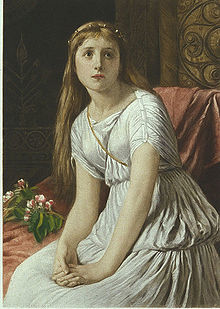
- Cordelia often depicted as being of lighter hair colour (usually blonde) and wearing lighter coloured clothing, whilst her sisters often have dark hair and wear darker clothing
- William Frederick Yeames' Cordelia
- A British 19th-20th century artist who had a preference for creating Tudor/Stuart style paintings
- 2008 McKellan stars a blonde Cordelia, who wears a white wedding style dress during the love test, whilst her sisters have darker hair and clothing
- Cordelia is also taller than her older sisters
- Goneril and Lear are already in the room in which the love test is held, whilst Cordelia enters on Lear's arm, showing her status as the preferred daughter of their father
- Also shown via Lear's double wedding rings - which would suggest that Goneril and Regan had one mother, whilst Cordelia was the dauhgter of the second marriage, most likely his the child of his favourite wife
- Kozintsev
- Cordelia still wears a white dress, but all of Lear's daughters are dark haired
- G & R are already in the room in which the love test occurs, whilst Cordelia descends down the stairs as if she is some heavenly figure who is ranked above her sisters
- William Frederick Yeames' Cordelia
- Cordelia often depicted as being of lighter hair colour (usually blonde) and wearing lighter coloured clothing, whilst her sisters often have dark hair and wear darker clothing
- Cordelia
- Lear's preferred daughter
- McKellan - G & R already in room when Lear enters (I.i), but Cordelia enters on his arm - higher standing in their father's eyes than her older sisters - AO3
- McKellan also wears two wedding rings, suggesting that G & R had a different mother to C, which shows that Lear could prefer C as she's the daughter of his preferred wife
- McKellan - G & R already in room when Lear enters (I.i), but Cordelia enters on his arm - higher standing in their father's eyes than her older sisters - AO3
- Only appears in three scenes in the play, having been in France with her husband for the majority of the play
- AO4 - In all likelyhood, she was most likely in so few scenes as when the play was performed, it was likely that the same actor portrayed both the Fool and Cordelia, as neither chracters appear on-stage at the same time
- Mary-like figure
- G & R are already in the room in which the love test occurs, whilst Cordelia descends down the stairs as if she is some heavenly figure who is ranked above her sisters
- Heavenly imagery is also shown in how she is portrayed whilst speaking during the love test; whilst her sisters speak from the darkness, C's face is lit from below whislt she soeaks, giving her an unearthly glow, which echoes the innocmece and purity of her words towards her father, whilst the shadows enclosing her sisters whilst they speak echo their darker intentions
- Cordelia often depicted as being of lighter hair colour (usually blonde) and wearing lighter coloured clothing, whilst her sisters often have dark hair and wear darker clothing
- G & R are already in the room in which the love test occurs, whilst Cordelia descends down the stairs as if she is some heavenly figure who is ranked above her sisters
- Lear's preferred daughter
- "women are seen as emasculating, disloyal, promiscuous, and the root of all the problems in the world." - Schmoop
- The deceased wives of L and Gl are not mentioned in the play, and as such, the lack of a positive female role model in their childrens' lives could be blamed for their actions
- The lack of a nurturing mother could be blamed for the attitudes and actions of Gl & L's children, as their mothers weren't around to teach them to have good morals
- So it could be suggested that the lack of mother in their lives forced the children of Lear and Gloucester to develop their own traits and choose which morals they would have
- Could be blamed for G's and R's poor sense morality
- Their callous natures and their ruthless actions
- Regan killing like a man by using a sword
- R & G showing a lack of sisterly solidarity over Edmund
- G & R betraying their father in order to maintain power
- L: (I) Made you my guardians ...Regan: No more (knights) with me (II,iv)
- Or just their slander towards their dad in general
- R: "I pray you, father, being weak, seem so"
- Or just their slander towards their dad in general
- Their blatant respect for Lear's messenger (Kent disguised as Caius) by putting him in the stocks
- AO4 - messengers were to be treated as the people they represented would be treated, so by allowing Cornwall to throw Caius in the stocks, they are openly insulting their father and his status as the (retired) King
- L: (I) Made you my guardians ...Regan: No more (knights) with me (II,iv)
- G committing sororicide
- G plotting to have her husband murdered ((via letter she addresses to Edmund)
- Their callous natures and their ruthless actions
- Could be the reason for Cordelia's and Edgar's unfailing loyalty to their father
- Cordelia
- Committing treason by bringing her husband's French troops to Britain in order to help bring back order and restore her father to power, and dying like a martyr out of love for him
- Her unwillingness to lie to her father during the love test as opposed to her sisters
- "I love your majesty/According to my bond, no more nor less"
- AO2 - Cordelia's fidelity and her conflict with her sisters is echoed in the stichomythia with C's aside comments during the love test
- Edgar escorting his father to Lear and even faking an interaction with a demon to prevent his beloved father from committing suicide
- Cordelia
- Could be blamed for G's and R's poor sense morality
- So it could be suggested that the lack of mother in their lives forced the children of Lear and Gloucester to develop their own traits and choose which morals they would have
- The lack of a nurturing mother could be blamed for the attitudes and actions of Gl & L's children, as their mothers weren't around to teach them to have good morals
- Lear literally states that G & R have stripped him of his "manhood" and his power
- AO3 - could be argued that Lear is the "disloyal" and "promiscuous" character in the 2014 Simon Russell Beale version of the play
- There are hints of sexual abuse and forced incest in the play, and Lear either forcing his daughters to commit adultery or that he abused his daughters prior to their marriages
- Lear is depicted as a tyrant, who forces Regan to sit on his lap during the love test and slaps her rear as she leaves
- His tyrannical ruling and his subsequent disregard of his subjects could be described as "the root of all the problems in the world", or at least in his kingdom
- Lear is depicted as a tyrant, who forces Regan to sit on his lap during the love test and slaps her rear as she leaves
- There are hints of sexual abuse and forced incest in the play, and Lear either forcing his daughters to commit adultery or that he abused his daughters prior to their marriages
- The deceased wives of L and Gl are not mentioned in the play, and as such, the lack of a positive female role model in their childrens' lives could be blamed for their actions
- AO2
- None of the three women in the play have soliloquies
- The only characters who do are the Fool and Edmund
- Edmund's (I,ii) - his plot to usurp his brother and become Gloucester's heir
- The only characters who do are the Fool and Edmund
- None of the three women in the play have soliloquies
- Goneril & Regan
Imágenes y archivos del mapa
Información
- Descripción
- Mapa Mental sobre King Lear: Themes, creado por Beth MacMillan el 15/03/2017.
- Creado por
- Beth MacMillan
- Visitas
- 1
- Historial
-
- Creado por xsophiekx · 9 feb 2015
- Copiado por Beth MacMillan · 15 mar 2017
- Valoración