
Mapa mental
Chapter 6: Oceans on the edge
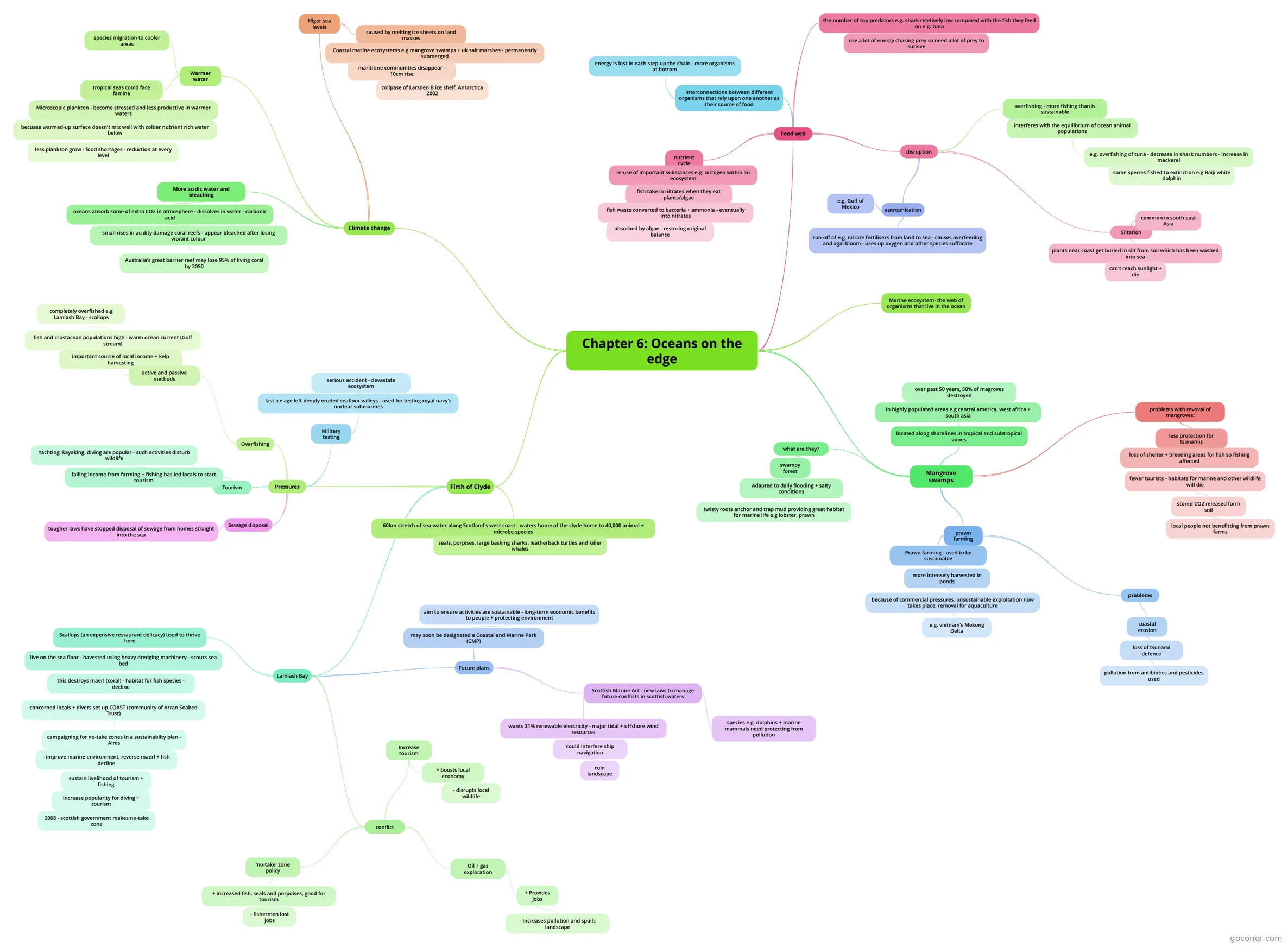
Mind map: Oceans on the edge
Contenido del mapa
Chapter 6: Oceans on the edge
Marine ecosystem- the web of organisms that live in the ocean
Mangrove swamps
- what are they?
- swampy forest
- Adapted to daily flooding + salty conditions
- twisty roots anchor and trap mud providing great habitat for marine life e.g lobster, prawn
- Adapted to daily flooding + salty conditions
- swampy forest
- located along shorelines in tropical and subtropical zones
- in highly populated areas e.g central america, west africa + south asia
- over past 50 years, 50% of magroves destroyed
- in highly populated areas e.g central america, west africa + south asia
- problems with revoval of mangroves:
- less protection for tsunamis
- loss of shelter + breeding areas for fish so fishing affected
- fewer tourists - habitats for marine and other wildlife will die
- stored CO2 released form soil
- local people not benefitting from prawn farms
- stored CO2 released form soil
- fewer tourists - habitats for marine and other wildlife will die
- loss of shelter + breeding areas for fish so fishing affected
- less protection for tsunamis
- prawn farming
- Prawn farming - used to be sustainable
- more intensely harvested in ponds
- because of commercial pressures, unsustainable exploitation now takes place, removal for aquaculture
- e.g. vietnam's Mekong Delta
- because of commercial pressures, unsustainable exploitation now takes place, removal for aquaculture
- more intensely harvested in ponds
- problems
- coastal erosion
- loss of tsunami defence
- pollution from antibiotics and pesticides used
- loss of tsunami defence
- coastal erosion
- Prawn farming - used to be sustainable
- what are they?
Food web
- interconnections between different organisms that rely upon one another as their source of food
- energy is lost in each step up the chain - more organisms at bottom
- the number of top predators e.g. shark reletively low compared with the fish they feed on e.g. tuna
- use a lot of energy chasing prey so need a lot of prey to survive
- nutrient cycle
- re-use of important substances e.g. nitrogen within an ecosystem
- fish take in nitrates when they eat plants/algae
- fish waste converted to bacteria + ammonia - eventually into nitrates
- absorbed by algae - restoring original balance
- fish waste converted to bacteria + ammonia - eventually into nitrates
- fish take in nitrates when they eat plants/algae
- re-use of important substances e.g. nitrogen within an ecosystem
- disruption
- overfishing - more fishing than is sustainable
- interferes with the equilibrium of ocean animal populations
- e.g. overfishing of tuna - decrease in shark numbers - increase in mackerel
- some species fished to extinction e.g Baiji white dolphin
- e.g. overfishing of tuna - decrease in shark numbers - increase in mackerel
- interferes with the equilibrium of ocean animal populations
- eutrophication
- run-off of e.g. nitrate fertilisers from land to sea - causes overfeeding and agal bloom - uses up oxygen and other species suffocate
- e.g. Gulf of Mexico
- Siltation
- plants near coast get buried in silt from soil which has been washed into sea
- can't reach sunlight + die
- common in south east Asia
- plants near coast get buried in silt from soil which has been washed into sea
- overfishing - more fishing than is sustainable
- interconnections between different organisms that rely upon one another as their source of food
Climate change
- Warmer water
- tropical seas could face famine
- Microscopic plankton - become stressed and less productive in warmer waters
- becuase warmed-up surface doesn't mix well with colder nutrient rich water below
- less plankton grow - food shortages - reduction at every level
- becuase warmed-up surface doesn't mix well with colder nutrient rich water below
- Microscopic plankton - become stressed and less productive in warmer waters
- species migration to cooler areas
- tropical seas could face famine
- More acidic water and bleaching
- oceans absorb some of extra CO2 in atmosphere - dissolves in water - carbonic acid
- small rises in acidity damage coral reefs - appear bleached after losing vibrant colour
- Australia's great barrier reef may lose 95% of living coral by 2050
- small rises in acidity damage coral reefs - appear bleached after losing vibrant colour
- oceans absorb some of extra CO2 in atmosphere - dissolves in water - carbonic acid
- Higer sea levels
- caused by melting ice sheets on land masses
- Coastal marine ecosystems e.g mangrove swamps + uk salt marshes - permenently submerged
- marititme communities disappear - 10cm rise
- collpase of Larsden B ice shelf, Antarctica 2002
- marititme communities disappear - 10cm rise
- Coastal marine ecosystems e.g mangrove swamps + uk salt marshes - permenently submerged
- caused by melting ice sheets on land masses
- Warmer water
Firth of Clyde
- Pressures
- Overfishing
- active and passive methods
- important source of local income + kelp harvesting
- fish and crustacean populations high - warm ocean current (Gulf stream)
- completely overfished e.g Lamlash Bay - scallops
- fish and crustacean populations high - warm ocean current (Gulf stream)
- important source of local income + kelp harvesting
- active and passive methods
- Tourism
- falling income from farming + fishing has led locals to start tourism
- Yachting, kayaking, diving are popular - such activities disturb wildlife
- falling income from farming + fishing has led locals to start tourism
- Sewage disposal
- tougher laws have stopped disposal of sewage from homes straight into the sea
- Military testing
- last ice age left deeply eroded seafloor valleys - used for testing royal navy's nuclear submarines
- serious accident - devastate ecosystem
- last ice age left deeply eroded seafloor valleys - used for testing royal navy's nuclear submarines
- Overfishing
- Lamlash Bay
- Scallops (an expensive restaurant delicacy) used to thrive here
- live on the sea floor - havested using heavy dredging machinery - scours sea bed
- this destroys maerl (coral) - habitat for fish species - decline
- concerned locals + divers set up COAST (community of Arran Seabed Trust)
- campaigning for no-take zones in a sustainabilty plan - Aims
- - improve marine environment, reverse maerl + fish decline
- sustain livelihood of tourism + fishing
- increase popularity for diving + tourism
- 2008 - scottish government makes no-take zone
- increase popularity for diving + tourism
- sustain livelihood of tourism + fishing
- - improve marine environment, reverse maerl + fish decline
- campaigning for no-take zones in a sustainabilty plan - Aims
- concerned locals + divers set up COAST (community of Arran Seabed Trust)
- this destroys maerl (coral) - habitat for fish species - decline
- live on the sea floor - havested using heavy dredging machinery - scours sea bed
- conflict
- 'no-take' zone policy
- + increased fish, seals and porpoises, good for tourism
- - fishermen lost jobs
- + increased fish, seals and porpoises, good for tourism
- Increase tourism
- + boosts local economy
- - disrupts local wildlife
- + boosts local economy
- Oil + gas exploration
- + Provides jobs
- - Increases pollution and spoils landscape
- + Provides jobs
- 'no-take' zone policy
- Future plans
- may soon be designated a Coastal and Marine Park (CMP)
- aim to ensure activities are sustainable - long-term economic benefits to people + protecting environment
- Scottish Marine Act - new laws to manage future conflicts in scottish waters
- wants 31% renewable electricity - major tidal + offshore wind resources
- could interfere ship navigation
- ruin landscape
- could interfere ship navigation
- species e.g. dolphins + marine mammals need protecting from pollution
- wants 31% renewable electricity - major tidal + offshore wind resources
- may soon be designated a Coastal and Marine Park (CMP)
- Scallops (an expensive restaurant delicacy) used to thrive here
- 60km stretch of sea water along Scotland's west coast - waters home of the clyde home to 40,000 animal + microbe species
- seals, porpises, large basking sharks, leatherback turtles and killer whales
- Pressures
Información
- Descripción
- Mapa Mental sobre Chapter 6: Oceans on the edge, creado por laurenclark90 el 05/05/2014.
- Creado por
- laurenclark90
- Visitas
- 36
- Valoración