
Mapa mental
Day care
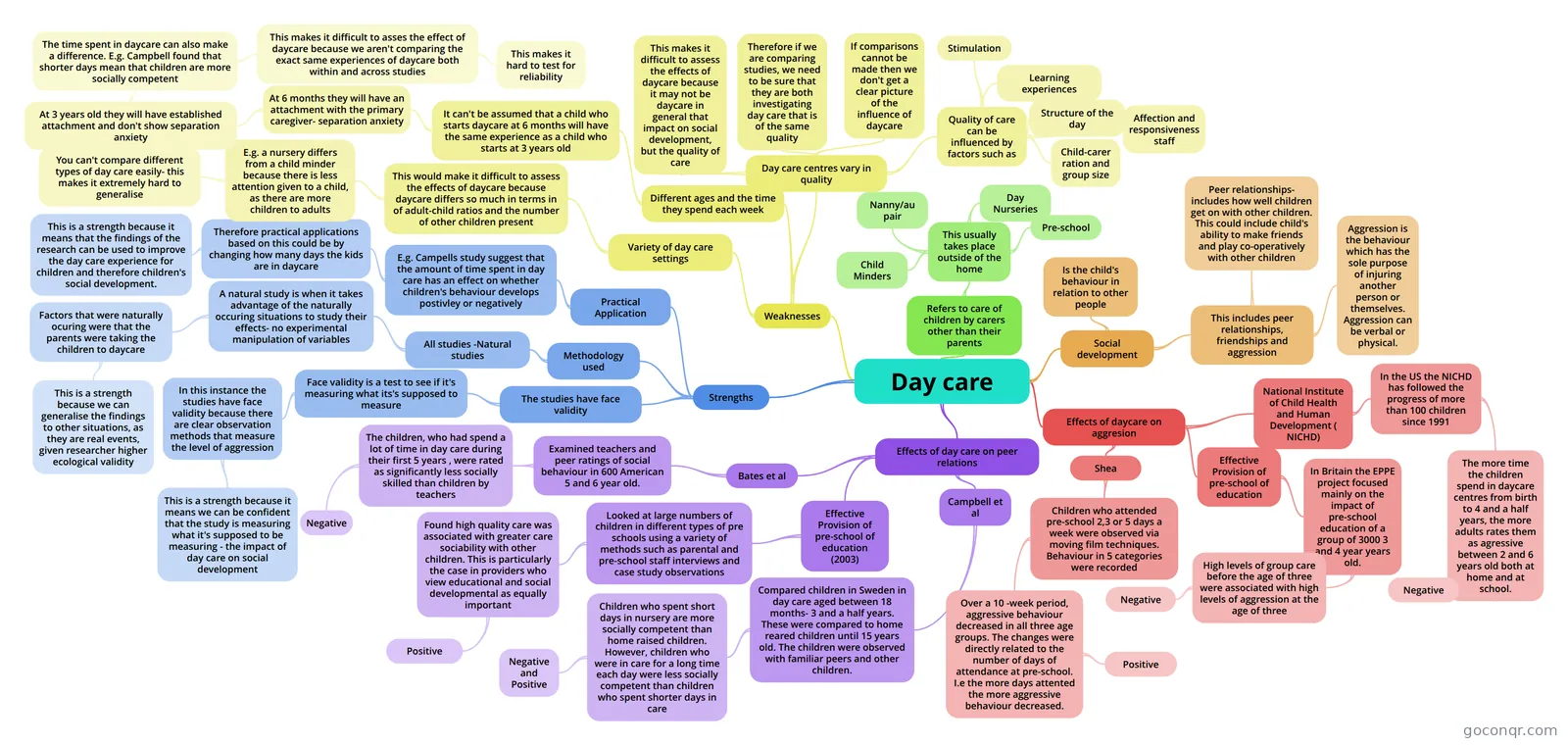
Mind map: Day care
Contenido del mapa
Day care
Refers to care of children by carers other than their parents
- This usually takes place outside of the home
- Child Minders
- Nanny/au pair
- Day Nurseries
- Pre-school
- This usually takes place outside of the home
Social development
- Is the child's behaviour in relation to other people
- This includes peer relationships, friendships and aggression
- Peer relationships- includes how well children get on with other children. This could include child's ability to make friends and play co-operatively with other children
- Aggression is the behaviour which has the sole purpose of injuring another person or themselves. Aggression can be verbal or physical.
Effects of daycare on aggresion
- National Institute of Child Health and Human Development ( NICHD)
- In the US the NICHD has followed the progress of more than 100 children since 1991
- The more time the children spend in daycare centres from birth to 4 and a half years, the more adults rates them as agressive between 2 and 6 years old both at home and at school.
- Negative
- The more time the children spend in daycare centres from birth to 4 and a half years, the more adults rates them as agressive between 2 and 6 years old both at home and at school.
- In the US the NICHD has followed the progress of more than 100 children since 1991
- Effective Provision of pre-school of education
- In Britain the EPPE project focused mainly on the impact of pre-school education of a group of 3000 3 and 4 year years old.
- High levels of group care before the age of three were associated with high levels of aggression at the age of three
- Negative
- High levels of group care before the age of three were associated with high levels of aggression at the age of three
- In Britain the EPPE project focused mainly on the impact of pre-school education of a group of 3000 3 and 4 year years old.
- Shea
- Children who attended pre-school 2,3 or 5 days a week were observed via moving film techniques. Behaviour in 5 categories were recorded
- Over a 10 -week period, aggressive behaviour decreased in all three age groups. The changes were directly related to the number of days of attendance at pre-school. I.e the more days attented the more aggressive behaviour decreased.
- Positive
- Over a 10 -week period, aggressive behaviour decreased in all three age groups. The changes were directly related to the number of days of attendance at pre-school. I.e the more days attented the more aggressive behaviour decreased.
- Children who attended pre-school 2,3 or 5 days a week were observed via moving film techniques. Behaviour in 5 categories were recorded
- National Institute of Child Health and Human Development ( NICHD)
Effects of day care on peer relations
- Campbell et al
- Compared children in Sweden in day care aged between 18 months- 3 and a half years. These were compared to home reared children until 15 years old. The children were observed with familiar peers and other children.
- Children who spent short days in nursery are more socially competent than home raised children. However, children who were in care for a long time each day were less socially competent than children who spent shorter days in care
- Negative and Positive
- Children who spent short days in nursery are more socially competent than home raised children. However, children who were in care for a long time each day were less socially competent than children who spent shorter days in care
- Compared children in Sweden in day care aged between 18 months- 3 and a half years. These were compared to home reared children until 15 years old. The children were observed with familiar peers and other children.
- Effective Provision of pre-school of education (2003)
- Looked at large numbers of children in different types of pre schools using a variety of methods such as parental and pre-school staff interviews and case study observations
- Found high quality care was associated with greater care sociability with other children. This is particularly the case in providers who view educational and social developmental as equally important
- Positive
- Found high quality care was associated with greater care sociability with other children. This is particularly the case in providers who view educational and social developmental as equally important
- Looked at large numbers of children in different types of pre schools using a variety of methods such as parental and pre-school staff interviews and case study observations
- Bates et al
- Examined teachers and peer ratings of social behaviour in 600 American 5 and 6 year old.
- The children, who had spend a lot of time in day care during their first 5 years , were rated as significantly less socially skilled than children by teachers
- Negative
- The children, who had spend a lot of time in day care during their first 5 years , were rated as significantly less socially skilled than children by teachers
- Examined teachers and peer ratings of social behaviour in 600 American 5 and 6 year old.
- Campbell et al
Strengths
- The studies have face validity
- Face validity is a test to see if it's measuring what its's supposed to measure
- In this instance the studies have face validity because there are clear observation methods that measure the level of aggression
- This is a strength because it means we can be confident that the study is measuring what it's supposed to be measuring - the impact of day care on social development
- In this instance the studies have face validity because there are clear observation methods that measure the level of aggression
- Face validity is a test to see if it's measuring what its's supposed to measure
- Methodology used
- All studies -Natural studies
- A natural study is when it takes advantage of the naturally occuring situations to study their effects- no experimental manipulation of variables
- Factors that were naturally ocuring were that the parents were taking the children to daycare
- This is a strength because we can generalise the findings to other situations, as they are real events, given researcher higher ecological validity
- Factors that were naturally ocuring were that the parents were taking the children to daycare
- A natural study is when it takes advantage of the naturally occuring situations to study their effects- no experimental manipulation of variables
- All studies -Natural studies
- Practical Application
- E.g. Campells study suggest that the amount of time spent in day care has an effect on whether children's behaviour develops postivley or negatively
- Therefore practical applications based on this could be by changing how many days the kids are in daycare
- This is a strength because it means that the findings of the research can be used to improve the day care experience for children and therefore children's social development.
- Therefore practical applications based on this could be by changing how many days the kids are in daycare
- E.g. Campells study suggest that the amount of time spent in day care has an effect on whether children's behaviour develops postivley or negatively
- The studies have face validity
Weaknesses
- Variety of day care settings
- This would make it difficult to assess the effects of daycare because daycare differs so much in terms in of adult-child ratios and the number of other children present
- E.g. a nursery differs from a child minder because there is less attention given to a child, as there are more children to adults
- You can't compare different types of day care easily- this makes it extremely hard to generalise
- E.g. a nursery differs from a child minder because there is less attention given to a child, as there are more children to adults
- This would make it difficult to assess the effects of daycare because daycare differs so much in terms in of adult-child ratios and the number of other children present
- Different ages and the time they spend each week
- It can't be assumed that a child who starts daycare at 6 months will have the same experience as a child who starts at 3 years old
- At 6 months they will have an attachment with the primary caregiver- separation anxiety
- At 3 years old they will have established attachment and don't show separation anxiety
- The time spent in daycare can also make a difference. E.g. Campbell found that shorter days mean that children are more socially competent
- This makes it difficult to asses the effect of daycare because we aren't comparing the exact same experiences of daycare both within and across studies
- This makes it hard to test for reliability
- This makes it difficult to asses the effect of daycare because we aren't comparing the exact same experiences of daycare both within and across studies
- The time spent in daycare can also make a difference. E.g. Campbell found that shorter days mean that children are more socially competent
- At 3 years old they will have established attachment and don't show separation anxiety
- At 6 months they will have an attachment with the primary caregiver- separation anxiety
- It can't be assumed that a child who starts daycare at 6 months will have the same experience as a child who starts at 3 years old
- Day care centres vary in quality
- Quality of care can be influenced by factors such as
- Stimulation
- Learning experiences
- Structure of the day
- Affection and responsiveness staff
- Child-carer ration and group size
- This makes it difficult to assess the effects of daycare because it may not be daycare in general that impact on social development, but the quality of care
- Therefore if we are comparing studies, we need to be sure that they are both investigating day care that is of the same quality
- If comparisons cannot be made then we don't get a clear picture of the influence of daycare
- Quality of care can be influenced by factors such as
- Variety of day care settings
Información
- Descripción
- Mapa Mental sobre Day care, creado por zeenakerai el 10/05/2014.
- Creado por
- zeenakerai
- Visitas
- 43
- Valoración